If you've been selling on Wildberries for even six months, you know the days of uploading three photos, stuffing keywords into the description, and casually collecting hundreds of daily organic orders are gone for good. Today, 70–80% of Wildberries search results are occupied by ad slots. Organic rankings have been pushed down the page, and the prime mobile screens belong to automated campaigns and promoted placements.
Yet the moment a seller opens the RWB Media ad dashboard, their head starts spinning. Which bidding model should you pick—pay per thousand impressions (CPM) or pay per click (CPC)? Should you pause ads overnight so you don't "burn budget while everyone's asleep"? How do the marketplace's built-in generative AI tools actually work, and why do manual bids no longer deliver the returns they used to?
In our recent breakdown of internal ad automation, we covered search query cluster management. Today we're going deeper into strategy: how the auction algorithm actually learns, why the overnight-pause myth is costing you money, and a step-by-step routine to keep your Advertising Cost of Sales (DRR) on target.
The Evolution of the RWB Media Auction: Why Manual Bids Lost to Automation
Remember how WB ads worked just a couple of years ago? A seller went into the "Search" dashboard, manually assembled an exact-match keyword list, added negative keywords, and set a rigid fixed bid for the top spot. Whoever bid 10 rubles more sat at the very top.
Today, the RWB Media auction runs on a completely different engine. The platform shifted to dynamic machine-learning ranking algorithms. Auto-campaigns (ARK) evaluate far more than your bid—they score your listing's overall attractiveness index:
- Delivery speed: the closer your stock sits to the end buyer in a regional warehouse, the lower the bid the algorithm needs from you to win the auction;
- Historical CTR (click-through rate): if your main photo grabs attention and shoppers click eagerly, the marketplace gladly ranks you higher for less money;
- Add-to-cart and buyout conversion: a listing that actually converts and generates commission revenue for the marketplace gets a priority boost in search results.
Trying to micromanage bids manually 24/7 has become a pointless waste of time. While you sleep or pack shipments, competitor bots and the platform's own AI adjust bids dozens of times a minute. Your job as a seller is to set clear efficiency guardrails and let the algorithm learn without interruption.
Model Battle: When Impression-Based CPM Wins and Where Click-Based CPC Saves You
One of the most frequent debates on seller forums comes down to which billing model is safer: CPM (cost per thousand impressions) or CPC (cost per actual click). There is no one-size-fits-all answer—it hinges on your unit economics and how sharp your visual packaging is:
- CPM model (cost per impressions): the classic and most widely used format on the platform. You pay for every 1,000 times your listing appears on shopper screens, whether anyone clicks the photo or not. This format is wildly profitable if you have a dialed-in, tested CTR (4–5% or higher). If 1,000 impressions at a 150-ruble CPM bring in 50 clicks, your real cost per click is just 3 rubles. But if your hero image is weak, washed out, and pulls only a 1% CTR, those same 150 rubles buy you just 10 clicks—pushing your effective CPC up to 15 rubles.
- CPC model (cost per click): the ideal safety net for beginners and for testing brand-new product niches. You pay only when an interested shopper actually taps into your listing. If the creative fails to attract clicks, your budget stays untouched. That eliminates the fear of burning cash on empty impressions, though base CPC bids in crowded categories (beauty, women's apparel, home goods) often run steep, artificially inflating your DRR.
A practitioner's rule of thumb: start testing a new SKU on CPC or small CPM budgets, use A/B tests to lock in the cover photo with the highest click-through rate, and only scale up on CPM once your high CTR is proven.
The Overnight Savings Illusion: How Pausing Campaigns Resets Machine Learning
Now let's tackle a classic mistake made by up to half of all newer sellers. The logic sounds completely reasonable at first: "At midnight Moscow time, normal people go to sleep. Why pay to show sweaters and frying pans at 2 a.m.? I'll schedule my ads to pause from 00:00 to 07:00 and save a third of my budget!"
Sounds smart, right? On the surface, yes. In practice, hitting pause deals a massive blow to campaign efficiency.
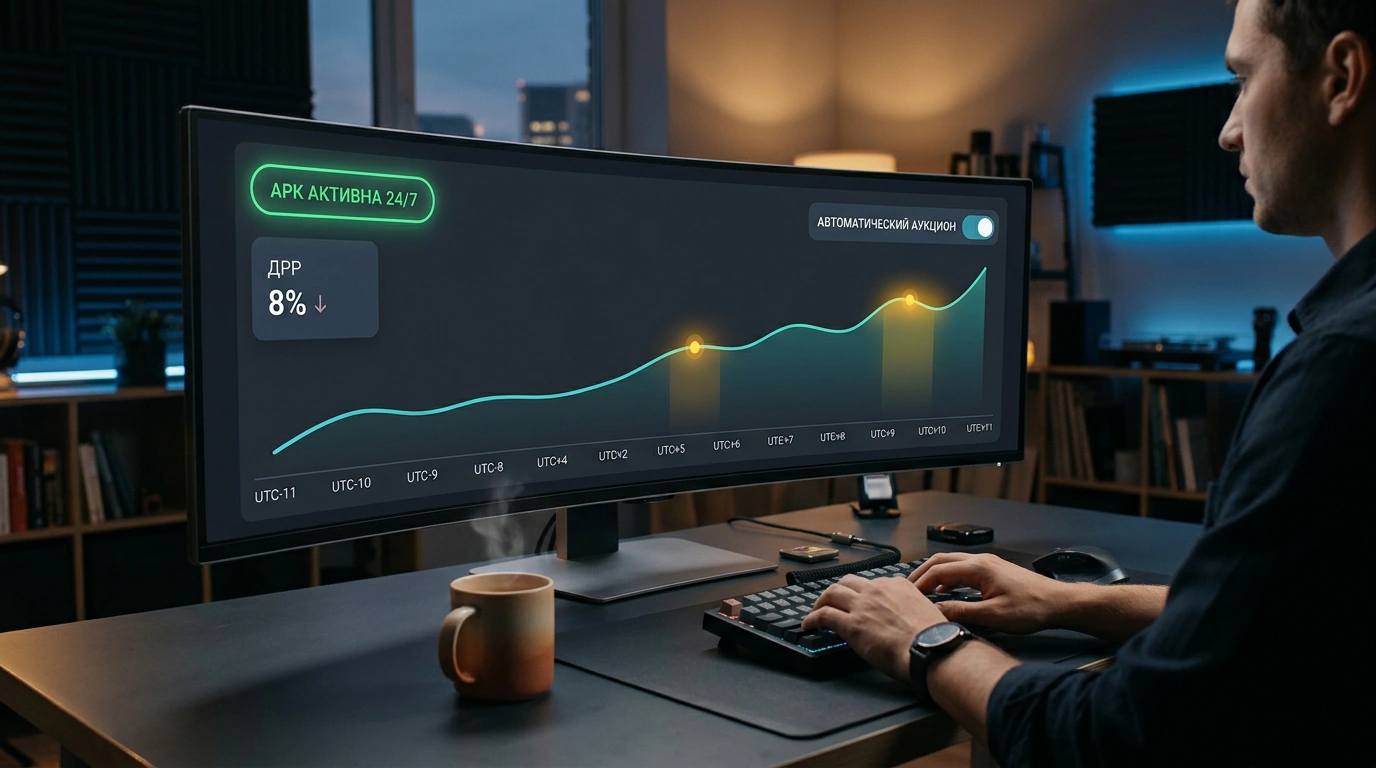
First, Russia spans eleven time zones. When it's 2 a.m. in Moscow, it's already 4 a.m. in Yekaterinburg, 6 a.m. in Novosibirsk and Krasnoyarsk, and the middle of the workday in Khabarovsk and Vladivostok! Shutting down ads on Moscow time means handing all that high-intent morning traffic across the Urals, Siberia, and the Far East straight to your competitors.
Second—and most importantly—an auto-campaign algorithm is a neural network continuously tuning impressions to shopper profiles. When a campaign runs uninterrupted, the system accumulates behavioral signals, stabilizes its auction slot, and holds the lowest effective bid.
The moment you pause the campaign, that data chain snaps. At 07:00 a.m., the campaign restarts from scratch. The algorithm has to recalibrate its audience all over again while fighting into a heated morning auction that demands higher bids just to reclaim yesterday's positions. Real-world testing shows sellers who turn ads off overnight end up spending 20–35% more budget regaining daytime visibility than sellers who keep modest, continuous 24/7 campaigns running.
Built-In Platform AI and Step-by-Step DRR Control
Wildberries is actively embedding generative AI directly into the seller dashboard. According to RWB Media, adoption of built-in AI tools among active sellers jumped more than 4x over the past year.
Today, the platform's neural networks can automatically generate clean studio backgrounds for product photos, assemble keyword cores from item attributes, and write conversion-focused descriptions. Still, trusting AI blindly is a recipe for trouble: a bot doesn't know your landed cost and isn't responsible for your checking account balance.
To keep your ad campaigns profitable, stick to a strict control routine:
- Set a hard daily spend cap: never launch an auto-campaign with an uncapped budget. Lock in a strict daily ceiling (say, 1,000–3,000 rubles) so an algorithm glitch or sudden bot-traffic spike can't drain your balance in two hours.
- Prune junk search clusters: every two to three days, open your search query report and ruthlessly move irrelevant terms to negative keywords. If you sell men's wool socks, queries like "newborn baby socks" or "sheer stockings" need to be blocked on day one.
- Calculate real DRR against bought-out orders: don't rely on the ad dashboard's rosy "DRR on orders: 8%" metric. Always cross-check ad spend against actual buyouts in your financial realization reports. If your product only has a 40% buyout rate, your real DRR against actual revenue collected isn't 8%—it's a full 20%!
Advertising on Wildberries is neither a lottery nor a magic bullet. It's a precision engineering tool where cold math and an understanding of platform algorithms beat gut feelings and frantic manual bidding every single time.