If you've been selling on Wildberries for even a couple of years, you definitely remember the gold rush around partner pickup points. The first wave of operators skimmed the cream off the top: they grabbed high-foot-traffic locations, collected generous renovation subsidies, and made their money back in three or four months. Today, the retail pickup market is packed wall to wall, margins have been squeezed to the bone, and operators are fighting over every block. Yet the marketplace's logistics conveyor hasn't stopped—it has simply shifted one step upstream in the supply chain.
Now the platform is inviting entrepreneurs into the warehousing business. The logic is straightforward: order volumes are growing faster than the marketplace can pour concrete for its own multi-hundred-thousand-square-meter mega-hubs. Instead of burying billions in new mega-warehouses and waiting years for them to open, Wildberries decided to scale through partners. That's how the Partner Fulfillment Center (PFC) and Goods Drop-Off Point (PPT) program was born.
On the surface, the pitch sounds like a dream: you lease a warehouse, put up racking, plug into the marketplace's warehouse management system—and get a steady stream of sellers without spending a single ruble on ads or a sales team. You get paid literally for every move: scanning an incoming box, placing an item in a bin, every day of storage, and picking and packing a customer order. Let's take off the rose-tinted glasses, grab a calculator, and strip this mechanism down to the bolts. I went through the technical regulations, the rate card, and real operator feedback to see how much actual cash stays in a warehouse owner's pocket once payroll, rent, and non-negotiable platform fines are deducted.
In our recent analysis of the marketplace's warehouse infrastructure, we touched on the baseline risks of the partner model. Now let's break down the full launch economics in detail.
Why the Marketplace Is Sharing the Warehouse Pie with Private Operators
To understand what's driving Wildberries, just look at the headlines from the past two years. Concentrating tens of millions of units in giant Moscow-region hubs like Koledino, Elektrostal, or Podolsk turned into a ticking time bomb. Any technical glitch, seasonal surge before Singles' Day (11.11), or operational hiccup at a sorting center instantly paralyzes deliveries across European Russia.
Thousands of trucks sit idling for days in miles-long traffic jams outside unloading bays. Furious sellers miss free receiving slots, pay trucking companies 15,000–20,000 rubles a day in detention fees, and miss their window to get stock onto the storefront. For the marketplace, that translates into direct financial and reputational damage: shoppers defect to Ozon or Yandex Market, where that sweater or coffee maker is promised for next-day delivery.
Building proprietary Class A logistics centers takes an enormous amount of time: land permits, securing tens of megawatts of power capacity, regulatory sign-offs, and construction easily eat up 18 to 30 months. A partner network solves that bottleneck right here, right now. An independent entrepreneur can lease an existing building, outfit it with basic warehouse gear, and start accepting seller shipments within three to four weeks of signing the agreement.
The marketplace gets a distributed, decentralized network of intercept hubs right inside major cities and metro areas, completely offloading the headaches of property leases, hiring floor staff, and day-to-day site supervision. All capital and labor risks shift onto the outside partner.
Format Options: How a PPT Drop-Off Point Differs from a Full PFC
Before you start scouting industrial parks on the edge of town, you need to be crystal clear on the two formats. Inside the WB Partners ecosystem, third-party logistics is split into two fundamentally different tiers:
- PPT (Goods Drop-Off Point) — a lightweight format, essentially a freight pickup point for business entities. The minimum space requirement here is just 100 square meters. A PPT acts as an entry gate for smaller sellers operating under FBW (fulfilled by Wildberries) or FBS (fulfilled by seller) models. A seller drops off mono- or mixed boxes, your staff scans the shipment barcodes, stages the transit freight, and hands it off to a Wildberries courier or linehaul truck. Goods aren't unboxed, counted piece-by-piece, or stored for weeks. It's pure, fast cross-docking. If a seller drags their feet picking up returns, Wildberries pays the partner extra for forced storage beyond 3 days, which keeps your floor from getting clogged.
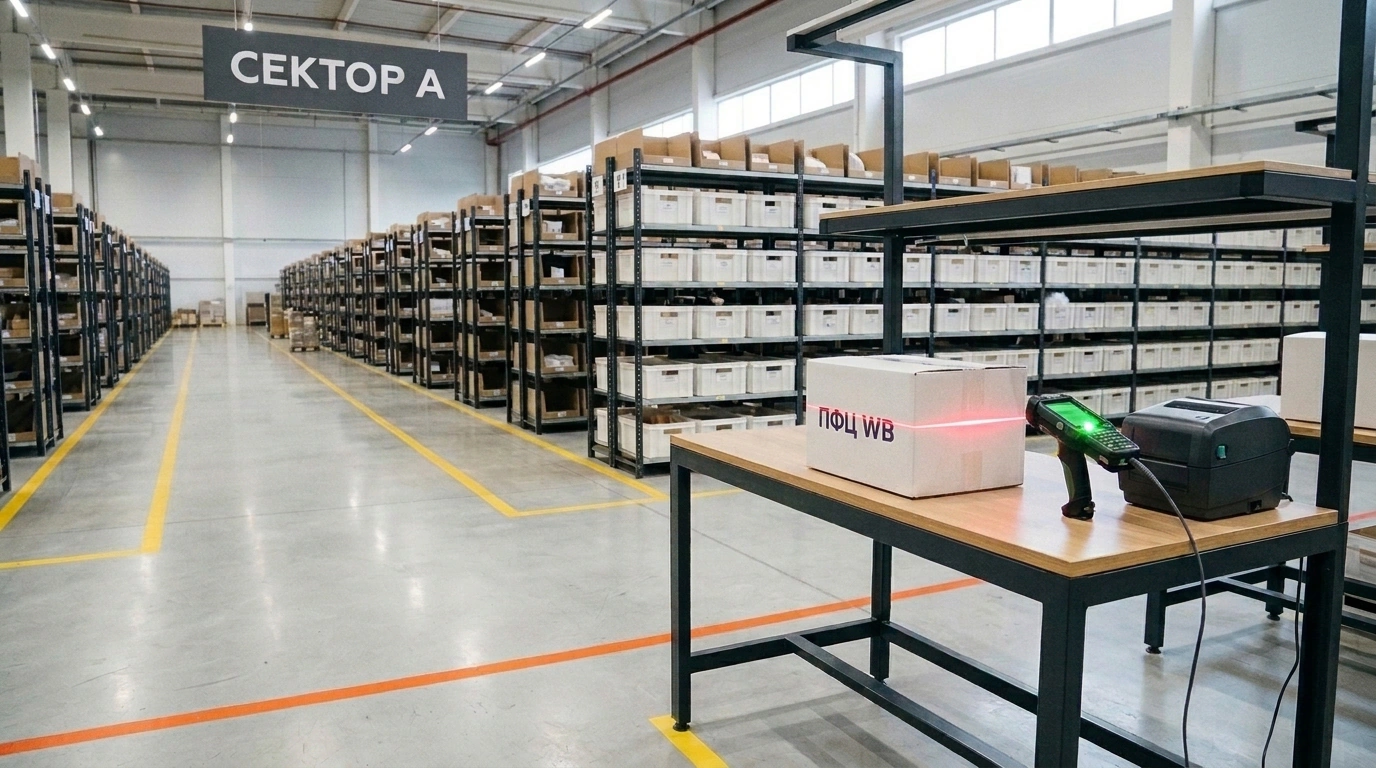
- PFC (Partner Fulfillment Center) — a full-scale logistics facility with a mandatory floor area starting at 500 square meters. This is where real warehousing begins: rows of racking with bin-level address storage, picking stations, packing tables, and material-handling equipment. A PFC handles the entire inventory lifecycle: unloading trucks, piece-by-piece receiving with barcode verification, put-away into bins, stock tracking inside the WB WMS, picking individual customer orders as they drop on the storefront, applying individual QR labels, heat-sealing tamper-evident bags, and palletizing freight for dispatch to sorting centers.
While a PPT can be launched on modest startup capital by a couple of people, a PFC demands an industrial approach, shift staffing, and ironclad adherence to standard operating procedures.
Rate Card and Revenue Anatomy: What Operations the Platform Pays For
The biggest difference between a PFC and a traditional independent 3PL warehouse is the complete absence of a commercial sales department. You don't burn budget on search ads, hire cold-callers, or spend weeks negotiating with picky sellers. The moment your facility passes verification and appears on the WB Partners portal map, sellers in your district or city start booking drop-off slots straight from their dashboards.
The marketplace pays the operator according to a fixed rate card of warehouse operations:
- Piece-by-piece receiving and identification: for every item barcode scanned, a fixed fee is credited to the partner's balance. The operator scans each unit's individual label using a handheld data terminal (TSD) and binds it to a virtual bin or container.
- Cargo unit receiving: a separate rate for handling inbound boxes and pallets under cross-docking, where goods aren't broken down to individual units and move straight to the transit zone.
- Address storage: recurring daily charges for every day an item sits in your warehouse. This is the single most important revenue line, providing a predictable financial cushion. At independent 3PLs, sellers constantly demand free off-season storage, choking shelves with dead stock. In the WB system, every occupied cubic decimeter of bin space generates daily income for the operator at a set rate.
- Picking and packing: payment for order fulfillment, where a picker follows a TSD prompt to locate the SKU on a shelf, scans it to confirm accuracy, checks condition, and packs it into a marketplace courier bag with the order shipping label.
- Palletizing and loading: compensation for stacking finished shipments onto Euro pallets, wrapping them tightly in stretch film, attaching a master pallet manifest, and physically loading them into a Wildberries linehaul truck.
Behind that seemingly transparent rate card, however, hides a make-or-break variable: the physical profile of the goods flowing through your dock. Look at how this plays out on the floor. If a pallet arrives at your ramp carrying six packaged orthopedic mattresses, your worker spends three minutes unloading it, makes six beeps with the scanner, and hits their quota. Now picture a different delivery: three small cartons packed with five thousand tiny pouches of sewing notions, beads, or fishing hooks. Every single pouch has to be pulled from the carton, flipped to find a microscopic barcode, scanned, checked for readability, and neatly sorted into a tote.
That takes half a day, leaves your worker exhausted, and earns a fraction of the revenue per labor hour compared to bulky items. Experienced operators configure category filters early and actively court sellers with straightforward, standardized, mid-sized products.
Internal Warehouse Topology: Functional Zones and Staff Routes
To keep your warehouse from turning into a chaotic pile of cardboard two weeks after launch, the floor has to be zoned along strict assembly-line logic. Every unnecessary step a worker takes carrying a box is pure net profit walking out the door. Across 500+ square meters, you lay out five mandatory functional sectors:
Industrial isometric diagram of a fulfillment warehouse with five operational zones
- Unloading and primary inspection zone: the staging area by the dock doors or ramp where supplier trucks pull in. Here, a receiver verifies piece counts against waybills, inspects pallet and carton integrity, photographs any damage, and checks inbound freight into a buffer zone.
- Receiving and labeling zone: receiving workstations equipped with heavy-duty tables, fixed scanners or wireless TSDs, scales for weight-and-dimension checks, and thermal printers. Here, goods are unpacked from transit cartons, identified, and labeled for warehouse put-away.
- Bin-level racking sector: rows of metal shelving with labeled shelves and plastic totes. Rack height is selected for comfortable manual picking without expensive reach trucks (typically up to 2.5–3 meters for mezzanines or shelving systems). Every bin has a unique address barcode (aisle-rack-tier-position) scanned during put-away.
- Picking and packing zone: order packers' workstations. When a shopper places an order on the storefront, the WMS plots an optimized picking path through the aisles. The item is brought to the packing table, scanned a second time to prevent SKU mix-ups, sealed in a branded tamper-evident bag or box, and tagged with the order barcode sticker.
- Dispatch and palletizing zone: the finish line, where packed orders are sorted by destination distribution hub, stacked onto pallets up to 1.8 meters high, wrapped in at least three layers of stretch film, and tagged with packing lists. From here, freight rolls into Wildberries trucks on a fixed schedule.
Team and Payroll: Why Fixed Salaries Kill Warehouse Economics
Line-staff payroll is the single largest and most dangerous variable cost in a warehouse. If you decide to put receivers and packers on a flat monthly salary (say, 60,000–70,000 rubles a month), the business is virtually guaranteed to nose-dive within a couple of months.
In warehouse operations, productivity on a flat salary drops to 40–50% of potential capacity. Staff start stretching smoke breaks, taking an hour to move a single carton, and complaining about finicky barcodes. The only viable compensation model for a PFC is piece-rate plus bonus pay, locked tightly to verified operations in the system:
- A fixed rate per successful scan at receiving;
- A per-unit rate for every picked and packed order;
- A shift bonus for zero errors and zero claims;
- A strict deduction from the personal bonus for mis-picks or shortages.
The second major challenge is the seasonal roller coaster. During quiet summer months, a 3–4 person shift easily handles a 500-square-meter facility. Then October hits, prep for 11.11 kicks off, Black Friday rolls right behind it, and December's New Year rush slams the dock.
Inbound deliveries and customer orders jump 30–50% week over week. Carrying excess full-time headcount year-round just for two peak months is financial suicide. Smart operators maintain a core crew of 4–5 experienced full-time shift leads and bring in self-employed gig workers through flexible staffing platforms during peaks—or temporarily redeploy staff from their own FBS operations.
Entry Calculator: Real Launch Budget for 500 m² in Class B
Let's run the real numbers to launch a 500–600 square meter partner fulfillment center in a major regional hub. We're skipping trophy Class A parks with sky-high rents and pricing a typical clean, dry Class B or B+ space with level dust-proof floors, at least 3.6 meters of clear ceiling height, and year-round heating between +17°C and +25°C:
- Rent and security deposit: average industrial-warehouse rates run 600 to 1,000 rubles per square meter per month, excluding utilities. For 500 m², that's 350,000–500,000 rubles monthly. Factoring in first and last month's deposit, you need to freeze 700,000–1,000,000 rubles upfront.
- Racking systems and zoning: buying metal shelving for unit storage, first-tier pallet beams, and plastic bin totes will run at least 400,000–600,000 rubles, even if you source quality used equipment.
- Warehouse gear and workstations: a couple of reliable 2–2.5 ton hydraulic pallet jacks, five packing tables with stretch-film and tape dispensers, calibrated check scales, and hand tools add another 180,000–250,000 rubles.
- IT infrastructure and security perimeter: industrial Android TSDs with long-range 2D laser scanners are the heart of the warehouse. You need at least 4–5 units at 35,000–55,000 rubles each. Add industrial thermal label printers (Zebra or Godex), seamless enterprise Wi-Fi that won't drop signal inside narrow metal racking aisles, and server gear—that's another 300,000–450,000 rubles.
- High-definition CCTV system: a non-negotiable Wildberries security requirement. Platform rules mandate 5 to 12 IP cameras at Full HD or higher, providing zero-blind-spot coverage of dock doors, receiving tables, packing stations, and dispatch bays. The video feed must stream to WB security in real time over a secured RTSP protocol, with at least 30 days of local archive storage. Installation, cameras, NVR, and high-capacity drives run 150,000–250,000 rubles.
- Initial consumables stock: Euro pallets, 20–23 micron stretch-film rolls, 58×40 mm thermal labels, packing tape, and tamper-evident bags—70,000–120,000 rubles.
Total startup capital comes to 1.8–2.6 million rubles, assuming the building doesn't need major floor or roof repairs. At current rate cards, break-even requires keeping bin occupancy steady at 65–70% of nominal capacity or higher.
Hidden Clauses in the Terms: Non-Negotiable Fines and Hub Recounts
Now let's talk about what glossy pitch decks conveniently leave out. The biggest systemic risk in partner fulfillment isn't rent or a broken pallet jack—it's buried in the marketplace's terms of service.
The first and most painful landmine is secondary recounting at central distribution hubs. Here's how the trap springs. A seller drops off sealed cartons at your PFC. Your worker scans the outer shipping barcodes without opening the boxes (unless piece-by-piece receiving was ordered), builds a pallet, and dispatches it via linehaul to the central sorting center in Koledino.
At the sorting center, the box is opened on a high-speed conveyor. If five units are missing, or black jeans are packed instead of blue ones, the system automatically flags a discrepancy. Guess who is presumed guilty by default? You guessed it—the partner warehouse that manifested the shipment. The marketplace issues a fine for mis-sort or shortage and deducts it automatically without recourse from your next agency payout. Trying to dispute that deduction retroactively through support is practically science fiction, requiring minute-by-minute video timestamp matching from your receiving table.
The second threat is strict fulfillment SLAs. The moment a shopper places an order on Wildberries, a countdown clock starts. If your warehouse fails to pick, pack, and hand off the order within the assigned window (typically 12–24 hours depending on the service tier), the marketplace levies a progressive hourly late penalty. During December peak days, when orders pour in by the hundreds per hour, a single picker bottleneck or TSD freeze can wipe out an entire week's warehouse margin.
The third hazard is loss and damage liability. Until a shipment is signed over to the linehaul driver, full financial liability for sellers' inventory rests on the partner. If a night-shift worker drops a pallet of household chemicals and soaks adjacent cartons of pricey electronics, you're reimbursing the seller at full storefront retail value.
Step-by-Step Launch: From Portal Application to Going Live on the Map
If a clear-eyed look at the risks hasn't scared you off and you have a suitable building plus working capital buffer, here is the launch roadmap:
- Register a legal entity or sole proprietorship: the partner agreement is open only to registered businesses (IP or LLC) with active OKVED business codes for warehousing and cargo handling (group 52.10).
- Submit an application at pfc.wb.ru: fill out the detailed form specifying exact warehouse address, gross and usable square footage, ceiling height, truck access specifications, and attach facility photos.
- Application review and on-site audit: the marketplace's logistics expansion team reviews applications within 5 business days. Upon preliminary approval, a regional curator visits the site to verify fire alarms, hydrants, floor flatness, ventilation, and actual square footage.
- Sign the electronic agreement: execute the official partner contract via an electronic document interchange (EDI) system.
- Tech integration and outfitting: purchase equipment, connect TSDs to the secure WB network, configure CCTV streams for WB security, and run a test upload of your warehouse bin map into the WMS.
- Go live on the interactive map: the marketplace makes your warehouse visible to all sellers on the platform, sets an initial daily receiving cap, and assigns an onboarding curator for your first shipments.
Partner fulfillment is neither passive income nor a plug-and-play "set up some tables and count the cash" franchise. It's a demanding, tech-heavy operational business where profitability is won in centimeters of shelf space, seconds per scan, and iron discipline at every packing bench. But for operators who know how to run tight physical processes and manage floor teams decisively, it opens up a long-term order stream backed by the sheer scale of the country's largest marketplace.