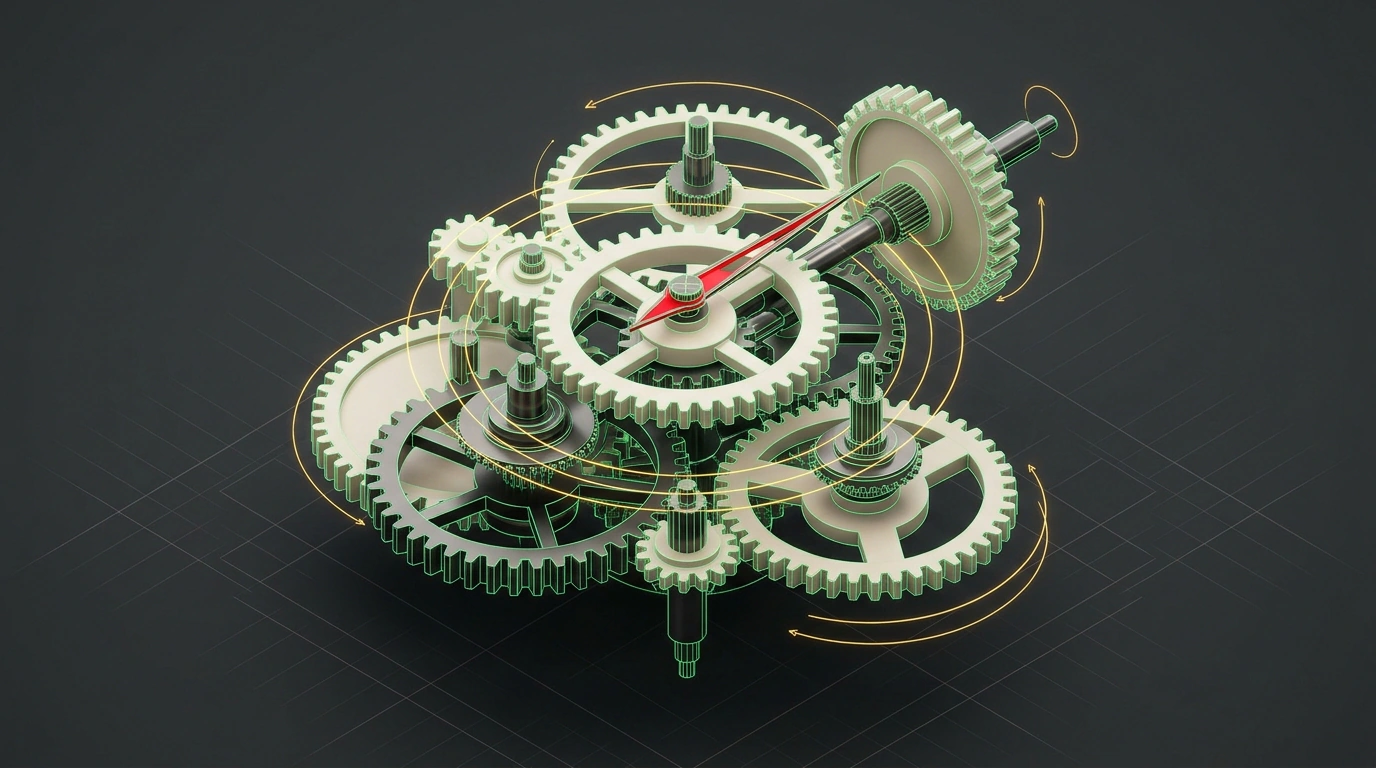
Have you ever asked a language model to code up a working 3D mechanism? If you have, you know the usual comedy of errors: misaligned axles, gears spinning the same direction, teeth clipping right through each other, and clock hands sweeping at random speeds. For a long time, the developer consensus was simple: pure autoregressive text models fundamentally lack spatial awareness. They think in tokens, not rigid bodies, so 3D geometry stays a blind spot.
The updated DeepSeek V4.1 Flash (including the fresh production checkpoint Flash-1017) just blew that assumption apart. Its engineers combined two traits that used to be mutually exclusive: blistering inference speed (over 1,200 tokens per second on tuned hardware) and a genuine leap in modeling physical space right inside its attention weights. We already touched on its record coding speeds in our earlier piece on DeepSeek V4.1 Flash 1017 and DeepInfer; today, independent researcher Matthew Berman put the release through a brutal spatial-reasoning crash test.
Mechanical Clock With Exploded View: A Kinematics Exam
The toughest gauntlet for DeepSeek V4.1 Flash was building an interactive 3D mechanical clock inside a single self-contained Three.js HTML file.
The spec left zero wiggle room:
- Build a working clockwork movement: gear train, balance wheel, plus second, minute, and hour hands;
- Enforce mathematically exact gear ratios so the hour hand completes one full turn for every 12 revolutions of the minute hand;
- Include an interactive exploded-view slider that separates the mechanism into distinct layers along the Z-axis.
Most top models choke on this test: hands spin backward, and sliding the exploded view scatters the parts into floating junk. V4.1 Flash nailed working code on the first shot without a single syntax fix. Drag the slider, and the case, crystal, bridges, hands, and gears glide apart smoothly while staying coaxial—and the gears keep meshing and turning in real time. The model proved it can hold an entire mechanism's 3D coordinate system in working memory.
The Macaron Pyramid and Hidden-Volume Math
Berman's second test targeted what's known as Spatial Hidden Object Reasoning.
He showed the model a photo of a tight, four-sided pyramid stacked out of round macaron pastries and asked a simple question: "How many macarons are hidden inside the pyramid and invisible from the outside?"
Even heavyweights like GPT-4o and Gemini 1.5 Pro routinely trip over this. They start mechanically counting the circles visible in the image and claim there are only 24 macarons total.
DeepSeek V4.1 Flash walked through a clean engineering chain of thought:
- Identified a square 5×5 base at the bottom of the pyramid;
- Recalled the sum-of-squares formula for a stepped pyramid: 25 on the bottom tier, 16 on the second, 9 on the third, 4 on the fourth, and 1 on top—55 macarons in total;
- Counted the visible pastries across the four sloped outer faces;
- Subtracted the visible count from the total volume and pinpointed that exactly 21 load-bearing macarons are hidden inside, keeping the structure from collapsing.
It's a textbook example of deep reasoning compensating for the lack of a built-in physics engine.
From Rubik's Cube to Browser Games: "Bean Blitz" in Three Seconds
Strong spatial coordination translates straight into web dev. Berman asked the model for an interactive Rubik's Cube. It didn't just render 27 cubes—it nailed the matrix math for face rotations: clicking any side rotates the exact 9 adjacent blocks and updates their color state cleanly.
Next, V4.1 Flash generated a 3D browser platformer called "Bean Blitz" from a single prompt—a snappy Fall Guys clone. It came with a controllable bean character, a procedural obstacle course with spinning hammers, gravity, and elastic collision physics, all compiled into a playable web interface in seconds.
Speed Benchmarks: 1,200 Tokens per Second on Production Clusters
Raw speed is the release's second killer feature. Paired with the optimizations we covered in our deep dive on ultra-fast inference architecture, the numbers are wild:
- On a tuned Lithos AI cluster running Ultra Chat, peak throughput hit 1,286 tokens per second;
- On Base10's cloud in FAST mode, sustained generation holds steady at 845–855 tokens per second with a Time to First Token (TTFT) of just 180 milliseconds;
- In standard setups with High Reasoning Effort cranked to max, speed stays at a brisk 210–250 tokens/sec.
A flexible reasoning-effort toggle lets engineers pick their trade-off: simple formatting edits return instantly, while heavy 3D kinematics prompts take 5–7 seconds to map out the geometric matrix before streaming code.
Browser 3D Trade-Offs and Limits
Of course, real-world production calls for a clear-eyed look at the caveats:
- The model defaults to basic Three.js materials (
MeshStandardMaterial), so without detailed art direction in your prompt, surfaces can look a bit flat and plasticky; - Pushing overly dense meshes with tens of thousands of polygons can still tank frame rates on phones or thin office laptops.
Even so, DeepSeek V4.1 Flash makes one thing clear: spatial modeling is no longer locked behind heavy, slow desktop suites. Live physics and geometry reasoning now happen right inside a chat window.