If you've ever run large language models locally or over open APIs, you know the number one pain point of coding assistants: agonizing time-to-first-token and sluggish character-by-character streaming. When you want to spin up a microservice or test a quick idea in the terminal, 30–40 tokens per second turns into a test of patience. For a long time, blazing speed—hundreds of tokens per second—seemed like the exclusive turf of proprietary hardware providers like Groq or Cerebras with their ultra-expensive custom silicon.
Once again, Chinese research lab DeepSeek just scrambled the board. The team open-sourced its production inference server DeepInfer under an Apache 2.0 license, alongside an optimized checkpoint of DeepSeek V4.1 Flash (build 1017) tuned specifically for autonomous code generation.
I dug through the repository's codebase, and today we'll unpack the two architectural tricks that let DeepSeek outrun classic serving engines—plus how to deploy this stack on your own hardware.
The Autoregressive Bottleneck: Why Standard LLMs Drag
To see what makes DeepInfer a breakthrough, let's revisit how a classic language model works. The Transformer architecture is autoregressive by nature: to emit the next token, the model has to push the entire preceding context through every single layer.
One generation step equals one token. The GPU spends massive compute cycles hauling trillions of weights from slow VRAM into fast on-chip registers just to predict a single character or short syllable. As a result, modern NVIDIA accelerators sit idle roughly 80% of the time, waiting on memory-bus transfers. That's the fundamental Memory-Bound Bottleneck that breaks naive attempts at acceleration.
The second headache for agentic systems is long, repetitive context. When a coding agent runs dozens of iterations, it resends the system prompt, project rules, documentation, and edit history on every turn. Standard engines force the GPU to recompute attention over those identical hundreds of thousands of tokens every single time, burning cycles for nothing.
DeepInfer's Two Springs: Speculative DSpark and Smart KV-Caching
DeepSeek's engineers tackled both bottlenecks right inside the inference server architecture.
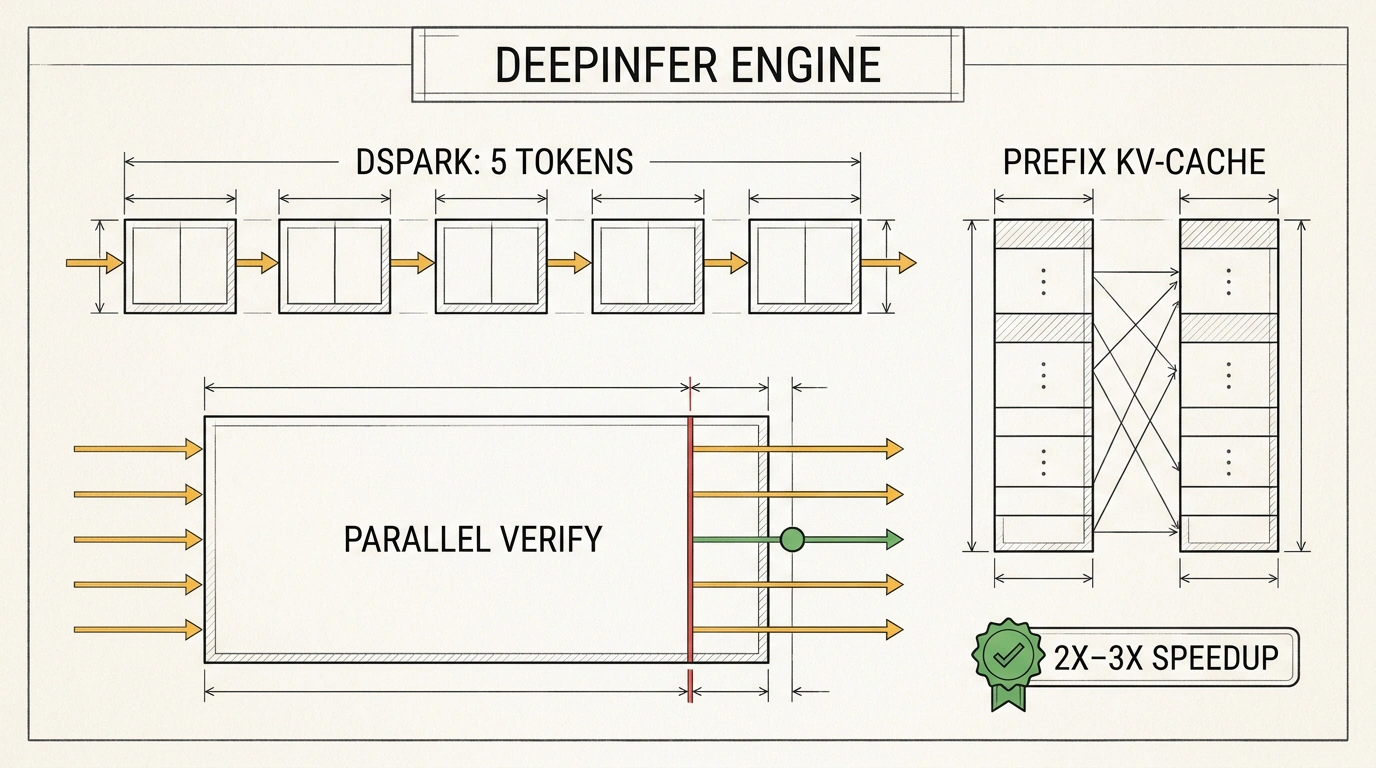
Architectural blueprint of the parallel DSpark pipeline with speculative token batches and DeepInfer's accelerated KV-cache.
The first spring is DSpark Speculative Decoding.
Instead of running the heavy main model for every single token, the engine embeds a lightweight Confidence Head. It runs almost instantaneously and drafts a batch of 3–5 tokens at once. In code, for example, the keyword def is almost certainly followed by a space and a function name, and return by a variable.
The heavy main model then performs just one forward pass and verifies the entire draft batch in parallel. If the draft head guessed 4 out of 5 tokens right, the system accepts all of them in a single step. Generation latency drops 2–3x while preserving 100% of the heavy model's mathematical accuracy.
The second spring is KV-Cache Prefix Sharing. DeepInfer splits key-value cache memory into pages and hashes the unchanging system prefix. When an agent sends its next request, the engine pulls the precomputed prefix straight from memory and only computes the delta of the newest message. That cuts redundant compute in agent pipelines by nearly 50%.
As we covered in our look at the open DeepInfer engine and Flash 1017, combining these two techniques squeezes maximum throughput out of standard server GPUs.
Deploying a Production DeepInfer Server
DeepInfer's server core is written in pure C++ with hand-tuned CUDA kernels and supports both NVIDIA server GPUs (A100, H100, B200) and Huawei Ascend NPUs.
Here's a production launch command for the inference server with DSpark enabled and tensor parallelism across 4 GPUs:
# Launch production DeepInfer server for DeepSeek-V4.1-Flash-1017
python3 -m deepinfer.entrypoints.openai.api_server \
  --model deepseek-ai/deepseek-v4.1-flash-1017 \
  --speculative-engine dspark \
  --speculative-draft-tokens 5 \
  --speculative-confidence-threshold 0.85 \
  --kv-cache-prefix-caching \
  --max-model-len 131072 \
  --tensor-parallel-size 4 \
  --port 8000
Pay close attention to --speculative-confidence-threshold 0.85: it sets the draft head's confidence floor. If prediction probability dips below 85%, the engine plays it safe and falls back to standard decoding, avoiding wasted rollbacks.
And here's how a client calls the deployed endpoint in Python using the standard OpenAI SDK:
"""
Call a DeepInfer inference server with DSpark enabled.
Streams generated code with ultra-low time-to-first-token (TTFT).
"""
from openai import OpenAI

client = OpenAI(
    base_url="http://localhost:8000/v1",
    api_key="deepinfer-local-token"
)

response = client.chat.completions.create(
    model="deepseek-v4.1-flash-1017",
    messages=[
        {"role": "system", "content": "You are an expert autonomous software engineer."},
        {"role": "user", "content": "Write an autonomous Go microservice to monitor an inference server's KV-cache."}
    ],
    temperature=0.2,
    max_tokens=2048
)

print(response.choices[0].message.content)
When generating strictly typed code (Go, Rust, TypeScript), you can safely lower --speculative-confidence-threshold to 0.75: predictable syntax pushes token acceptance rates up to 80–90%, giving you maximum streaming speed.
Flash 1017 in Action: Pairing With OpenCode
A fast engine doesn't help much without a model that writes clean, syntax-error-free code. The updated DeepSeek V4.1 Flash (build 1017) checkpoint is tuned specifically for autonomous dev environments like OpenCode.
With a context window of up to 1 million tokens, the model shines at one-shot full-stack builds. From a single text prompt in test runs, it generated:
- A working Tetris clone in vanilla JavaScript with smooth animations and score tracking;
- Interactive 3D Three.js/WebGL scenes with zero rendering glitches;
- Complete REST API microservices in Go with auto-generated Swagger docs.
As our deep dive into the OpenCode ecosystem showed, the open coding stack has pulled right up alongside proprietary flagships—at roughly a tenth of the token cost.
Hardware Reality: What Benchmarks Don't Mention
As exciting as this open release is, you need to keep the hardware requirements in mind:
- VRAM footprint. Holding V4.1 Flash with a 131k-token context and KV-cache takes at least two NVIDIA RTX 4090 cards (48 GB combined) when quantized, or an 80 GB A100/H100 server GPU for full FP16.
- Speedups shrink on dense algorithms. Speculative decoding shines on predictable syntax—boilerplate, layouts, standard CRUD handlers. On heavy math formulas or unusual algorithms, the draft head misses more often, dropping the speedup to a more modest 20–30%.
Even so, DeepSeek's move is a milestone for the entire industry: frontier inference algorithms are no longer locked behind proprietary cloud walls. Any team can now stand up a high-speed coding loop on its own iron.
