In modern microservice architectures, applications constantly need unstructured object storage: media files, user avatars, logs, PDF reports, and backups. The Amazon S3 API has become the undisputed de facto standard for handling that data.
In reality, though, company infrastructure is rarely uniform. Some services run in the public cloud, others sit on bare-metal servers, and compliance policies often require sensitive data to stay strictly on local disks. Before long, your codebase collects a zoo of incompatible vendor SDKs, developers wrestle with passing access keys around, and migrating a service between clouds turns into a painful refactor.
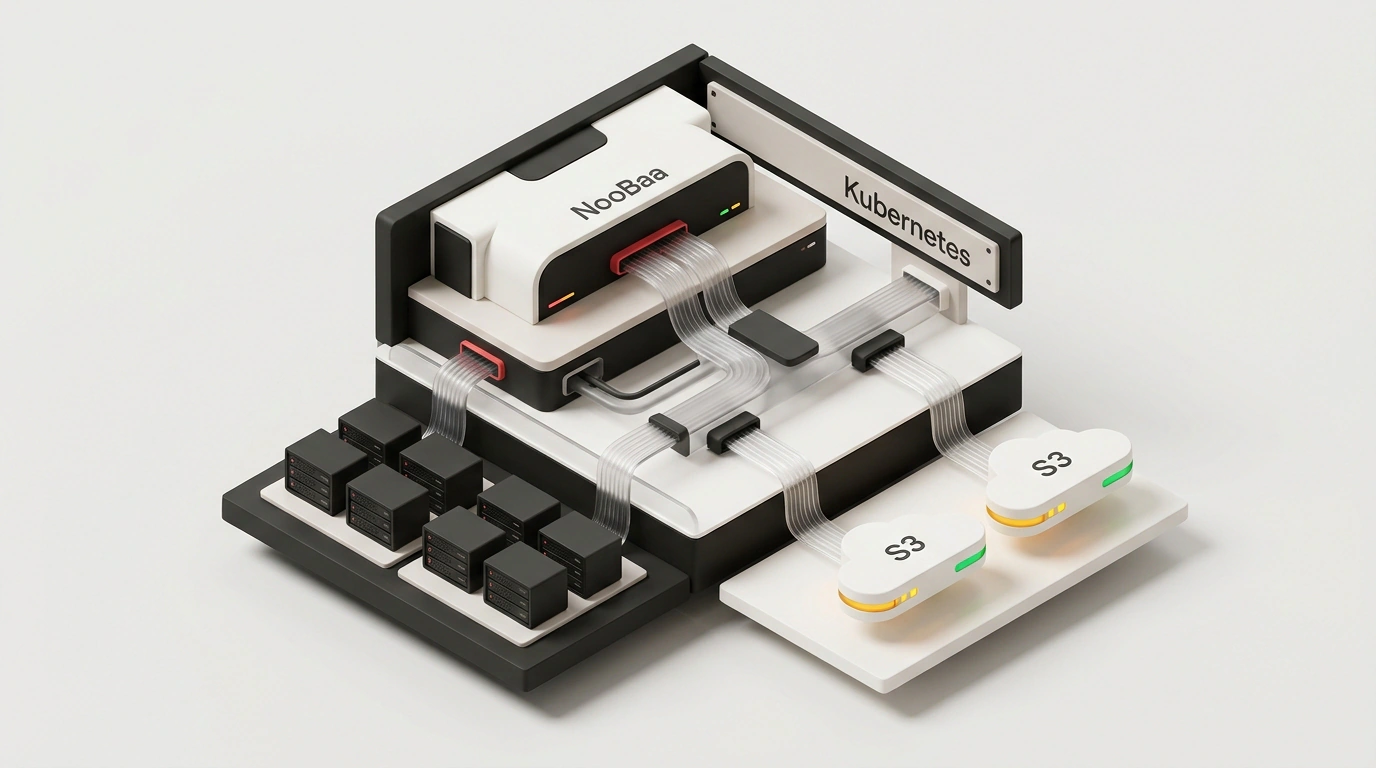
The open-source NooBaa project (widely known in the Red Hat OpenShift ecosystem as Multicloud Object Gateway) takes a much cleaner approach: give your Kubernetes cluster a single, vendor-neutral S3 gateway that abstracts away every physical storage backend.
Earlier, we explored running isolated sandboxes in Kubernetes without passing secrets directly. Today, let's see how the NooBaa Operator unifies object storage.
Architectural Concept: Abstraction and Tiering
NooBaa Operator implements the Kubernetes Operator pattern to automate the full lifecycle of your object gateway:
- Single entry point: in-cluster services talk to one internal endpoint,
http://s3.noobaa.svc.cluster.local, using the standard S3 protocol. - Heterogeneous backends: physically, objects can live on local Persistent Volumes (PVC) backed by Ceph, in AWS S3, Google Cloud Storage, Azure Blob, or any third-party S3-compatible store.
- Smart tiering: the gateway can keep fresh "hot" objects on fast local SSDs while transparently moving aging archive files to cheap cloud buckets.
- Mirroring: a single object write can be replicated simultaneously across two independent cloud providers for maximum disaster resilience.
- Serverless triggers: built-in bucket notifications on object creation or deletion let you fire serverless processing functions without maintaining external message queues.
Custom Resource Definitions (CRD) Model
All of NooBaa's magic rests on three straightforward declarative resources:
BackingStore: describes a concrete physical storage target (a pool of local PVC disks or credentials for an external AWS/GCP bucket).BucketClass: defines placement policies—replication, compression, encryption, and how data is distributed across available BackingStores.ObjectBucketClaim(OBC): a developer's declarative request for a bucket, much like a PVC for file storage.
# 1. Install the NooBaa operator into the cluster via CLI
noobaa install

# 2. Create a local disk pool backed by the system StorageClass
noobaa backingstore create pv-pool local-pv-store --num-volumes 3 --pv-size-gb 50

# 3. Create a bucket class bound to the local pool
noobaa bucketclass create fast-local-class --backingstores local-pv-store
Declarative Wiring to Your Application
Microservice developers no longer need to know cloud credentials or generate keys by hand. You just define an ObjectBucketClaim manifest:
# app-bucket-claim.yaml — declarative request to provision a bucket
apiVersion: objectbucket.io/v1alpha1
kind: ObjectBucketClaim
metadata:
  name: user-media-bucket
  namespace: default
spec:
  bucketClassName: fast-local-class
  generateBucketName: media-storage
Once applied, the NooBaa Operator automatically creates two linked resources in the default namespace:
ConfigMap/user-media-bucket: holdsBUCKET_NAME,BUCKET_HOST, andBUCKET_PORT;Secret/user-media-bucket: holds the generatedAWS_ACCESS_KEY_IDandAWS_SECRET_ACCESS_KEY.
All that's left is wiring them into your application container:
apiVersion: apps/v1
kind: Deployment
metadata:
  name: media-service
spec:
  replicas: 2
  template:
    spec:
      containers:
        - name: app
          image: media-service:latest
          envFrom:
            - configMapRef:
                name: user-media-bucket
            - secretRef:
                name: user-media-bucket
To test manifests on your laptop, install with noobaa install --mini. The operator deploys a compact, lightweight component profile that won't overwhelm your local machine's memory.
Practical Takeaway
NooBaa Operator makes object storage in Kubernetes feel just as predictable and standardized as mounting regular volumes. Developers get a familiar S3 interface free of vendor lock-in, while platform admins gain centralized control over security and cloud infrastructure costs.