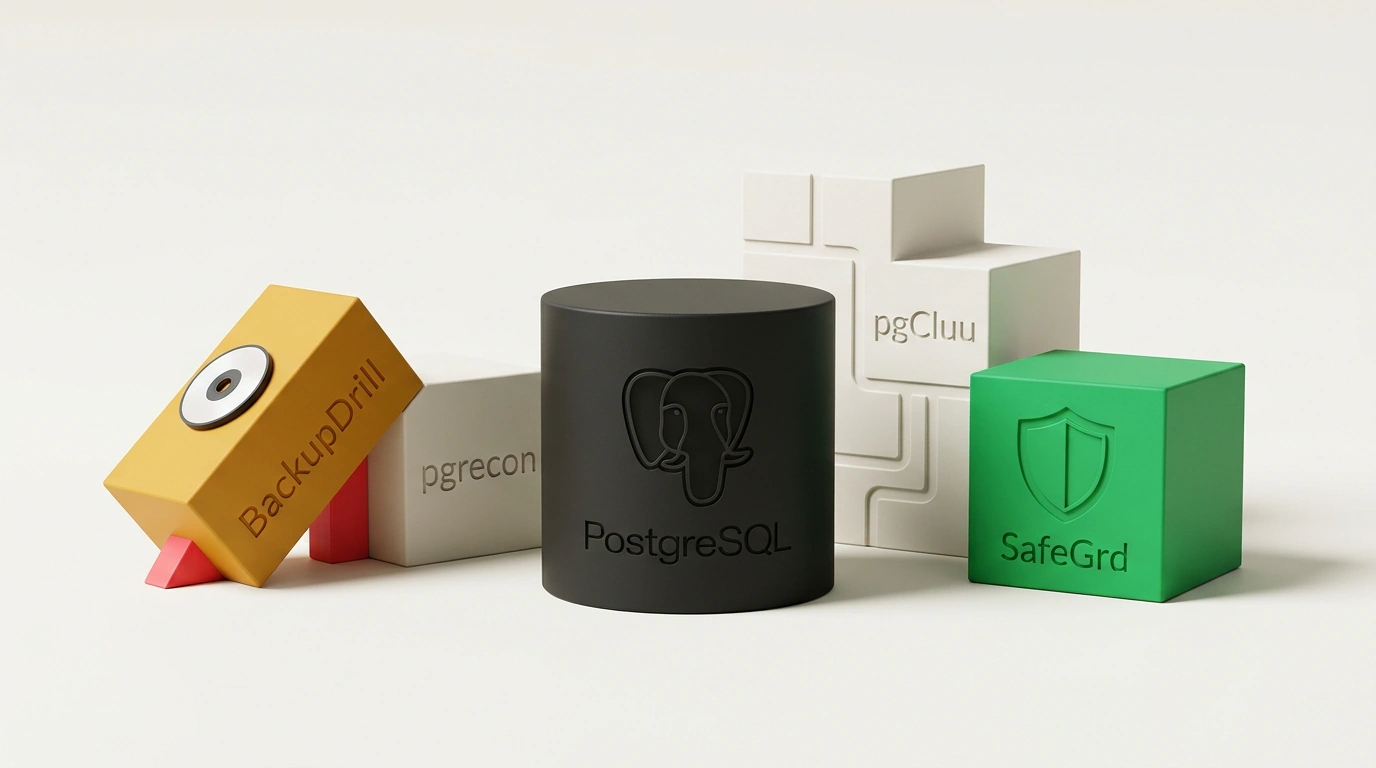
Ask any seasoned DBA or systems engineer about their worst on-call nightmare, and you'll get the same answer: discovering in the middle of a 3 a.m. outage that your regular database backups are corrupted and won't restore. Real data reliability doesn't magically appear because you checked a box in a hosting dashboard—it takes continuous automated drills, clear server resource audits, and safe migration tooling.
One of the best things about the PostgreSQL ecosystem is the steady stream of focused open-source utilities solving real operational pain points. Earlier, we covered PostgreSQL security and backup tool releases, and today we're looking at four fresh open-source finds from the official PostgreSQL News feed.
BackupDrill
Supabase has won over plenty of teams as a convenient Postgres-based cloud backend. Still, running a standard pg_dump leaves you guessing: will that dump actually restore onto a clean server if your instance goes down?
The open-source BackupDrill CLI (MIT license, github.com/backupdrill/cli) automates the full Restore Drill cycle:
- Captures a consistent custom-format dump of your Supabase database and streams the archive to your own S3-compatible bucket (AWS S3, Cloudflare R2, Backblaze B2, Wasabi) with cryptographic checksums recorded in a manifest;
- Runs
backupdrill drillto spin up an isolated temporary PostgreSQL container in Docker and execute a fullpg_restore; - Verifies that foreign keys, indexes, triggers, and views recreate cleanly, while measuring your exact Recovery Time Objective (RTO);
- Syncs Supabase Storage files as well, preventing drift between table references and actual binary objects.
# Install the CLI and run a backup streaming to S3
npm install -g backupdrill
backupdrill backup --project-ref my_supabase_ref --s3-bucket my-backup-bucket

# Automatically run a restore drill in local Docker
backupdrill drill --latest
pgCluu 5.0
When database performance suddenly tanks, you need to correlate OS-level metrics with internal DBMS stats. The popular pgCluu auditor by Gilles Darold and the HexaCluster team just hit major version 5.0.
It collects telemetry via the sar system daemon and internal psql views, generating clean static HTML reports without forcing you to deploy heavy paid APM stacks:
- Adds detailed replication-slot monitoring from
pg_replication_slotsand access-rule auditing viapg_hba_file_rules; - Introduces full disk I/O collection from
pg_stat_io(PostgreSQL 16+): throughput by backend type, dirty buffer flushes, cache hit ratios, I/O latency, and async I/O (for PG18+); - Captures key Linux kernel parameters: Transparent Huge Pages (
shmem_enabled), CPU frequency governors,vm.dirty_*page-flush settings, and OOM-killer protection thresholds (oom_score_adj).
# Background collection of PostgreSQL and sar metrics at 60-second intervals
pgcluu_collectd -D -i 60 /tmp/pgcluu_data

# Generate a comprehensive HTML report with all charts
pgcluu -o /var/www/html/pgcluu /tmp/pgcluu_data
pgrecon
Migrating enterprise databases from Oracle Database to open-source PostgreSQL always runs into security friction: InfoSec teams flatly forbid connecting external migration tools directly to production Oracle instances.
pgrecon by DevCrafterAI (version 0.7.3, Apache-2.0 license) solves this by working 100% offline:
- A lightweight, transparent SQL*Plus script exports metadata from any Oracle version (from ancient 9.2 up to modern 23ai) into plain text files;
- A local engine backed by embedded SQLite runs 80 deterministic checks: accurately mapping data types with byte vs. char semantics (
VARCHAR2(30 CHAR)becomesvarchar(30)), parsing table partitioning, and rewriting hierarchical queries (CONNECT BYintoWITH RECURSIVECTEs); - Its PL/SQL parser builds a full grammar tree and outputs clean DDL for PostgreSQL 16–18, isolating any ambiguous constructs in a separate residue report instead of emitting broken SQL.
SafeGrd
While BackupDrill targets the Supabase ecosystem, the open-source SafeGrd tool is built for classic self-hosted PostgreSQL 13+ servers.
Its core philosophy is scheduled, automated Fire Drills:
- A local agent reads the schema via
pg_dumpand streams table data over high-speed binaryCOPYinside a single transaction (requiring only the minimalpg_read_all_datarole); - The dump is encrypted right on the server with an
agepublic key before hitting object storage with Object Lock enabled; - On schedule, a daemon spins up a sandbox, restores the data, and runs table-by-table row-count and checksum comparisons, chaining the verification results into a cryptographic attestation log.
Taken together, these four utilities show how mature the PostgreSQL ecosystem has become. Instead of crossing your fingers and hoping backups "probably work," BackupDrill and SafeGrd give you continuous automated drills. Meanwhile, pgCluu 5.0 gives you a clear window into hardware health, and pgrecon lets you plan a confident, air-gapped exit from proprietary databases to an open stack.