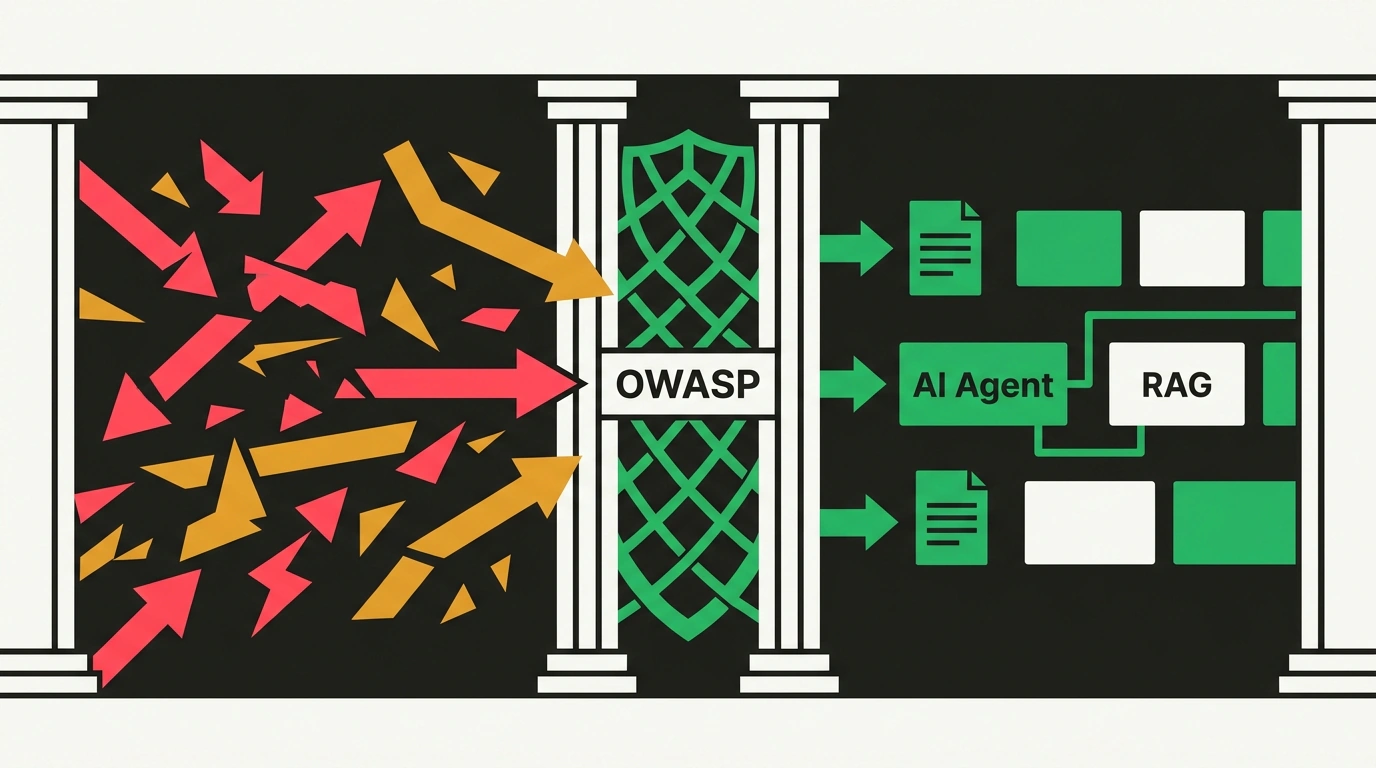
"Life is too short and application security is hard—use cheat sheets!" That's the motto behind the OWASP Cheat Sheet Series, which gives engineers practical checklists instead of dense academic tomes.
With autonomous AI agents and RAG pipelines entering production, the threat landscape has shifted dramatically. Earlier, we looked at approaches to isolating untrusted code in AI agents. The latest update to the OWASP Cheat Sheet Series systematizes security standards for LLM-powered systems.
The Threat Paradigm Shift: When Data Becomes Instructions
In traditional software engineering, security rests on a clean boundary between executable code and user data. Parameterized SQL queries and HTML escaping for XSS work because the runtime knows with certainty: this part is immutable program logic, and that part is passive text.
LLM architectures tear down that wall. Inside a single context window, the model mixes together:
- The developer's system metaprompt;
- Untrusted user input;
- Text chunks pulled from a corporate knowledge base (RAG);
- Outputs from external tool calls and API responses.
This creates a fundamental new vulnerability class: Indirect Prompt Injection. An attacker no longer needs to target your chatbot directly—they can simply plant a hidden instruction inside an internal wiki page, product listing, or public webpage. The moment an autonomous agent ingests that chunk via RAG, the injected text hijacks the model's control flow.
New Dedicated OWASP Cheat Sheets
The updated collection adds specialized guidance for modern AI stacks:
- AI Agent Security: hardening autonomous systems that can invoke tools, run scripts, and interact with infrastructure.
- RAG Security: filtering, sanitizing, and validating data retrieved from vector databases before it ever reaches the model's context.
- AML Sanctions AI Agent Payments: compliance and financial controls when intelligent agents initiate autonomous payments.
- Abuse Cases: structured threat modeling for how neural services can be abused.
Four Core Principles of Agent Security
After digging through the updated guides, four non-negotiable rules stand out for any AI service architecture:
- Least Privilege: never hand an agent generic superpowers like "run any bash command" or "execute arbitrary SQL." Expose access strictly through narrow, purpose-built APIs with tightly constrained parameters.
- Deterministic Guardrails: parameters generated by an LLM for a tool call must be validated against strict JSON Schemas, regexes, and static rules before reaching any external system.
- Human-in-the-Loop (HITL): destructive or irreversible actions (deleting files, transferring funds, sending bulk emails) must require explicit human approval.
- Session Memory and Vector Index Isolation: strict cross-tenant isolation in vector stores so one customer's private data can never leak into another user's context.
Trying to protect an agent with system-prompt instructions like "Never run delete commands" is doomed to fail. Every language model is vulnerable to jailbreaks. Security must be enforced by code-level permission boundaries and network isolation—not polite requests in a prompt.
The Classic Foundation: Standards You Still Can't Skip
Even with all eyes on AI, the OWASP Cheat Sheet Series remains the go-to reference for core application security:
- SQL Injection Prevention;
- Cross-Site Scripting (XSS) Prevention;
- Safe handling of JWT tokens and OAuth2 flows;
- Hardening Docker configurations and Kubernetes clusters.
Practical Takeaway
New technology doesn't repeal the laws of information security. The updated OWASP Cheat Sheets give architects and developers a concrete playbook to close critical AI vulnerabilities right at the schema and API design stage.