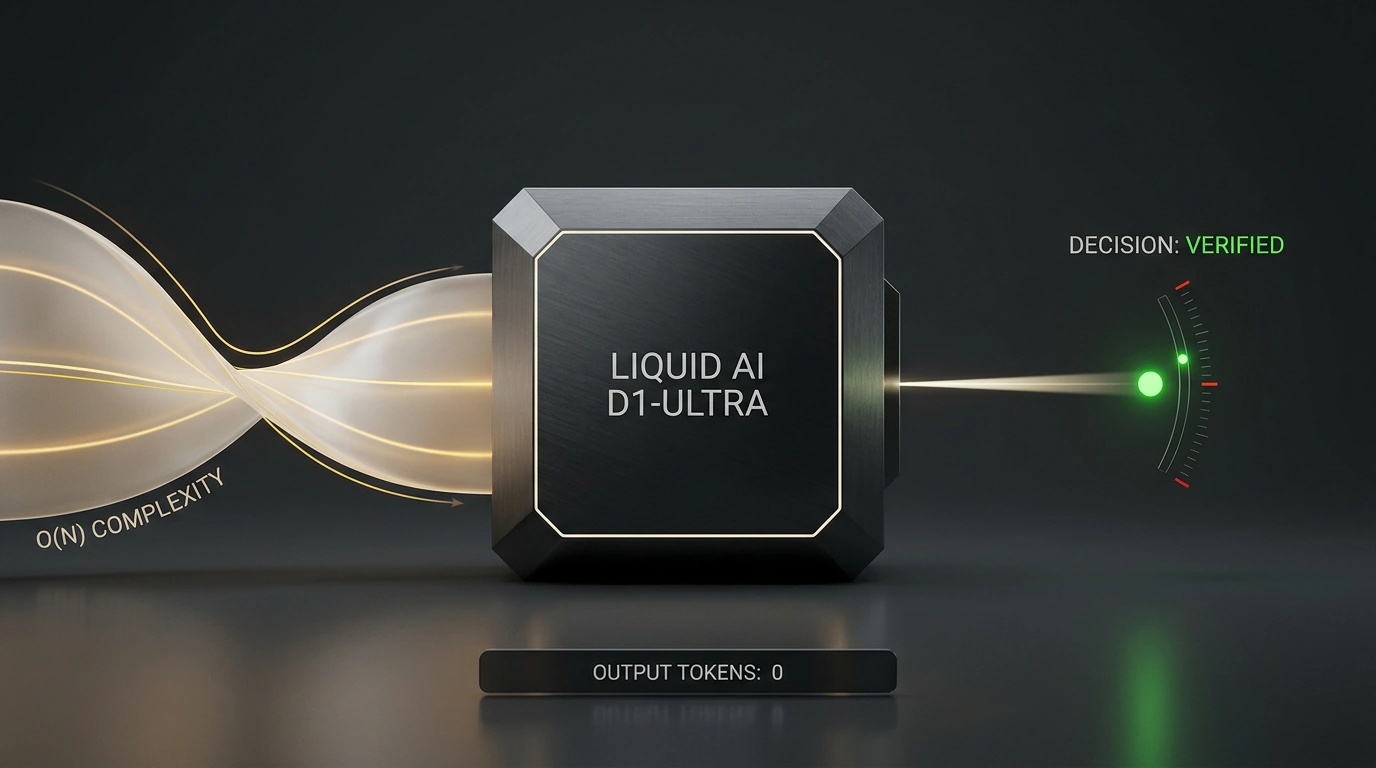
Have you ever stopped to think about how absurdly wasteful our use of modern language models has become? Picture a factory line or an agent pipeline that needs an answer to a simple yes-or-no question: "Is this pull request safe to ship to production?" or "Is there a defect in this part photo?" Instead of returning a single number or a "yes/no," a massive Transformer starts printing a whole essay character by character: "Hello! After carefully reviewing the provided code snippet, I conclude that..."
Hundreds of milliseconds of precious latency and megawatts of power get burned on pointless prose. We're hammering nails with a microscope simply because we've grown used to autoregressive chatbots.
Liquid AI—a startup spun out of MIT CSAIL under Ramin Hasani—just proposed a radical exit from that dead end. Their new multimodal model, d1-ultra, belongs to a completely different class of systems: it's not a generative model, it's a Decision Model. Its output_tokens count is literally zero.
I dug into the architecture and benchmark numbers to show you why dynamic neural networks could become the go-to referee inside tomorrow's autonomous systems.
The Quadratic Curse of Attention: Why Transformers Hit a Wall
Every modern LLM—from GPT-4 to Claude and Gemini—is built on the Transformer architecture and Self-Attention. That mechanism is brilliant at capturing context, but it carries a fatal mathematical flaw: quadratic compute complexity, $O(N^2)$.
Double the input context length, and the compute and attention-cache memory jump fourfold. Increase it tenfold, and costs explode 100x. When you're dealing with continuous data streams—security camera feeds, autopilot telemetry, or millions of server log lines—Transformers choke almost immediately.
Liquid AI took a different route: they replaced discrete attention matrices with Liquid Neural Networks (LNN) and Continuous-Time State Space Models. Their math runs on differential equations with dynamic coefficients, so neuron behavior adapts to incoming data on the fly—like fluid flowing around an obstacle.
The biggest computational payoff: sequence processing drops from quadratic to linear or sub-quadratic complexity, $O(N)$. The model can ingest an endless stream of information at constant speed and fixed memory cost.
Anatomy of a Decision Model: When Words Aren't Needed
By design, d1-ultra cannot generate text at all. It takes text, an image, or both, passes them through its dynamic network, and in a single forward pass returns a scalar decision or probability distribution.
Sculptural infographic composition of the three verdict types in Decision Model d1-ultra with zero output token usage.
The architecture supports three core query types:
- Binary Decision: a crisp Yes/No with a risk score (e.g., checking whether a commit leaks secrets).
- Categorical Choice: picking the right category from a fixed list without having to regex-parse a chatty reply.
- Calibrated Scalar: a numerical confidence score from 0.0 to 1.0 (e.g., how well a resume matches a job spec).
Here's what calling the Decision Engine looks like in Python:
"""
Liquid AI Decision Engine integration.
The model evaluates whether a pull request is safe for auto-merge
and returns a calibrated probability with zero text token generation.
"""
import requests
import json

API_URL = "https://api.liquid.ai/v1/decide"
API_KEY = "lqd_live_sample_token"

payload = {
    "model": "d1-ultra",
    "inputs": {
        "text": "PR #402: Refactored database connection pooling. Added retry logic for transient timeouts. All 142 unit tests passed. No schema migrations.",
        "question": "Is it safe to auto-deploy to production without manual lead approval?",
        "decision_type": "binary",
        "confidence_threshold": 0.90
    }
}

headers = {
    "Authorization": f"Bearer {API_KEY}",
    "Content-Type": "application/json"
}

response = requests.post(API_URL, json=payload, headers=headers)
result = response.json()

# The model returns a verdict with zero output tokens consumed
print(f"Verdict: {result['decision']}")
print(f"Confidence: {result['confidence']:.4f}")
print(f"Tokens used: Input={result['usage']['input_tokens']}, Output={result['usage']['output_tokens']}")
Look at that last line: output_tokens: 0. You aren't paying to generate words, and you aren't waiting for a model to finish typing throat-clearing intros. The verdict arrives in milliseconds.
And here's an example of multimodal defect inspection on a manufacturing line:
"""
Evaluating product defects from a photo and tolerance spec using d1-ultra.
"""
import base64
import requests

def check_component_defect(image_bytes: bytes, tolerance_rule: str) -> dict:
    b64_img = base64.b64encode(image_bytes).decode('utf-8')
    data = {
        "model": "d1-ultra",
        "inputs": {
            "image": f"data:image/jpeg;base64,{b64_img}",
            "text": tolerance_rule,
            "question": "Are micro-cracks present on the crystal surface?",
            "decision_type": "binary"
        }
    }
    res = requests.post(
        "https://api.liquid.ai/v1/decide",
        json=data,
        headers={"Authorization": "Bearer lqd_live_sample_token"}
    )
    return res.json()
A classic LLM is trained to predict the next most likely token in a sentence, which encourages verbosity and false overconfidence. A Decision Model like d1-ultra is trained directly to minimize outcome-prediction error, giving you honest, mathematically calibrated probabilities.
Record Score on the Artificial Analysis Decision Index—and Beating Overconfidence
The biggest curse of traditional neural networks in risk assessment is pathological overconfidence. A chatbot will declare complete nonsense with 99% certainty, derailing automated pipelines.
On the Artificial Analysis Decision Index, d1-ultra scored around 65 points, beating its closest specialized rival (TypeSafe's Jev line) by more than 8 points.
Even more impressive is its probability calibration. When d1-ultra reports an 85% failure probability, real-world samples across a hundred similar cases actually fail right around 85 times. For financial scoring, medical triage, and quality control, that kind of calibration is critical.
Inference economics shift dramatically too: API pricing sits around $0.042 per million input tokens with zero output cost. The Liquid AI lineup includes the flagship D1 Ultra, balanced D1 Base, ultra-light 3B for edge devices, and multimodal Omni.
As we discussed in our piece on decision models for AI agents, splitting roles between a "generator" and a "judge/referee" is quickly becoming the gold standard for reliable automation.
Where Liquid AI Doesn't Fit
As elegant as LNNs are, the tool has clear boundaries:
- Zero content generation. d1-ultra won't write you an article, brainstorm a creative script, or hold a chat. It's a pure analytical decision unit.
- Custom serving stack. Existing inference optimizers (vLLM, TensorRT-LLM) are built around Transformer attention. Running liquid neural networks on your own servers requires specialized kernels from Liquid AI.
In modern architectures, d1-ultra's sweet spot is acting as an instant judge and router inside agentic factories. While big generative models write the code, d1-ultra checks safety, filters hallucinations, and makes objective calls in milliseconds for fractions of a cent.
