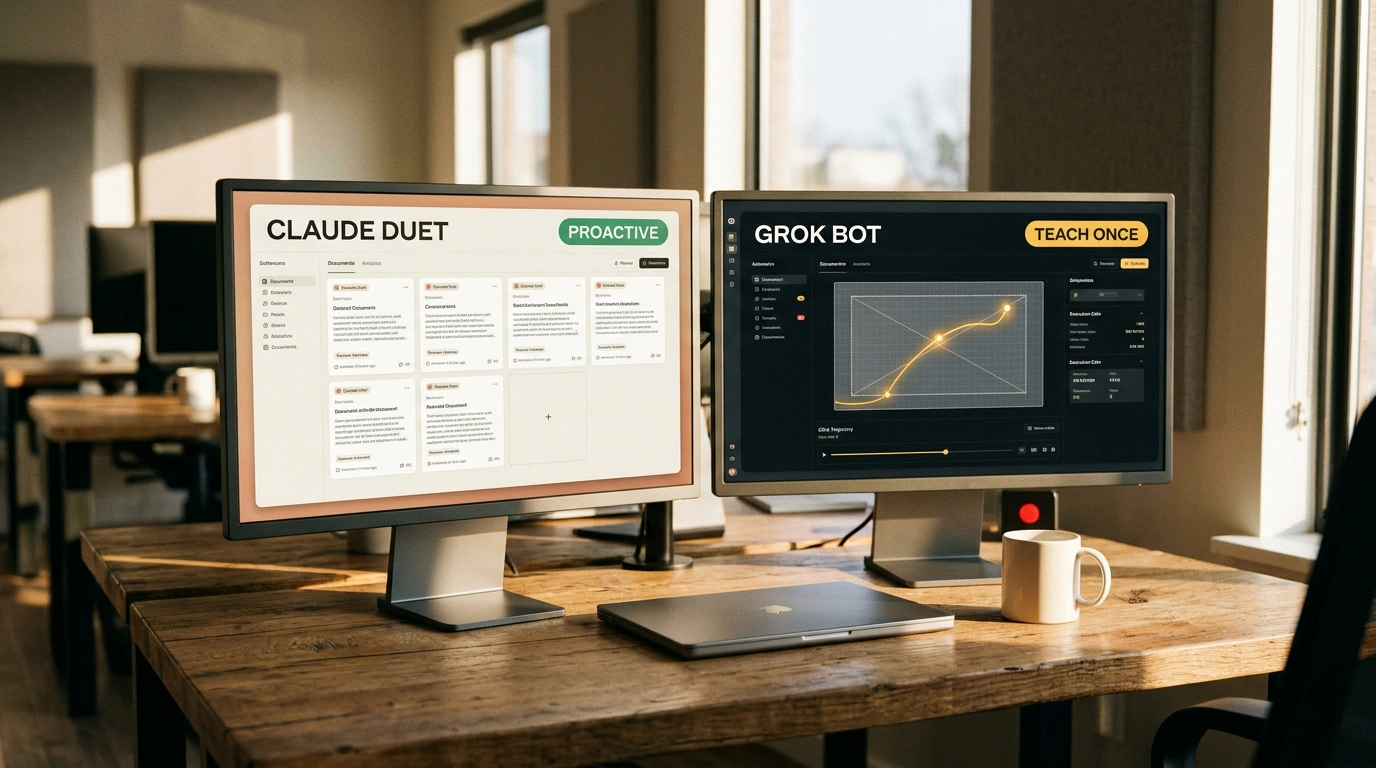
Think back to how we used AI for the last couple of years: you open a chat window, type a prompt, patiently wait thirty seconds for the model to print its reply, read through it, and type the next follow-up. You sit at your screen like a typewriter operator. Over the past two and a half months, however, the industry has undergone a tectonic shift that buries the very idea of the conversational chatbot.
In just 71 days, four of the largest labs on the planet rolled out products in a fundamentally new category—Cloud-hosted Desktop Agents:
- On August 11, xAI released Grok Bot;
- On September 8, Meta unveiled Muse;
- On September 29, OpenAI showed off Dots;
- On October 21, Anthropic struck back with Claude Duet, powered by Claude Opus 5.5.
This is no longer a Q&A window. It's a full-fledged virtual employee running on a dedicated computer in the cloud. You assign a complex task, close your laptop lid, and go to sleep. Meanwhile, the agent spends hours clicking through interfaces, compiling reports, cross-checking spreadsheets, and pinging you only when it needs your call on a key fork in the road.
Let's compare the two flagships of this new race—Anthropic's Claude Duet and xAI's updated Grok Bot—and look at how the division of office labor is changing.
Claude Duet's Architecture: A Personal Desktop in Anthropic's Cloud
The main difference between Claude Duet and the Claude you're used to in a browser is moving the execution environment off your device and onto a dedicated cloud virtual machine. When you give Duet a job, it spins up an isolated container with a full operating system, graphical desktop, browser, and filesystem.
Three fundamental capabilities flow from this architecture:
First, asynchronous autonomy. The agent no longer needs you online. You can send Duet to sort through a week's worth of invoices, shut down your laptop, and go for a walk. Inside the cloud container, it keeps opening pages, downloading PDFs, parsing tables, and filling out a summary sheet in Google Sheets.
Second, a proactive pattern ("Messages You First"). Until now, AI was always passive: it never spoke first. Claude Duet breaks that mold. In the morning, connected to your calendar and inbox, the agent messages you on its own: "Good morning! You have a partner meeting at 2:00 PM today. I pulled together a brief on their latest publications and drafted a deck. Take a look at the slides."
Third, seamless memory inheritance. Duet draws directly on your long-term Claude Memory, personal skills, and authorized services (Google Workspace, Slack, Jira). At the same time, the agent never sees raw passwords—it uses tokenized authentication backed by a continuous Sensitive Information Checker.
As we explored in our analysis of the Claude Cowork philosophy, Anthropic's core idea is to make the agent a teammate that handles the grunt work rather than a replacement for the human.
Grok Bot's Evolution: Speed, Voice, and the 'Teach Once' Paradigm
While Anthropic positions Duet as a thoughtful, meticulous corporate analyst, Elon Musk's team at xAI is betting on raw compute speed and practical, hands-on training.
First-person view of demonstrating a task to Grok Bot in Teach Once training mode on a laptop screen.
Grok Bot's October update brought three major upgrades:
- Threefold faster reaction time. The agent's UI interactions on screen are now nearly instant. Grok Bot reads visual page elements, switches tabs, and fills out fields at the speed of a seasoned QA tester, without unnatural pauses between clicks.
- Persistent memory and voice. You can now assign a task by voice straight from your phone while driving. The bot remembers your preferences across dozens of sessions without needing you to re-explain the context.
- The "Teach Once" paradigm. This is Grok Bot's strongest feature. Instead of writing elaborate prompts describing standard operating procedures, you simply turn on screen recording and slowly perform a routine task once by hand—say, logging into a supplier portal, downloading a reconciliation statement, renaming the file to match a template, and uploading it into your accounting software (like 1C). Grok Bot memorizes the sequence, converts it into an executable routine, and repeats it in the background every Monday. Zero APIs or scripts required.
As noted in our detailed comparison of Meta Muse and xAI Grok Bot, xAI's approach is built for knocking out everyday business and personal chores right here and now.
Battle of Approaches: Duet vs. Grok Bot
Let's put these two automation philosophies side by side:
| Parameter | Claude Duet (Anthropic) | Grok Bot (xAI) |
|---|---|---|
| Base model | Claude Opus 5.5 | Grok 3 / Grok Vision |
| Execution environment | Isolated cloud virtual machine | Cloud Action Sandbox with accelerated inference |
| Work style | Proactive analyst, deep documents | Pragmatic operator, screen automation |
| Process training | SOPs, prompts, and Claude Memory | On-screen demonstration ("do as I do") + voice |
| Security | Multi-layer audit, approval gates | Sandboxed action control, speed focus |
| Availability | Waitlist for Pro/Max plans (US) | X Premium / SuperGrok subscription |
If your job is reconciling ledgers, writing a detailed report, or auditing a legal contract with airtight wording, Claude Duet looks stronger thanks to the rigor of Anthropic's reasoning models. If you need to automate repetitive clicks in web tools that lack a proper API, Grok Bot's show-once screen training gets you there faster and with less friction.
No cloud-agent provider takes legal responsibility for what its AI does. Both Anthropic's terms of service and xAI's rules state clearly: any financial loss, deleted data, or outbound emails legally remain the account owner's actions. That's why critical steps—payments, file deletions, high-stakes emails—must always require explicit human approval.
Maturity Limits and Autonomous Assistant Traps
For all the early-adopter excitement, it pays to stay realistic about the technology's limits.
The main vulnerability of cloud agents is non-standard interfaces. If a site redesigns its buttons, pops up an unexpected cookie consent banner, or changes a modal layout, an agent can get stuck clicking empty space and burn right through your token quota.
The second issue is the illusion of full readiness. Right now, Claude Duet is rolling out in Research Preview with a strict waitlist for Pro and Max subscribers in the US. It's not a mass-market utility yet—it's the first clear signal of the shift ahead.
Still, the direction is unmistakable: the era of the plain text chat is winding down. We're moving into a world where every specialist has a personal virtual assistant with its own desktop, getting work done in parallel with you.
