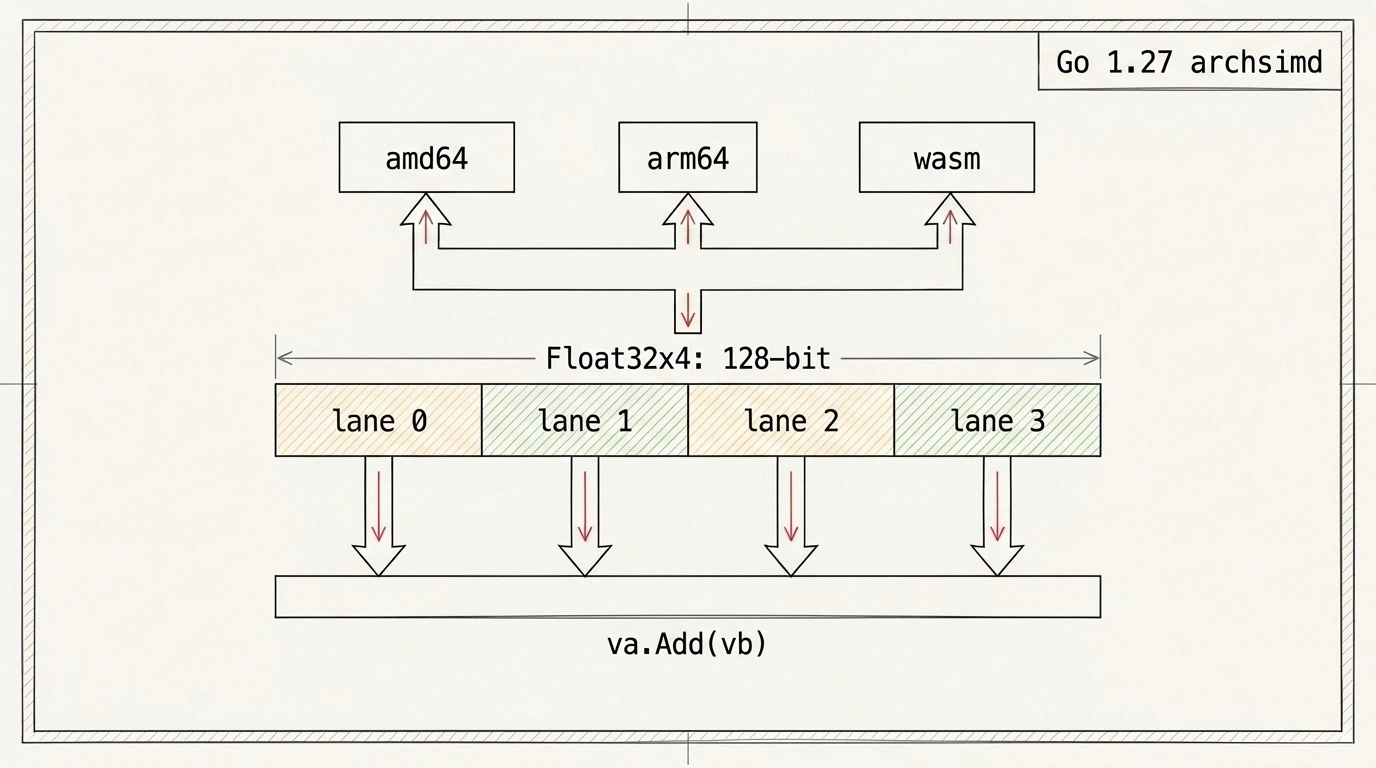
Go has always leaned into deliberate simplicity: you write clean, readable Go code, and the compiler does its best to turn it into fast machine instructions. Yet in heavy workloads—big data processing, JSON parsing, cryptography, search indexing, and multimedia—scalar loops eventually slam into the physical performance ceiling of a single CPU core.
For years, the only way to squeeze maximum throughput out of modern silicon in Go was writing Plan 9 assembly files (.s). That came at a steep price: the compiler couldn't inline assembly calls, static linters broke down, and maintaining multiple architectures (x86_64, ARM64, WebAssembly) turned into an endless chore of third-party code generation tools.
In the upcoming Go 1.27 release, the Go team led by Junyang Shao and David Chase has taken a major leap forward. The experimental vector-instruction API now has full support for ARM64 and WebAssembly.
Earlier, we covered how portable SIMD in Go 1.27 was shaping up for general-purpose algorithms. Now developers also get access to the low-level simd/archsimd package, letting you invoke hardware-specific CPU intrinsics directly from standard Go code.
Two-Tier Model: Portability vs. Raw Speed
To serve both camps—engineers who need broad portability and those chasing every last clock cycle—Go's architects built a two-tier design:
- High-level
simdpackage: offers portable math and logic operations (conceptually similar to C++'s Google Highway library). You write one vectorized algorithm, and it compiles for any CPU with vector registers. - Low-level
simd/archsimdpackage: gives you direct access to a specific chip's hardware capabilities. If your server supports AVX-512, NEON, or Wasm SIMD, you can call specialized instructions through strongly typed methods.
You opt into the experimental package with a build flag:
GOEXPERIMENT=simd go build
In Go 1.27, archsimd already spans three key targets:
amd64— SSE, AVX2, and AVX-512 vector extensions;arm64— 128-bit ARM NEON vector instructions (with architectural groundwork for scalable SVE and SVE2 extensions);wasm— the standardized 128-bit WebAssembly SIMD profile.
Strict Typing and Normalized Instruction Names
In C or C++, working with intrinsics famously scares newcomers away with cryptic header-file names like _mm512_mask_add_ps or _mm256_shuffle_epi8. Go's engineers brought the language's signature clarity and restraint to the API design.
Vectors are modeled as strongly typed, fixed-width structs:
Float32x4— four 32-bit floating-point numbers (128 bits);Int32x8— eight 32-bit integers (256 bits);Uint8x16— sixteen bytes (128 bits).
All operations are methods on these structs. Adding two vectors, regardless of the target CPU, is always written as va.Add(vb). Instead of opaque compiler mnemonics, you get readable verbs: shifting elements is ShiftAllLeft, bitwise AND is And, and finding the minimum is Min.
Under the hood, the Go compiler runs deep peephole optimizations. If you chain va.Add(vb).Masked(m), the optimizer folds the addition and bitmasking into a single predicated hardware instruction (such as VPADD on AVX-512).
You also get zero-cost bitcasts. Methods like ToBits(), ReshapeToUint32s(), or BitsToFloat32() reinterpret the data inside a vector register at compile time without emitting a single memory-copy instruction.
Subtle Semantic Differences: PermuteOrZero vs. LookupOrZero
The most fascinating part of simd/archsimd is how the Go team handled hardware differences across CPUs when indices go out of bounds (boundary semantics).
Comparative diagram of platform semantics for PermuteOrZero and LookupOrZero vector instructions when indices exceed table bounds.
Take a classic example: shuffling sixteen bytes by index. On Intel x86_64 CPUs, the VPSHUFB instruction behaves asymmetrically when an index goes out of range: if the high bit of the index is set (negative), the output byte is zeroed; if the index is positive but greater than 15, the CPU simply wraps it modulo 16. In Go on amd64, this operation is accurately named PermuteOrZero.
On ARM64 CPUs, NEON's equivalent VTBL instruction is stricter: if an index falls outside 0–15 in either direction (too high or negative), the output byte is always zeroed. WebAssembly's i8x16.swizzle behaves the exact same way.
To prevent developers from introducing silent bugs when porting an algorithm from an x86_64 server to an Apple Silicon Mac or browser WebAssembly, Go gives the ARM64 and Wasm operation a distinct name: LookupOrZero. Different names force you to be explicit about platform semantics.
And for AMD64 instructions that operate independently within 128-bit lanes inside wider 256-bit or 512-bit registers, Go appends the Grouped suffix (such as PermuteOrZeroGrouped).
//go:build goexperiment.simd

package main

import (
    "fmt"
    "simd/archsimd"
)

// VectorAdd performs parallel element-wise addition of two float32 slices
func VectorAdd(a, b, result []float32) {
    n := len(a)
    i := 0

    // Main loop: process 4 elements per vector iteration
    for ; i+4 <= n; i += 4 {
        va := archsimd.LoadFloat32x4(a[i:])
        vb := archsimd.LoadFloat32x4(b[i:])
        vr := va.Add(vb)
        vr.Store(result[i:])
    }

    // Tail handling when slice length is not a multiple of 4
    if i < n {
        va, _ := archsimd.LoadFloat32x4Part(a[i:])
        vb, _ := archsimd.LoadFloat32x4Part(b[i:])
        vr := va.Add(vb)
        vr.StorePart(result[i:])
    }
}
Look how clean the tail-handling code is above. LoadFloat32x4Part safely reads the remaining elements (from 1 to 3 floats), padding the unused vector lanes with zeros, and StorePart writes back only the bytes actually read—never touching memory past the end of the slice.
# Cross-compile for ARM64 (AWS Graviton servers or Apple Silicon)
GOEXPERIMENT=simd GOARCH=arm64 go build -o app-arm64 ./cmd/app

# Cross-compile for WebAssembly for high-speed browser compute
GOEXPERIMENT=simd GOOS=js GOARCH=wasm go build -o app.wasm ./cmd/app
Enabling GOEXPERIMENT=simd does not auto-vectorize ordinary for loops. You must structure your algorithm using vector types explicitly and always include a scalar fallback path for older CPUs that lack the required instruction set.
Where to Put the New API to Work
Low-level vectorization in Go opens huge opportunities for infrastructure software:
- Databases and analytics: bitmask scanning, column filtering, and aggregating millions of numeric values;
- Format parsers: UTF-8 validation, scanning for control characters in JSON, and protocol parsing without byte-by-byte loops;
- Cryptography and hashing: hardware-accelerated hashing and symmetric encryption routines;
- WebAssembly: bringing high-performance compute libraries to the browser without C++ or Emscripten.
Practical Takeaway
Go 1.27's simd/archsimd experiment proves that raw performance and readable code don't have to be enemies. We can finally tap into the full throughput of server hardware while keeping Go's familiar tooling, type safety, and effortless cross-compilation.