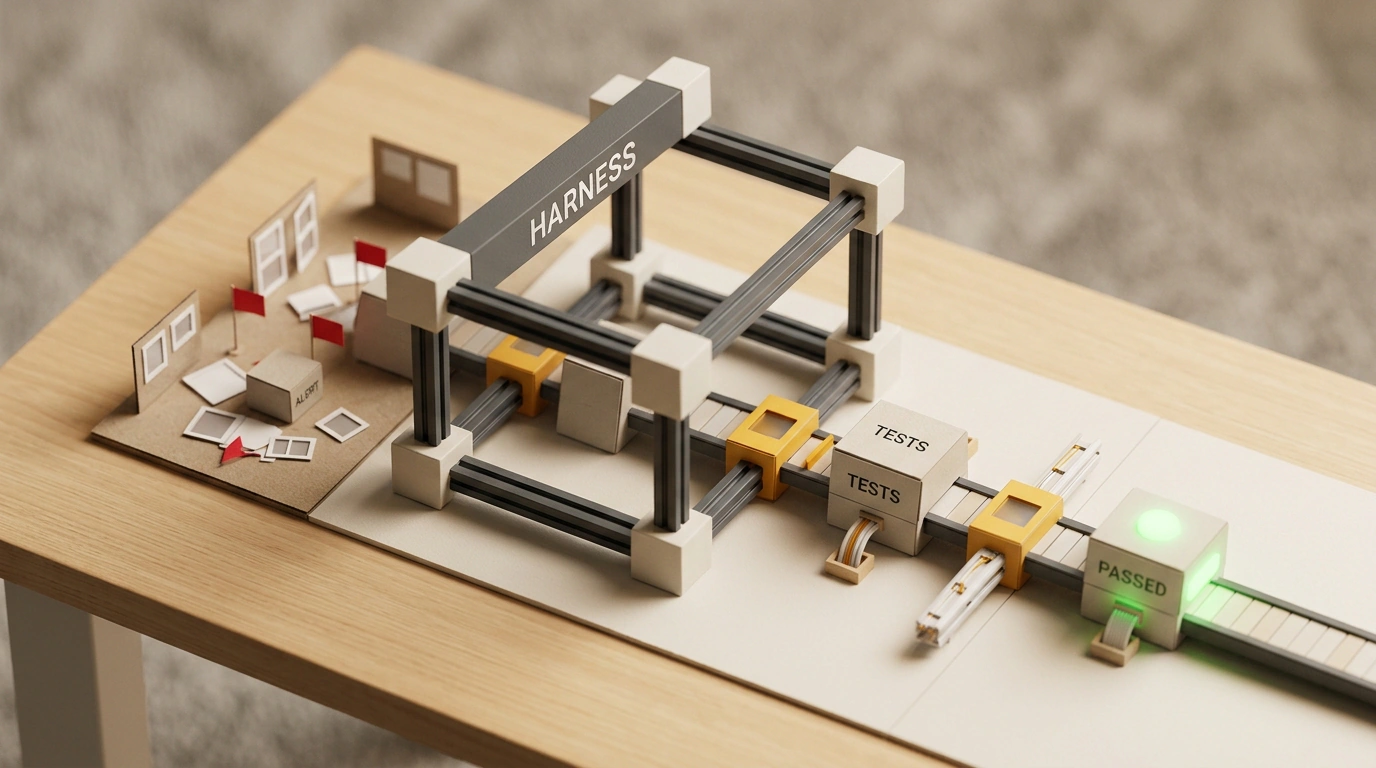
You've probably caught yourself feeling this weird kind of exhaustion at the end of a workday: you haven't written a single line of complex code by hand, a few coding-agent sessions were humming along in your terminal, commits were rolling in by the dozen, and yet your head feels like you just unloaded a truck full of servers. That's not ordinary fatigue—it's the classic "Fried Brain Effect" that engineers keep running into as they shift to multi-agent development.
For a long time, I couldn't figure out why the promised productivity revolution turned into exhausting micromanagement. We were sold a pretty picture: spin up five smart assistants, hand out tasks, and calmly sip your coffee. In reality, you turn into a jittery air-traffic controller: every two minutes, one tab wants you to approve git rebase, the second trips over a version conflict, the third hallucinates an API method, and the fourth quietly rewrites half your project's architecture. Your attention gets shredded, flow state evaporates, and output drops.
Let's peel back the glossy wrapper on the agent hype, look at the mechanics of this trap, and see how Google Research and the autonomous software factory community are breaking the cycle with self-improving Harness² scaffolding.
The Dispatcher Trap: Why Parallel Sessions Break Your Focus
The root of the problem is a fundamental biological constraint: the human brain is strictly single-threaded when solving complex engineering problems. We can focus deeply on one problem at a time, holding a dependency graph and edge cases in working memory. When you run parallel chat sessions, your brain drops into Context Thrashing—just like an overloaded OS spending almost all its cycles swapping memory pages instead of doing real work.
In the "AI Software Factory" concept developed by researcher Cole Medin, this contradiction is stated bluntly: human-level parallelization doesn't work. If an agent nudges you every three minutes to confirm the next step, it isn't saving your time—it's consuming all of it.
Every context switch between unrelated tasks costs an engineer 10 to 15 minutes to rebuild deep focus. Five active sessions generate up to 30 interruptions per hour, completely destroying your ability to spot subtle architectural flaws.
The way out is to ditch interactive babysitting. A mature workflow moves to upfront alignment and batch validation. You spend 15–20 minutes writing a tight spec, generating deterministic tests, and setting environment constraints, then send the agent into an autonomous loop for several hours. You don't watch intermediate logs—you only open the finished pull request once the agent has passed every check in an isolated branch.
As we already explored in our piece on agent loop architecture and loop engineering, the real productivity leap starts with a closed feedback loop. But that raises the next question: how do you teach an agent not to step on the same rake during long runs?
Brain vs. Harness: Where Reliability Actually Lives
For a long time, the default assumption was simple: to make an agent more reliable, just wait for the next base model from the big labs. Pay more for a giant LLM, and the problems will vanish.
However, a Google Research team in Harness²: Recursive Agent Harnessing for an Open World showed that the base model is just the raw "brain"—a general reasoning processor. What actually determines whether a task succeeds is its Agent Harness.
A harness brings together eight critical environment components:
- System prompt and role instructions.
- Guardrails and safety validators.
- Long-term memory space and accumulated experience.
- Specialized skills and operating procedures.
- Tool documentation and signatures.
- Helper executable scripts and environment hooks.
- A hierarchy of callable sub-agents.
- Middleware.
If a library's documentation is vague or the system prompt doesn't specify argument types, even a frontier flagship model will throw errors. But when the harness is tightly engineered, a light, fast model can easily outperform heavy closed systems.
Here's what a practical manifest for an autonomous agent harness looks like when isolating execution risks:
# agent_harness_config.yaml
version: "2.0"
agent:
  id: "software-factory-worker"
  base_model: "gemini-2.5-pro"
  temperature: 0.1
harness:
  max_autonomous_turns: 50
  reflection_cycle:
    enabled: true
    trigger: "on_task_completion"
    evaluation_benchmark: "internal_test_suite"
    persist_lessons_to: ".agents/memory/experience_log.json"
  guardrails:
    forbidden_commands:
      - "rm -rf /"
      - "git push --force origin main"
    budget_limit_usd: 15.00
    timeout_seconds: 7200
  tool_scaffolding:
    dynamic_guidance: true
    retry_on_syntax_error: 3
    verify_with_linter: true
Notice the guardrails section: the budget cap and timeout are enforced in hardware at the runtime level, not as polite requests in a system prompt. If an agent gets stuck in a loop, the system kills the process automatically.
Recursive Optimization in Harness²: Learning Without Touching Weights
The main breakthrough in Google Research's Harness² framework is an automatic dual-loop mechanism for recursively improving the harness itself.
Infographic diagram of the Harness² dual-loop self-learning cycle with task validation and documentation patching streams.
The first loop is Task-Level Recursion (Propose–Probe–Compose). Given a task, the system generates alternative ways to use tools and prompts, tests them on probing queries, and composes the best trajectory. Evaluation happens with zero human involvement, using objective signals: passing tests, clean compiler output, and API status codes.
The second loop is Harnessing-Level Recursion. Once a task finishes, a reflection module inspects the trace: where did a tool return a parameter error, and where did the model trip over data types? The framework then automatically patches the harness—adding edge-case hints to tool docs, updating self-check rules, and saving the lesson to long-term memory.
On the WorkBuddy-Bench office task suite, Harness² delivered a +11.5 point gain; on JobBench, +4.5 points; and on the legal benchmark LAB, +11.8 percentage points while cutting tool-call errors by 36%—all without changing a single weight in the base model.
Below is an example Python reflection module that tracks execution traces and updates the system's lessons log:
"""
Recursive agent harness reflection module (Harness Reflection Loop).
Analyzes execution traces, catches tool-call errors,
and updates system documentation without modifying model weights.
"""
from dataclasses import dataclass
from typing import List, Dict, Any
import json
import os

@dataclass
class ExecutionTrace:
    task_id: str
    tool_calls: List[Dict[str, Any]]
    errors_encountered: List[str]
    success: bool

class HarnessOptimizer:
    def __init__(self, memory_path: str):
        self.memory_path = memory_path
        os.makedirs(os.path.dirname(self.memory_path), exist_ok=True)

    def analyze_trace_and_adapt(self, trace: ExecutionTrace) -> Dict[str, str]:
        improvements: Dict[str, str] = {}
        if not trace.success or trace.errors_encountered:
            for error in trace.errors_encountered:
                if "parameter mismatch" in error.lower():
                    improvements["tool_guidance"] = (
                        "Warning: strictly verify API argument types before calling. "
                        f"Recorded error: {error}"
                    )
            lesson = {
                "task_id": trace.task_id,
                "errors": trace.errors_encountered,
                "updates": improvements
            }
            self._save_lesson(lesson)
        return improvements

    def _save_lesson(self, lesson: Dict[str, Any]) -> None:
        with open(self.memory_path, "a", encoding="utf-8") as f:
            f.write(json.dumps(lesson, ensure_ascii=False) + "\n")
As you can see, instead of endless manual prompt tweaking, the harness patches its own bottlenecks. As noted in our look at harness engineering and self-learning agents, environment evolution is becoming the main driver of reliability in autonomous systems.
Don't inspect an agent's intermediate commits on the fly. Set up a local CI pipeline so the agent runs linters, executes tests, and writes a change summary on its own. Your review should only begin once every automated check is green.
Where Autonomy Draws the Line
Recursive harnesses show strong reliability on deterministic tasks with tight feedback: legacy refactoring, test coverage, isolated microservice generation, and database schema migrations. In all of these, the compiler and test suite act as an objective referee.
In open-ended product decisions, though, an agent left without human judgment quickly starts optimizing made-up metrics or piling on unnecessary abstractions. That's why the architect's role stays yours: defining goals, setting boundaries, and validating the final result. As for chasing syntax errors and keeping environments in sync, it's time to hand that grind over to solid harnesses.