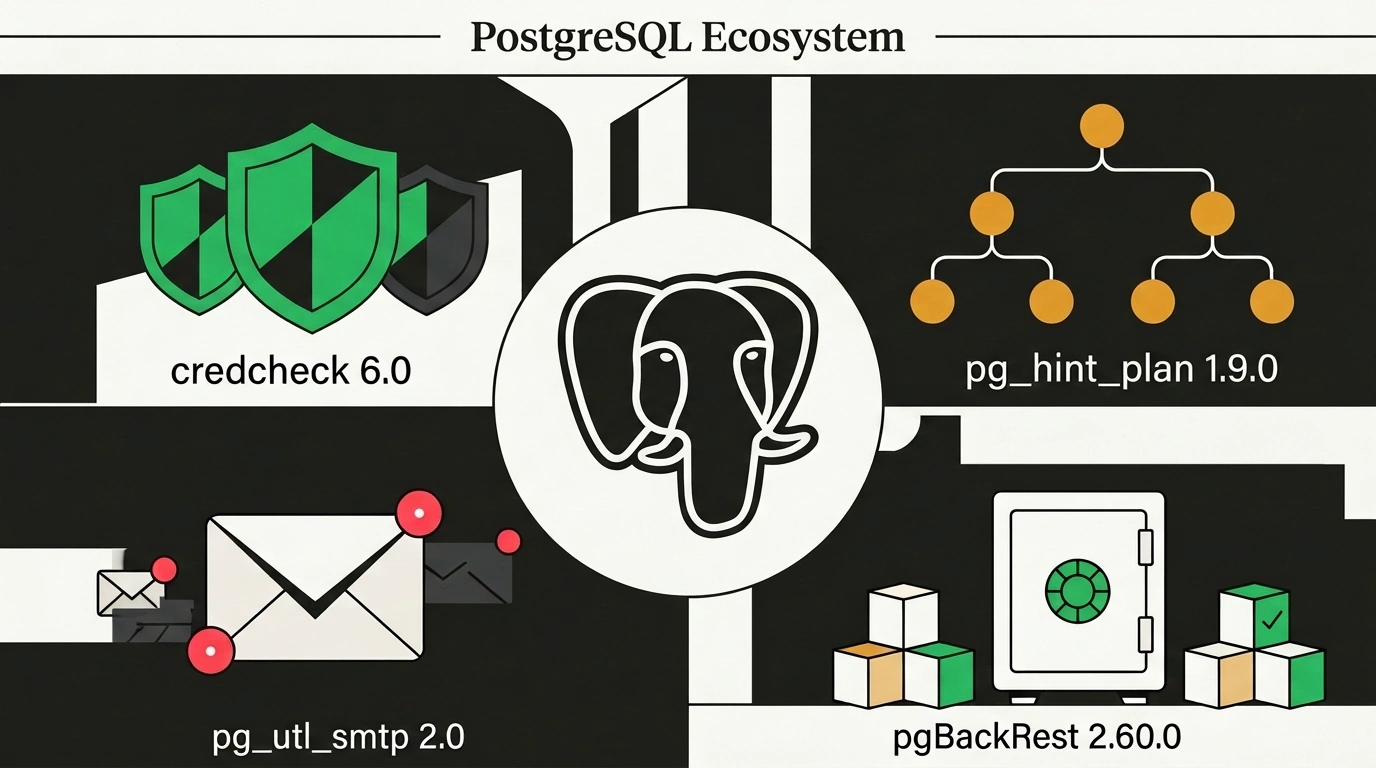
When we talk about PostgreSQL's reliability and flexibility, we rarely mean just the database engine itself. Postgres's real superpower lives in its rich architecture of extensions and companion utilities. Thanks to internal hooks and shared libraries, engineers can tailor the database to the strictest enterprise requirements—from PCI DSS security auditing to directly steering the query planner. Recently, the PostgreSQL community rolled out a synchronized wave of updates for four core admin tools, fixing several long-standing operational headaches at once.
Let's walk through what these new releases bring to the table and how they strengthen production clusters.
credcheck 6.0
Created by Gilles Darold (HexaCluster), credcheck has long been the de facto standard for projects that need strict account auditing: password complexity checks, brute-force lockouts, and session tracking in the spirit of classic Unix wtmp files and the last(1) command.
The headline feature of 6.0 is full integration of max_auth_failure with the PgBouncer connection pooler. Previously, running PgBouncer in transaction pooling mode meant failed login interception often misfired or failed to block an attacking IP in time. Now auditing works seamlessly. On top of that, password history storage has been moved to a memory-mapped file (mmap), slashing memory overhead.
There is also a handy pg_check_password() function for validating password strength directly from client code:
-- Upgrade the extension version in the cluster
ALTER EXTENSION credcheck UPDATE TO '6.0';

-- Check a candidate password without modifying account settings
SELECT pg_check_password('analyst_user', 'Str0ng!P@ssw0rd2026');

-- Set minimum password validity (in days) for new roles
SET credcheck.password_valid_min = 7;
Because credcheck hooks into core internals and loads via shared_preload_libraries, running ALTER EXTENSION alone isn't enough—you'll need a full PostgreSQL service restart (pg_ctl restart) to load the updated shared library.
pg_hint_plan 1.9.0
PostgreSQL's query optimizer relies on a cost-based model, but on complex analytical joins spanning hundreds of thousands of rows, statistics can occasionally steer it wrong. In those moments, pg_hint_plan lets you pin the exact execution plan using special comments inside your SQL query.
Release 1.9.0 adds official support for the upcoming PostgreSQL 19 branch, introduces new Path Generation Strategies (PGS), and fixes a long-standing parser infinite-loop bug on multi-statement strings:
-- Force an index scan and a HashJoin
/*+
    SeqScan(t1)
    IndexScan(t2 t2_created_at_idx)
    Leading((t1 t2))
    HashJoin(t1 t2)
*/
SELECT t1.id, t1.name, t2.status, t2.created_at
FROM orders t1
JOIN order_events t2 ON t1.id = t2.order_id
WHERE t2.created_at >= '2026-10-01';
For teams already testing service compatibility against PostgreSQL 19 RC, this is a critical update. We previously covered the broader momentum in PostgreSQL Ecosystem Pulse: PgBouncer Security Patches, ODBC Protection, and Fresh Utilities, and this batch of updates continues that exact trajectory.
pg_utl_smtp 2.0
The pg_utl_smtp extension started as part of the open-source HexaRocket migration stack, built to ease migrations from proprietary databases like Oracle and Microsoft SQL Server to PostgreSQL. Those platforms heavily relied on UTL_SMTP packages and sp_send_dbmail to fire off system email notifications straight from triggers and stored procedures.
Version 2.0 brings the long-awaited pg_utl_smtp.asynchronous setting. Sending notifications no longer blocks the active transaction—messages go into a local non-blocking queue instead. It also adds full TLS encryption support right before the SMTP handshake, letting you connect directly to corporate mail gateways without insecure intermediate relays.
pgBackRest 2.60.0
For physical backups of multi-terabyte databases, pgBackRest remains the undisputed gold standard. Version 2.60.0 introduces a fundamental safeguard for data integrity: the checksum-page-error option.
Previously, if a restore encountered a block with a corrupted page checksum, the utility could keep restoring data anyway, leaving the admin unaware of silent filesystem degradation. Now, pgBackRest immediately halts the restore with a critical error by default, preventing a damaged cluster from ever booting into production. The release also adds Workload Identity Federation authentication for Google Cloud Storage (GCS) and support for OpenSSL 4.
Taken together, these synchronized releases show exactly where the ecosystem is heading: tighter data-security guarantees, replacing synchronous locks with queues, and getting core infrastructure tools ready for PostgreSQL 19. If you manage production databases, now is a great time to schedule these utility upgrades into your next maintenance window.