If you've ever tried stitching together a handful of AI tools to automate your workday, you know how fast the whole thing turns into a headache. One agent lives in a terminal window, a second generates images in a browser tab, a third checks code in your editor—and you're stuck playing human glue, copy-pasting context back and forth.
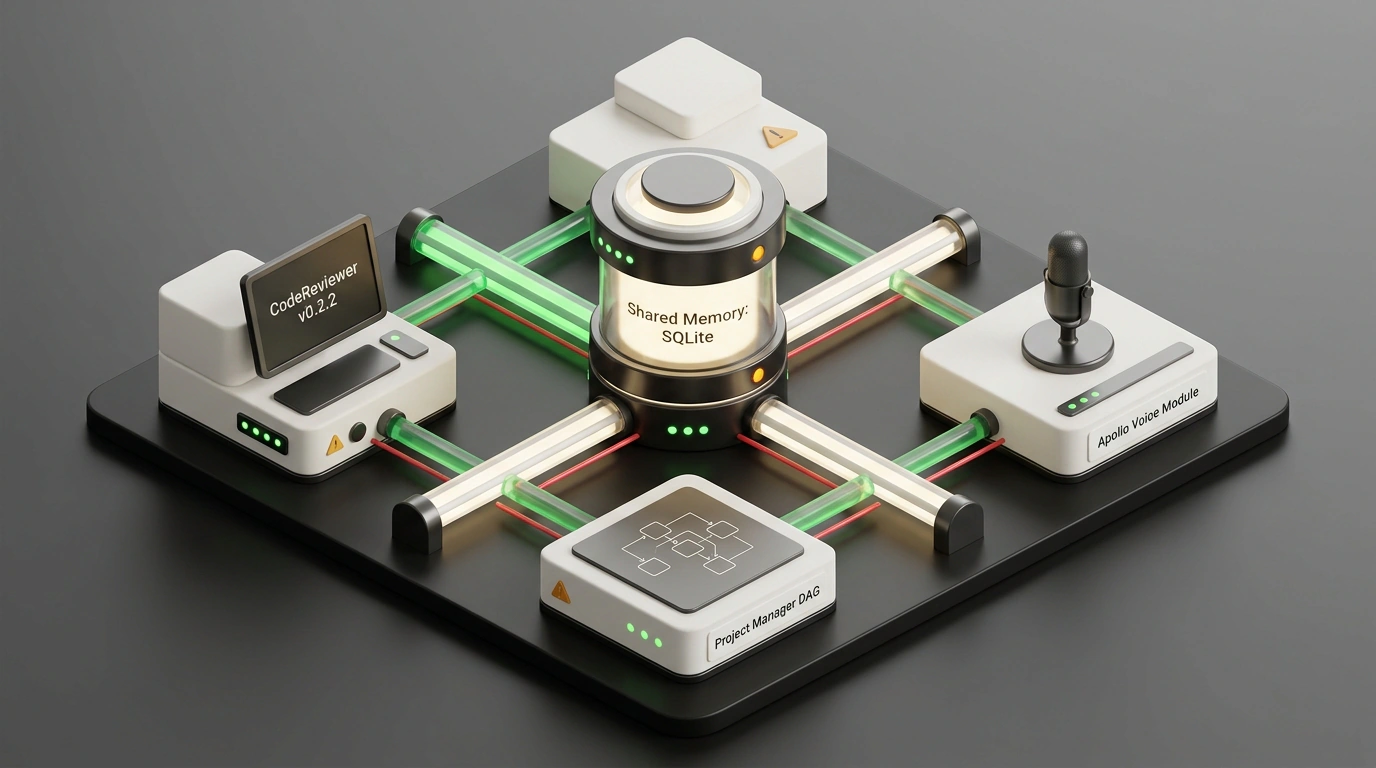
Research lab Nous Research has been methodically building an antidote to that chaos: the open-source modular platform Hermes Agent. Instead of scattered scripts, they offer a full operating environment for agents (Agent OS), where every digital assistant has a defined role, shared memory, and a standardized toolset. The latest wave of updates brings four major pieces of the ecosystem together.
A Single Command Center
Agent OS is built around one simple idea: working with AI shouldn't force you to hop across dozens of browser tabs. As Julian Goldie SEO demonstrates in his walkthroughs, Hermes spins up a unified command center.
The platform's biggest architectural win is its Shared Memory Bus backed by local SQLite. When a research agent uncovers a key project detail, that context becomes instantly available to the coding agent and the copywriting agent—no extra prompting required.
Each agent in the system is defined by a concise declarative config file that spells out its permissions and available tools:
# agents/developer_agent.yaml
name: "CodeReviewerAgent"
version: "0.2.2"
role: "Senior Code Quality Inspector"
model:
  provider: "nous_hermes"
  name: "Hermes-3-Llama-3.1-8B"
  temperature: 0.1
memory:
  shared_bus: true
  persistence: "local_sqlite"
tools:
  - "terminal_executor"
  - "git_diff_inspector"
  - "linter_runner"
permissions:
  require_confirmation_for: ["git_push", "rm_rf"]
That permission isolation protects you from accidental destructive commands in the terminal. We've tracked this concept's earlier steps in our look at the evolution of Hermes Agent OS, and this release puts practical stability front and center.
The Threshold v0.2.2 Release
The Nous Research team calls v0.2.2 a threshold release—the jump from experimental prototypes to production-ready use.
Here is what changed under the hood:
- Native llama.cpp support: you can now run the entire agent stack 100% locally without sending a single byte to external cloud APIs.
- Signed desktop builds: the installer no longer forces you to compile dependencies from source for every operating system.
- Parallel session conflict resolution: when multiple agents run side by side, the state database cleanly isolates intermediate task variables.
Thanks to a modular tool registry, extending the system takes just a few lines of Python:
from hermes_agent.tools import BaseTool, tool_registry

class SystemAuditTool(BaseTool):
    name = "audit_system_resources"
    description = "Checks available RAM, CPU load, and GPU memory for agent orchestration."

    def execute(self) -> dict:
        import psutil
        return {
            "cpu_percent": psutil.cpu_percent(interval=1),
            "ram_available_gb": psutil.virtual_memory().available / (1024 ** 3),
            "status": "ready"
        }

tool_registry.register(SystemAuditTool())
print("Hermes tool registered successfully.")
Voice Interface and Screen Context
Text-only interaction often adds needless friction. That's why Hermes now integrates the multimodal voice module Apollo.
This isn't basic speech-to-text dictation. Apollo runs in real time with under 300 milliseconds of response latency and, more importantly, continuously reads your screen's video buffer alongside your voice.
You can simply say into your mic, "Look at the right column of that table and tell me why the total doesn't add up," and the agent immediately understands what's on your screen—no manual screenshots or copy-pasting numbers into a chat box.
Autonomous Task Decomposition
The final piece of the puzzle is the Project Manager coordinator.
Ordinary chatbots fall apart when handed a multi-step request like "run a competitive price analysis, update the config file, and write a summary report in Markdown." They either drop half the requirements or time out.
Hermes's Project Manager intercepts the high-level goal, breaks it into a directed acyclic graph (DAG) of subtasks, and dispatches each one to a specialized agent. If a step fails, the coordinator reroutes it to a fallback worker or asks you for clarification without losing overall progress.
Bottom Line: A Battle-Ready Toolkit
The Hermes ecosystem makes one thing clear: the days of isolated AI scripts are fading. By combining a unified memory bus, a rock-solid local engine, live screen awareness, and role coordination, the open-source community now has a serious alternative to locked-down enterprise agent platforms.
