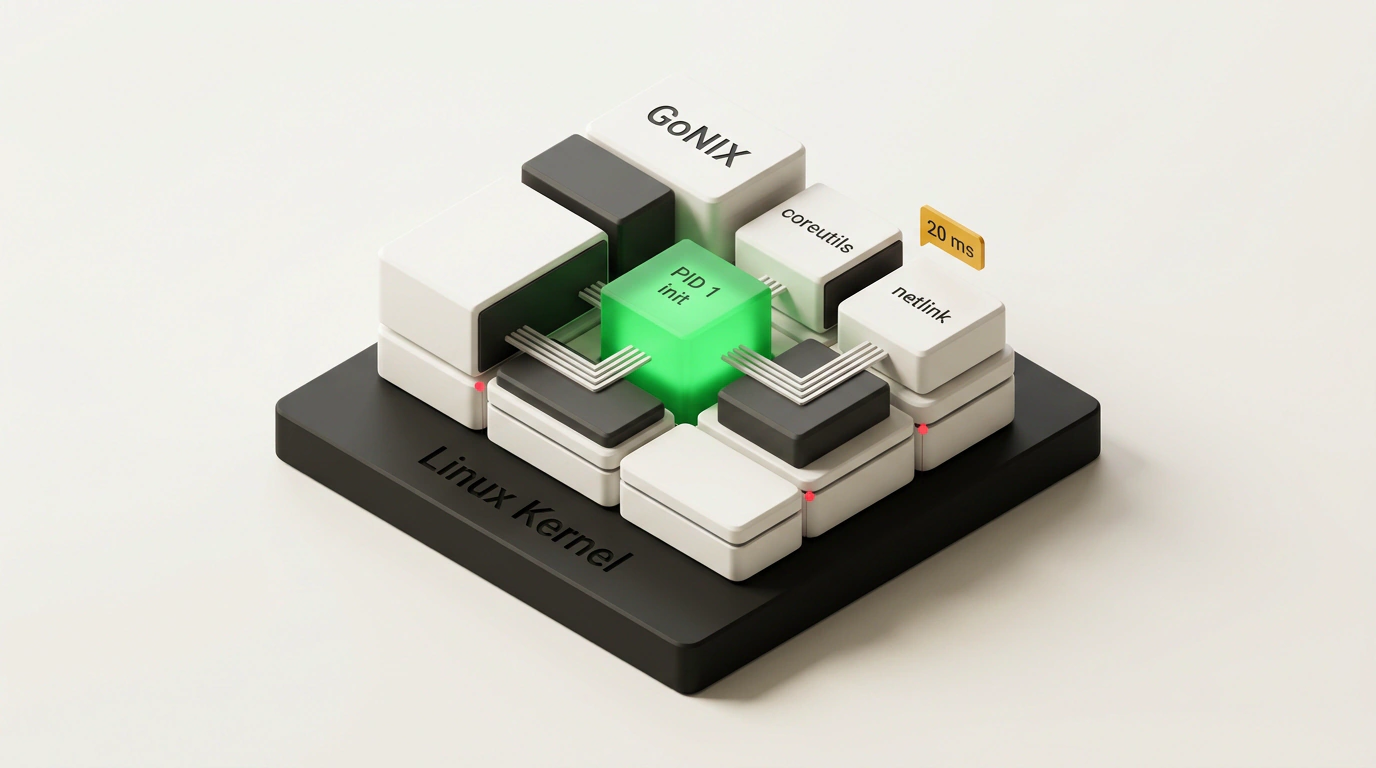
Anyone who has ever built a minimal Linux image for Docker or tuned a VM for a microservice knows the usual starter kit: the Linux kernel, the compact musl standard library, the BusyBox Swiss Army knife, and a pile of shell scripts gluing everything together. That architecture has been around for decades, and it feels like there's nothing left to reinvent. Yet the classic C-based stack carries plenty of legacy baggage: brittle bash scripts during init, manual memory management in system utilities, and the constant specter of buffer overflows.
Recently, an intriguing project caught the attention of systems engineers: GoNIX (official site gonix.dev). Its creators asked a radical question: what if we keep the standard Linux kernel for hardware support and virtualization, but strip C out of userspace entirely and rewrite all core components in Go?
I dug into the distro's architecture, and I have to admit: the concept is surprisingly cohesive and practical.
How a C-Free Userspace Works
In GoNIX, there's no systemd daemon, no sprawling /etc/init.d/ scripts, and no tools like udev. Almost every system building block is statically compiled in Go:
- The init process (PID 1). The very first process the kernel hands control to is written in pure Go. It mounts pseudo-filesystems (
/proc,/sys,/dev), initializes base directories, manages service lifecycles, and cleanly reaps child process exit signals. Noshorbashinterpreter ever spawns during boot—the init logic is strictly typed and executes as native machine code. - A single multicall
coreutilsbinary. Much like BusyBox, dozens of standard commands (ls,cat,cp,ps,mkdir,kill) are packed into a single executable and exposed via symlinks. This drastically cuts down the binary size overhead of the Go runtime. - Direct kernel communication over netlink. To bring up networking, configure routes, or run the built-in DHCP client, GoNIX doesn't shell out to
iproute2utilities. The code talks directly to the kernel's networking subsystem overnetlinksockets. - Built-in SSH server. Instead of heavyweight OpenSSH or Dropbear, the system embeds a lightweight SSH daemon built on the standard
golang.org/x/crypto/sshpackage.
On top of that, the developers implemented zero-copy initramfs handling: a writable filesystem layer sits over the base image without duplicating files in RAM. The result? Going from kernel handoff to a login prompt takes roughly 20 milliseconds.
Why It Matters: Micro-VMs and Serverless
You might reasonably ask why anyone would bother when Alpine Linux with BusyBox is already just a few megabytes. The answer is that modern infrastructure is steadily shifting away from long-lived, heavyweight VMs toward ephemeral micro-VMs (powered by Firecracker, Cloud Hypervisor, or QEMU). In those environments, cold-start time and memory safety are everything:
- Memory safety. System utilities and daemons written in Go are immune to classic buffer-overflow and pointer-corruption vulnerabilities. Auditing an entire OS written in a single, strongly typed language is orders of magnitude clearer. Earlier, we explored how deep Go's concurrency primitives go in C: recreating the goroutine scheduler, channels, and RCU, and moving userspace to pure Go frees developers from juggling raw pointers and safety by hand.
- Built for single-microservice images. You can assemble a minimal ISO or disk image containing just the kernel, GoNIX init, and your own Go binary. You end up with something very close to a unikernel, but with the standard, predictable behavior of the Linux kernel.
There's no free lunch, and choosing Go comes with costs. First, every standalone Go binary carries its own runtime and garbage collector, so small Go daemons will consume more RAM than their C/musl equivalents. Second, to run traditional C software (like browsers or databases), GoNIX relies on a pkg package manager that compiles packages against musl libc from the pkgs.ulinux.org repository.
The project supports amd64 and arm64, boots cleanly in QEMU, and can even spin up a graphical desktop powered by the lightweight Wayland compositor labwc. If you want to poke around without installing anything, the authors host a public demo server—just run ssh root@gonix.dev in your terminal. It's a great example of how rethinking the base architecture lets you squeeze maximum speed out of a familiar kernel.