If you've ever left an autonomous coding agent running in a loop, you know that sinking feeling when your API balance evaporates in real time. Feed a model a couple dozen files and ask it to rewrite authentication logic with tests, and flagship models like Claude 3.5 Sonnet or Claude Opus burn through a whole day's token budget in two or three runs.
That's why the post-trained checkpoint DeepSeek-V4.1-Flash-1017, dropped on October 17, 2026, caused such a stir among developers. I decided to look closely at whether its claims of rapid app assembly hold up—and whether it can genuinely serve as a dirt-cheap alternative to the established heavyweights.
A Million Tokens and a 50x Price Gap
The specs on this update are striking: the team kept a massive 1-million-token context window (with 99.8% accuracy on Needle-In-A-Haystack retrieval) while radically slashing latency. The first token arrives in just 140 milliseconds, and raw code generation tops 120 tokens per second. In agentic workflows, that speed changes everything: the agent stops stalling mid-thought when it needs to scaffold a UI quickly.
In a benchmark test by Julian Goldie SEO, the model was handed a practical assignment: build a client service portal complete with a dynamic pricing calculator, tier forms, and interactive 3D elements powered by Three.js.
Here is where the economics get wild:
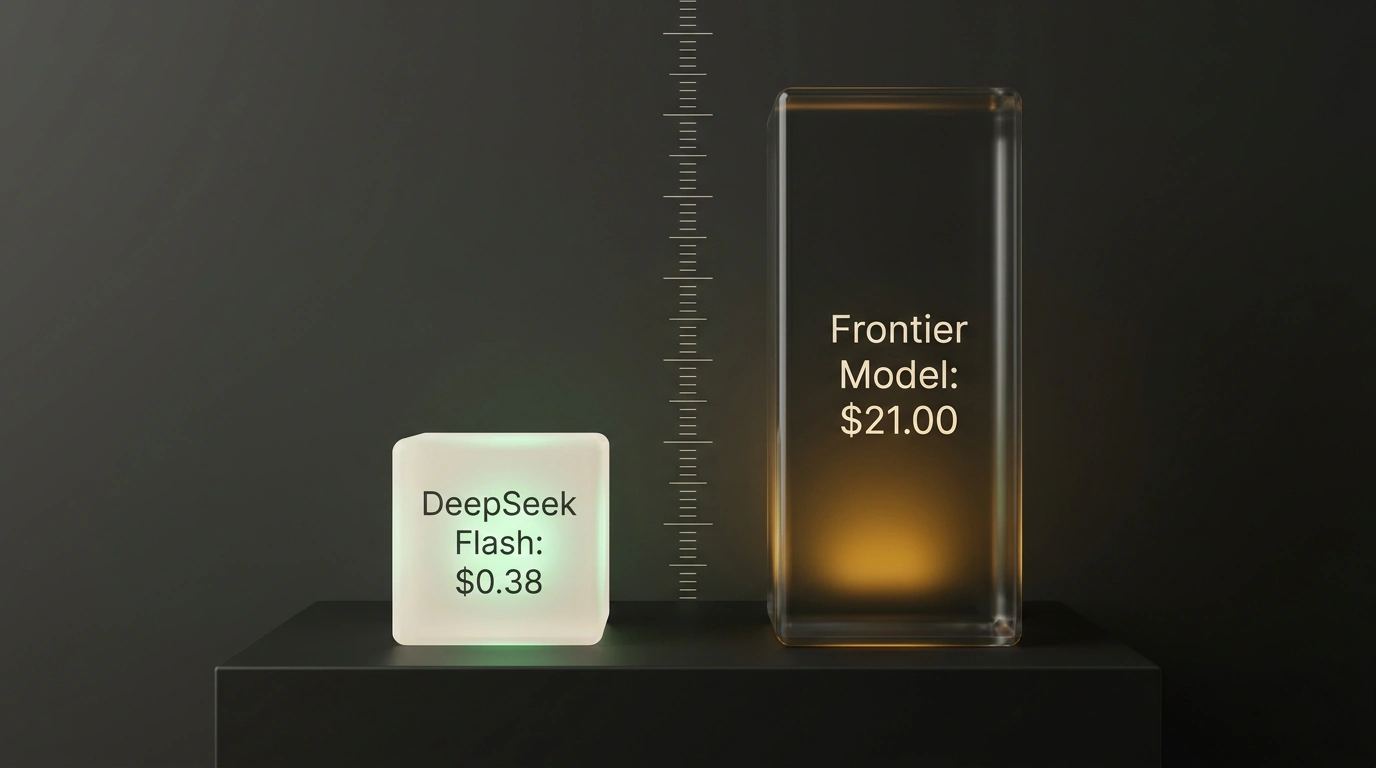
- Building three complete app variations through Flash 1017 used exactly $0.38 worth of tokens (thirty-eight cents!).
- The same volume of prompts and synthesized code on flagship models like Claude Opus or GPT-4o ran over $21.00.
That's more than a 50x difference in cost. It's a direct continuation of the trend we looked at in our piece on DeepSeek's aggressive model pricing: routine prototyping is no longer gated behind massive API budgets.
Running Generation via API and Wiring It Into an Agent
The model is fully compatible with the OpenAI API standard, so you can call it using standard client libraries without rewriting your stack:
import os
from openai import OpenAI

client = OpenAI(
    api_key=os.environ.get("DEEPSEEK_API_KEY"),
    base_url="https://api.deepseek.com/v1"
)

response = client.chat.completions.create(
    model="deepseek-v4.1-flash-1017",
    messages=[
        {
            "role": "system",
            "content": (
                "You are an expert full-stack developer. Generate production-ready "
                "standalone single-page applications using Tailwind CSS and Alpine.js. "
                "Output clean, modular code with complete error handling."
            )
        },
        {
            "role": "user",
            "content": "Create a modern client billing portal with package selector, pricing calculator, and mock Stripe checkout."
        }
    ],
    temperature=0.2,
    max_tokens=8192
)

print(response.choices[0].message.content)
And if you're running multi-agent operating environments like Hermes Agent OS, you can register the model as a fast worker for routine tasks right in your config file:
# config/models/deepseek_flash_1017.yaml
model_id: "deepseek-v4.1-flash-1017"
provider: "deepseek"
endpoint: "https://api.deepseek.com/v1"
context_window: 1048576
max_output_tokens: 8192
pricing:
  prompt_per_million: 0.14
  completion_per_million: 0.28
parameters:
  temperature: 0.2
  top_p: 0.95
capabilities:
  tool_calling: true
  streaming: true
  vision: false
A Reality Check: Where to Save and When to Call the Heavy Hitters
Does this mean it's time to retire Claude Opus? Not at all. Let's stay realistic.
Flash 1017 shines as a daily workhorse: throwing together layouts, wiring up a calculator script, spinning up a web service prototype in five minutes, or running a first-pass function audit. But when your task calls for abstract business logic, tricky math, or designing a fault-tolerant distributed architecture, Opus's deep reasoning still has no real rival.
The sweet spot today is a hybrid setup: keep Flash 1017 on tap for rapid iterations and routine coding, and bring out the expensive artillery selectively when you hit tough architectural forks.
