If you have ever run an autonomous coding agent across a large codebase, you already know the main headache. Heavyweight closed models like Claude Opus or top-tier GPT variants write thorough code, but they move at a leisurely pace and burn through your API balance like a sports car on afterburner. Kick off an automated bug-hunting loop across a couple hundred files, and your daily quota vanishes. Lightweight models, on the other hand, usually stumble over syntax errors, mix up types, and get stuck in endless hallucination loops.
Chinese research lab DeepSeek just pulled off a move that shook the industry. On October 17, 2026, they released the DeepSeek-V4.1-Flash-1017 checkpoint and immediately open-sourced their production inference engine DeepInfer under the Apache 2.0 license. The result is a potent combination: a lightweight Mixture of Experts (MoE) model tuned for "wish-driven programming," paired with a low-level inference server built to squeeze every drop of performance out of the hardware.
Why Flash 1017 Beats Flagships on SWE Benchmarks
Let's look under the hood at why a compact model suddenly outperforms massive closed systems. On automated bug-fixing benchmarks like SWE-bench and Mini-SWE, heavyweight models often suffer from "overachiever syndrome." They spend tens of thousands of tokens on internal monologue, philosophize about architectural trade-offs, and try to rewrite half the neighboring modules instead of cleanly patching two lines in the broken function.
The Flash 1017 checkpoint was trained with a strict penalty for unnecessary chatter. It behaves like a seasoned on-call engineer on the night shift: it quickly isolates the failing stack trace, checks edge cases, and produces a minimal, syntactically tight diff. In benchmark runs, it builds working web services in minutes for pennies compared to competitors. We already spotted this trajectory in DeepSeek V4.1 Flash 1017: Faster App Builds and Cost Comparison Against Claude Opus, and now that software checkpoint comes backed by a serious infrastructure engine.
DeepInfer Architecture: Inside the Engine
Until now, the de facto standard for self-hosting open models has been vLLM or TensorRT-LLM. Both are powerful, yet general-purpose—which inevitably means carrying architectural compromises. DeepSeek took a different route: in the deepseek-ai/DeepInfer repository, they published the exact code powering their own public API.
Macro photograph of a specialized DeepInfer inference accelerator showing parallel memory chips and compute buses
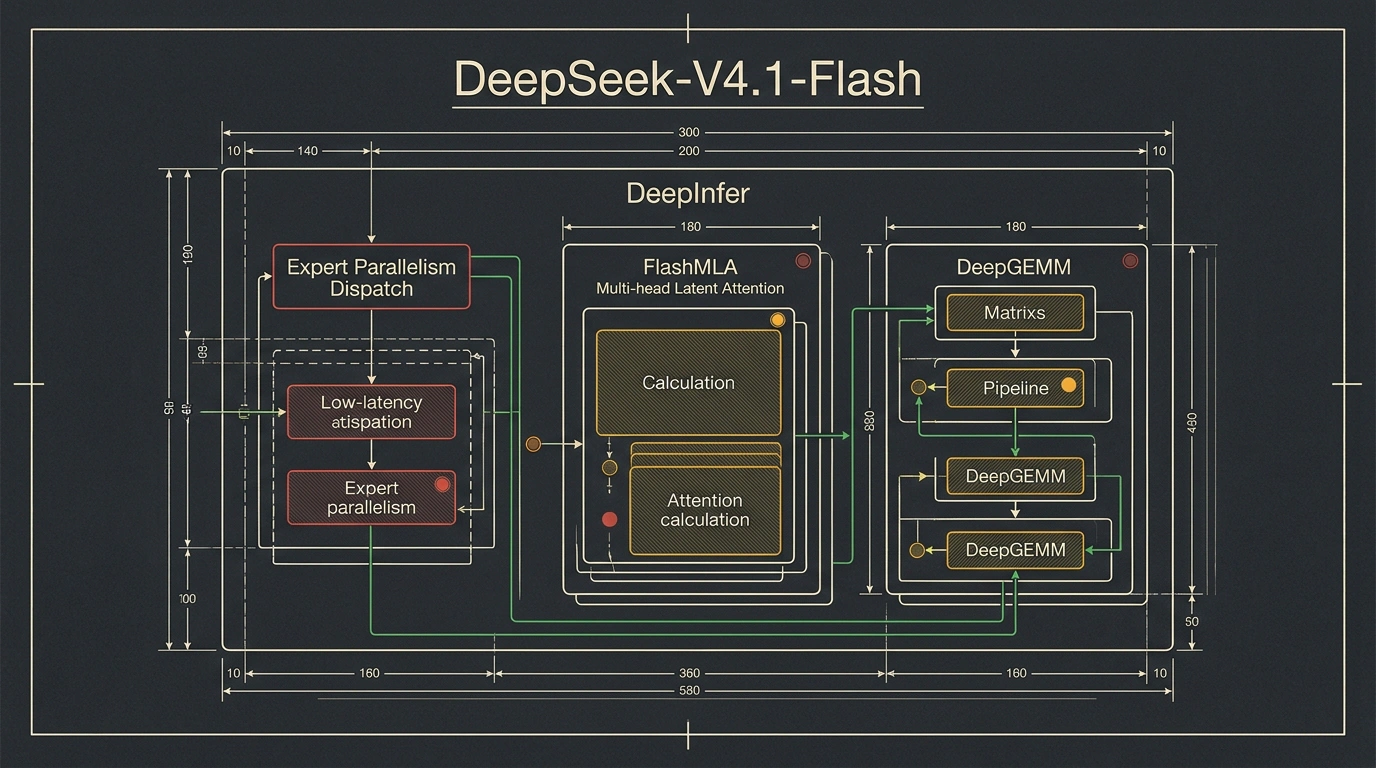
The biggest bottleneck when serving thousands of concurrent requests to MoE models is GPU memory fragmentation and inter-chip communication overhead. DeepInfer tackles this with a suite of custom low-level libraries:
- FlashMLA: custom kernels for Multi-Head Latent Attention that drastically cut memory consumption for key-value matrices;
- DeepGEMM and DeepEP: high-speed matrix multiplication routines and an Expert Parallelism protocol that keeps weight transfers across NVLink razor-fast;
- TileLang and TileKernels: a specialized tile compilation language tailored directly for tensor core architectures.
The engine ships with native optimizations for NVIDIA's newest Blackwell SM100 accelerators (B200 and GB200 racks) as well as Huawei Ascend 950 chips. For developers building terminal-based tools, this opens huge doors—we previously covered the autonomous environment in The OpenCode 2.0 Ecosystem: An Open Terminal Agent and Fast Model Integration, and DeepInfer pushes local inference into industrial territory.
Here is how generation looks through DeepInfer's Python API with explicit expert parallelism:
import deepinfer
from deepinfer import EngineConfig, MoEParallelConfig

# Distributed inference configuration for Flash 1017
config = EngineConfig(
    model_path="deepseek-ai/DeepSeek-V4.1-Flash-1017",
    tensor_parallel_size=4,
    moe_parallel_config=MoEParallelConfig(
        expert_parallel_size=8,
        load_balancer="EPLB",          # Dynamic expert load balancing
        enable_flash_mla=True
    ),
    kv_cache_dtype="fp8_e5m2",         # 8-bit KV-cache quantization
    max_batch_size=128
)

engine = deepinfer.InferenceEngine(config)

# Generation with strict grammar constraints
output = engine.generate(
    "Напиши lock-free очередь на C++20 с использованием std::atomic",
    temperature=0.2,
    structured_grammar="json_schema"
)
print(output.text)
DeepInfer includes DSpark, a mechanism that uses adaptive confidence scheduling for speculative token generation. Even with speculative decoding active, the engine guarantees bit-for-bit identical output for a fixed seed on NVIDIA hardware—a crucial property for regression testing generated code.
Caveats and Practical Boundaries
Before you rush to spin up DeepInfer on your production server, keep the project's current scope in mind. Right now, it is built primarily for offline batching and high-throughput queues.
The current release does not include a built-in HTTP daemon supporting the OpenAI API spec (/v1/chat/completions). To wire the engine into a web service, you will need to build your own wrapper in FastAPI/Rust or use the deepseek-recipe library. Also, running distributed MoE across multiple nodes requires high-speed RDMA/InfiniBand networking—standard gigabit Ethernet will immediately choke on inter-expert traffic.
Even with those caveats, open-sourcing DeepInfer is a milestone for fall 2026. The monopoly that closed labs held over high-efficiency serving infrastructure is over: any startup or independent engineer can now run a high-speed coding stack on their own hardware.
