Running PostgreSQL in production is always a team sport played by several specialized tools. Even the fastest database won't save you if your backup system restores a corrupted file, your API gateway lets a client bypass access controls, or your background job queues lock up system catalogs.
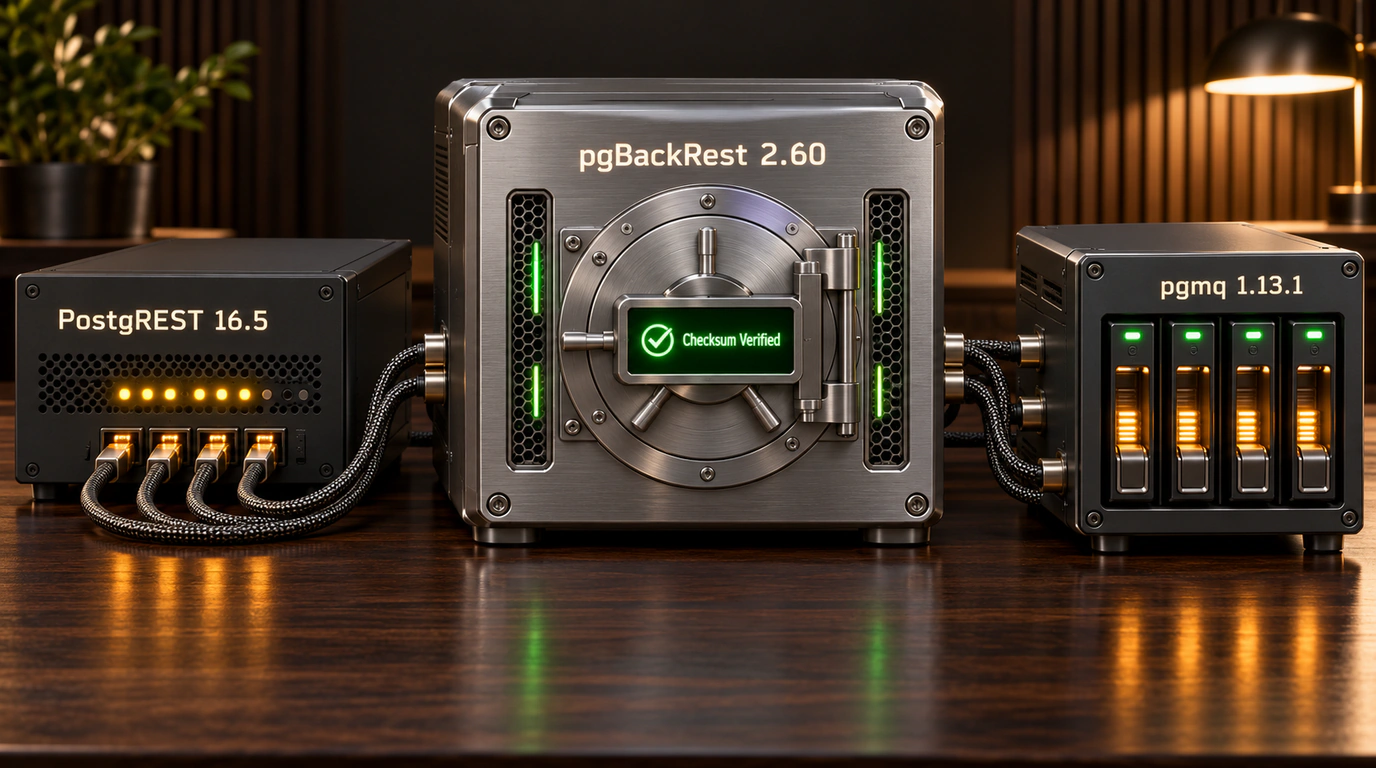
In today's roundup, we're looking at new releases of three foundational utilities in the PostgreSQL infrastructure layer: the backup tool pgBackRest 2.60, the PostgREST 16.5 gateway, and the lightweight pgmq 1.13.1 queue.
Let's see what production risks these updates take off the table.
pgBackRest 2.60
pgBackRest has earned its reputation as the gold standard for enterprise PostgreSQL backups thanks to on-the-fly compression, multithreaded transfers, and page checksum verification.
Version 2.60 introduces a critical safeguard: automatically halting a restore when an invalid page checksum is detected:
# pgbackrest.conf — restore configuration
[global]
repo1-type=s3
repo1-s3-bucket=corp-pg-backups
repo1-s3-endpoint=s3.storage.corp.local

[app-cluster]
pg1-path=/var/lib/postgresql/19/main
# New in 2.60: force-stop on block checksum error
checksum-page-error=y
Previously, during rare disk subsystem hardware failures, a restore could skip over a damaged block and only mention it as a warning buried deep in the logs. The database would start up fine, only to panic the moment a query touched that broken page. Now the restore aborts immediately with a clear pointer to the corrupted block, preventing an inconsistent cluster from ever reaching production.
PostgREST 16.5
PostgREST turns your PostgreSQL schema into a full-featured RESTful API server without writing a single line of backend code. Client requests are translated directly into SQL queries, while permissions are enforced through built-in roles and Row-Level Security (RLS) policies.
In release 16.5, the engineers patched a client-side vulnerability:
- The issue: under certain reverse-proxy setups, an attacker could manipulate
Prefer: return=representationheaders and transaction context headers, triggering unintended side effects during bulk inserts. - The fix: stricter validation of incoming HTTP headers, tighter role-context isolation, and a bug fix for parsing complex JSON filters.
pgmq 1.13.1
When a project needs a simple message queue, the knee-jerk reaction is often to spin up RabbitMQ or Kafka. Yet for moderate workloads—sending emails, generating thumbnails, scheduling delayed jobs—running a separate message broker is pure operational overhead.
The pgmq extension turns PostgreSQL itself into a reliable message queue with at-least-once delivery guarantees, visibility timeouts, and message archiving.
In release 1.13.1, the maintainers focused on security and privilege boundaries:
-- Create a message queue in the pgmq schema
SELECT pgmq.create('user_notifications');

-- Send a JSON message with a 10-second delay
SELECT * FROM pgmq.send('user_notifications', '{"user_id": 481516, "event": "welcome_email"}', 10);

-- Read a message from a worker with a 30-second visibility timeout
SELECT * FROM pgmq.read('user_notifications', 30, 1);

-- Acknowledge and delete the processed message
SELECT pgmq.delete('user_notifications', 1);
The headline change in 1.13.1 is privilege isolation. Previously, queue-creation functions required superuser permissions. Now those operations are cleanly separated: a regular application service account can work with queues without any risk of compromising system database tables.
Infrastructure takeaway
Pairing rock-solid backups in pgBackRest 2.60 with a hardened PostgREST 16.5 gateway and privilege-isolated queues in pgmq 1.13.1 gives you a dependable backbone for projects of any scale.