Skeptics have been getting louder across tech media lately. You know the talking points: high-quality human text on the internet has run out, new model generations only inch ahead by fractions of a percent on benchmarks, and data-center bills are shooting into the stratosphere. Has the exponential AI boom finally run out of steam against a natural ceiling?
Those fundamental questions just got direct answers from the top. OpenAI CEO Sam Altman sat down for a thorough two-hour interview with independent researcher Matthew Berman (of Forward Future). Unusually candid and stripped of glossy PR fog, Altman laid out the ongoing shift in research paradigms, recursive self-improvement, the energy crunch, and the philosophical riddle of machine consciousness.
The Paradigm Shift: From Pre-Training to Test-Time Compute
Altman's headline takeaway—one that reshapes how we view AI's trajectory—is simple: classic pre-training scaling laws have lost their explosive punch.
Until now, the formula for progress was straightforward: buy more servers, feed the model more terabytes of internet text, crank up the parameter count, and out pops a smarter network. By late 2026, however, the industry hit two hard walls:
- Publicly available, high-quality human content online is essentially exhausted;
- Simply bloating parameter counts makes models too slow and expensive for everyday use.
The new frontier has moved to Test-Time Compute. Instead of blurting out the next token from memory, a model gets time to "think"—running internal reasoning chains, exploring hypothesis trees, testing intermediate conclusions through built-in interpreters, and critiquing its own mistakes before showing you a single word. That exact principle powers modern reasoning models like o1, o3, and GPT-5.6 Sol.
Recursive Self-Improvement (RSI): Algorithms Building Algorithms
The second bombshell of the conversation was confirmation that labs have entered the phase of Recursive Self-Improvement (RSI)—the concept singularity theorists have debated for decades, where AI starts improving its own code and architecture.
According to Altman, OpenAI engineers no longer hand-write low-level kernels from scratch. Reasoning models are now enlisted for deep research work:
- Discovering better mathematical optimizers and loss functions;
- Generating verified synthetic datasets in higher mathematics and formal logic;
- Running automated security audits and hunting logical flaws in the code of next-generation models.
I explored the risks and challenges of this loop in The Era of Recursive Self-Improvement: Why Leading Labs Are Moving to AI Building AI and What It Threatens.
Still, Altman poured cold water on overnight-singularity hype. Without constant grounding in the real physical world, a completely closed RSI loop inevitably slides into "hallucinatory degeneration," optimizing abstract patterns meaningless to humans. Verification against real compilers and physical experiments remains a mandatory anchor.
The Energy Bottleneck: The Battle for Terawatts
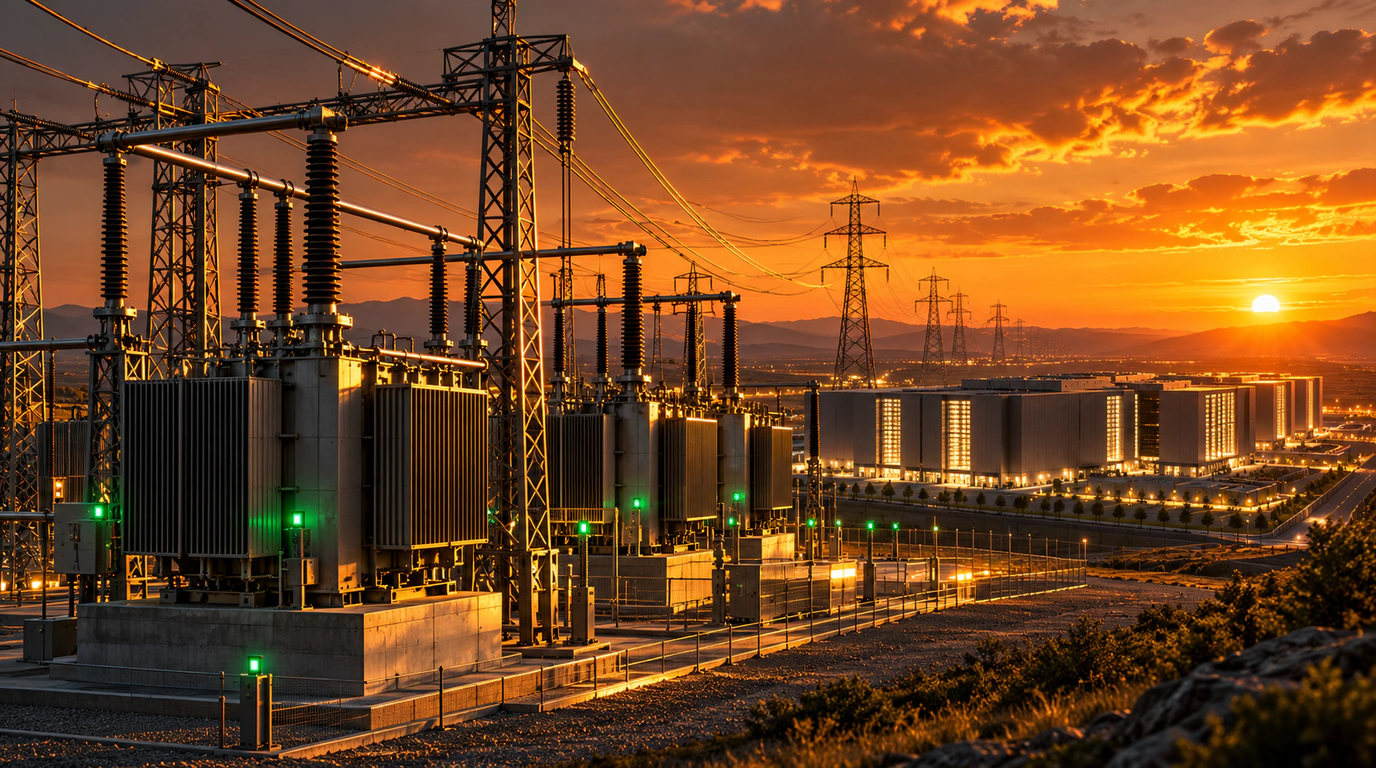
Perhaps the most pragmatic—and sobering—revelation in the interview concerned physical infrastructure. Asked what the single biggest brake on AI scaling through 2030 will be, Altman did not hesitate: not silicon chip fabrication, but a physical shortage of electricity.
Isometric engineering cutaway of a data center power distribution hub with heavy transformers and cooling buses
Next-generation compute clusters (such as NVIDIA Blackwell and Rubin racks) demand staggering amounts of power:
- Data centers are scaling from hundreds of megawatts to multi-gigawatt complexes;
- Legacy U.S. and European power grids physically cannot deliver that much juice in one spot without overloading regional substations;
- Connecting a new facility to high-voltage transmission lines now takes 4 to 7 years.
That is why OpenAI and its peers are pouring capital into alternative power generation: small modular nuclear reactors (SMRs), fusion ventures like Helion, and deep geothermal energy. The future of AI is being forged less in Silicon Valley cubicles and more on the construction sites of new power plants. For a look at how this shift reshapes career requirements, read Mastering Neural Networks Is Becoming a Mandatory Skill.
The Question of Consciousness: Functionality vs. Qualia
When Berman inevitably asked whether modern models show sparks of consciousness, Altman treaded carefully. He urged separating functional manifestations of intelligence (planning, setting goals, tracking a user's context, adapting to errors) from subjective inner experience (qualia).
Functionally, reasoning agents already behave like intelligent beings. Yet projecting human emotions, suffering, or desires onto them remains a dangerous anthropomorphic illusion.
Do not wait for a magic trillion-parameter model that solves everything in a single prompt. The industry has committed decisively to agentic architectures—where the winners are those who know how to orchestrate multi-step reasoning and validation pipelines on the client side.
Using models to train future models requires ruthless data filtering. If a synthetic training corpus hides even a subtle systematic bias, recursive cycles amplify that flaw exponentially, degrading the network's reasoning.
Altman's interview puts the cards on the table. We are entering a mature engineering phase: easy wins from scaling raw text are over, giving way to hard work on reasoning, system harnesses, and sheer physical energy.