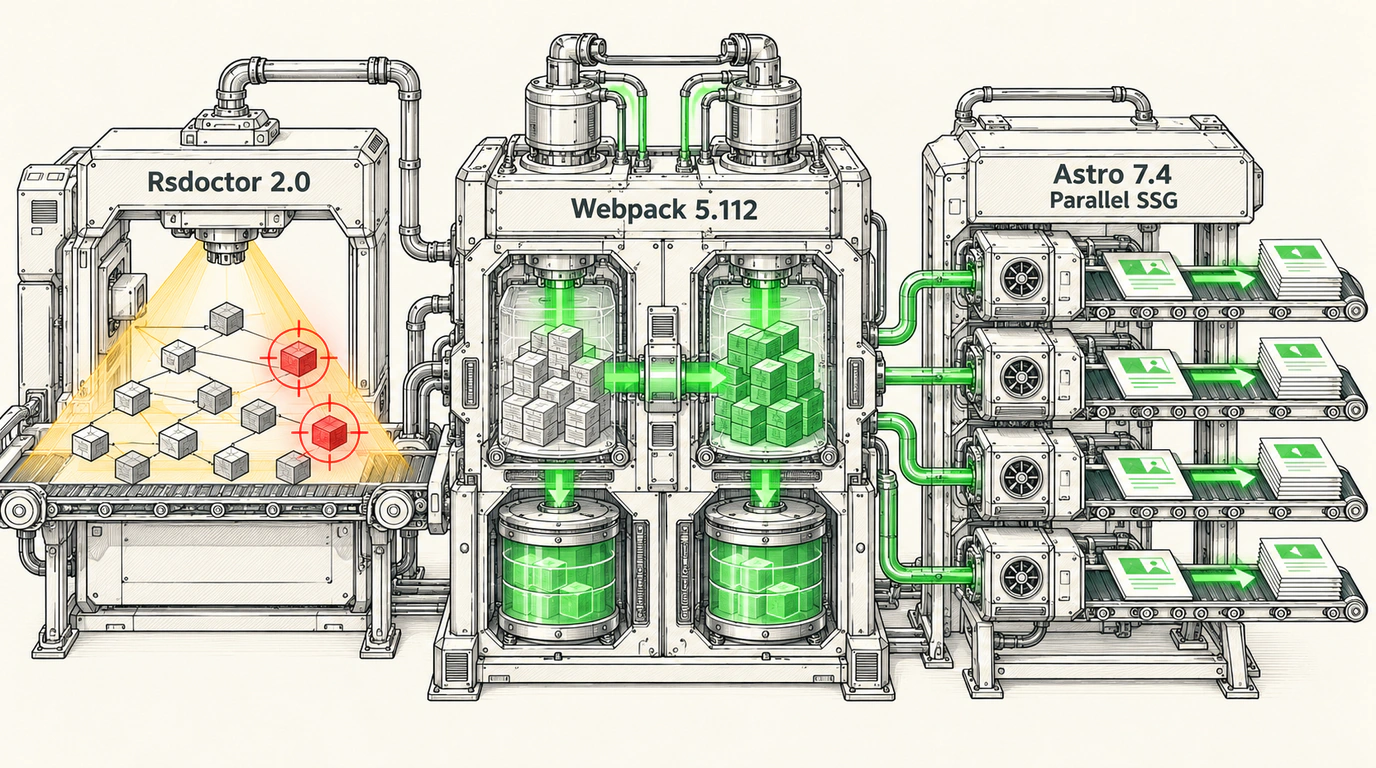
Your project's build speed and final JavaScript bundle size directly govern two things that actually matter: how fast you can iterate as a developer, and how quickly the site loads for real users (hello, Core Web Vitals).
Even the slickest UI will bleed conversions if three different versions of lodash or a chunky date-formatting library quietly sneak into your bundle and bloat the page by an extra megabyte.
In today's build-tooling roundup, we're looking at the Rsdoctor 2.0 analyzer, a maintenance update for classic Webpack 5.112, and the fresh Astro 7.4 release for content-heavy sites.
Let's see how these tools keep your bundles in fighting shape.
Rsdoctor 2.0
Rsdoctor started out in the Rspack ecosystem, but these days it works just as well with classic Webpack, acting as a deep X-ray for your entire build pipeline.
The 2.0 major release brings a few standout features:
- Duplicate Package Detection: Shows you exactly which modules got bundled multiple times due to mismatched version ranges in
package.json, along with concrete deduplication recipes. - Chrome Tracing Integration: Profiles the execution time of every plugin and loader and exports it straight to a DevTools flamechart.
- Tree Shaking Analysis: Highlights why a specific function wasn't dropped by the bundler (down to the exact line of code causing a side effect).
# Run build profiling via the Rsdoctor CLI
npx rsdoctor analyze --config rspack.config.js
Once the command finishes, an interactive dashboard opens in your browser with a detailed module graph, each file's contribution to chunk weight, and practical optimization hints.
Webpack 5.112
Despite the rise of Vite and Rspack, classic Webpack is still the backbone of a massive number of enterprise codebases.
In version 5.112, the maintainers focused on keeping long-term caching rock-solid:
- Better Deterministic Chunk IDs: The chunk ID generation algorithm was tuned to minimize CDN cache invalidation when you make small edits to source files.
- Persistent Caching Memory Fixes: Patched memory leaks that crept in during repeated cache serialization to disk in watch mode.
Astro 7.4
Astro keeps solidifying its spot as the go-to framework for content sites, blogs, and documentation hubs.
The headline feature in 7.4 is parallel static page prerendering:
// astro.config.mjs — enabling parallel prerendering
import { defineConfig } from 'astro/config';

export default defineConfig({
  output: 'static',
  build: {
    // New in 7.4: parallelize HTML generation across CPU cores
    concurrency: 8,
    inlineStylesheets: 'auto',
  },
});
Previously, generating tens of thousands of HTML pages for a large catalog or knowledge base ran sequentially or with a constrained worker pool. Now Astro distributes page generation across a pool of system threads, cutting CI/CD build times by 3–4x. We previously covered Astro 7.3 and its server loggers, and 7.4 makes static generation even snappier.
Build Pipeline Takeaway
Modern build pipelines are getting smarter and far more transparent: with diagnostics like Rsdoctor and parallelized builds in Astro, you get blazing-fast sites without spending your afternoons micromanaging bytes by hand.