User interfaces in 2026 are going through a tectonic shift. Classic forms with five inputs and a Submit button are giving way to conversational workspaces where humans collaborate with autonomous AI assistants.
But how do you show on screen what a model is "thinking" right now? How do you display agent planning steps (Reasoning Traces), parallel tool calls, and streaming generated code without layout jank or freezing the DOM?
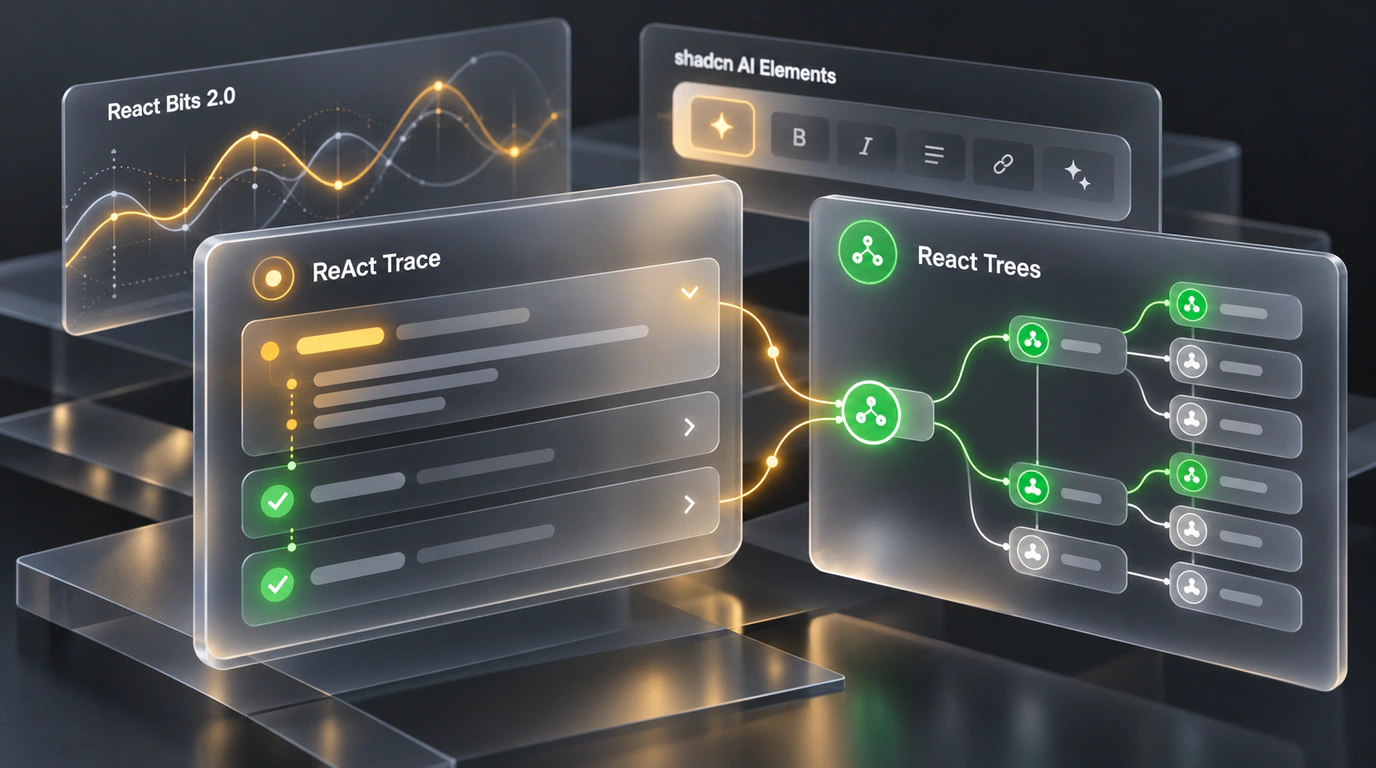
In today's roundup, we're looking at five standout UI ecosystem releases: shadcn/ui AI Elements, Meta's Astryx rich-text editor, the React Bits 2.0 animation collection, the React Trees component visualizer, and the c15t v3 consent engine.
Let's see how these tools help build next-generation interfaces.
shadcn/ui AI Elements
The wildly popular copy-and-paste component library shadcn/ui has introduced an official set of AI Elements primitives.
Instead of hand-rolling pulsing dot animations or custom spoilers for LLM reasoning, you get accessible, Radix-based components out of the box:
<ReasoningTrace>: an expandable block showing a timeline of the agent's reasoning and intermediate steps.<StreamingCodeBlock>: a code block with virtualized syntax highlighting tuned for token streams at 100+ words per second.<PromptInput>: an adaptive input field with drag-and-drop file support and voice commands.
// Using shadcn/ui AI Elements primitives
import { ReasoningTrace, StreamingCodeBlock } from '@/components/ai-elements';

export function AgentMessage({ trace, code, isStreaming }) {
  return (
    <div className="space-y-4 rounded-xl border p-4 bg-muted/30">
      {/* Agent reasoning block with smooth step animations */}
      <ReasoningTrace steps={trace.steps} status={trace.status} />

      {/* Streaming output for generated code */}
      <StreamingCodeBlock
        language="typescript"
        code={code}
        isStreaming={isStreaming}
      />
    </div>
  );
}
The components aren't coupled to any specific SDK and plug cleanly into the Vercel AI SDK or LangChain.
Astryx
Meta's team continues investing in open-source tooling for complex web apps. Astryx RichText is a next-generation modular WYSIWYG editor built on top of Lexical.
Astryx's core strength is its hybrid architecture:
- Full on-the-fly Markdown support without rendering lag.
- Built-in collaborative editing layers powered by CRDTs (Yjs).
- An interface architecture designed for AI agents to read and comment on content—something we covered in depth in our piece on Meta's Astryx and design systems for AI.
// Initializing the lightweight Astryx editor
import { AstryxEditor, MarkdownPlugin } from '@meta/astryx';

export function DocumentWorkspace({ initialMarkdown }) {
  return (
    <AstryxEditor
      initialContent={initialMarkdown}
      plugins={[MarkdownPlugin()]}
      onChange={(markdown) => console.log('Updated document:', markdown)}
    />
  );
}
React Bits 2.0
If your landing page or promo site needs extra visual polish, React Bits 2.0 packs a collection of 215 interactive animated components.
There are no heavy external dependencies here: the components rely on pure CSS, Tailwind, and lightweight canvas math. The catalog includes shimmering gradient meshes, kinetic typography effects, cursor-reactive particles, and glassmorphism cards.
React Trees
Debugging deeply nested component trees in large applications often turns into a headache.
React Trees Playground gives you a clear visual map: it inspects your app's structure and builds an interactive graph of relationships across props, contexts, and child elements. That makes it easy to spot unnecessary Prop Drilling and wasteful re-renders at a glance.
c15t v3
Complying with data-privacy laws (GDPR / CCPA) often means slapping an ugly cookie banner onto your site.
The lightweight c15t v3 (Consent Engine) library handles this cleanly: it weighs just 3.2 KB bundled, supports granular analytics category toggles, and automatically blocks third-party scripts until the user grants consent.
UI ecosystem takeaway
Modern frontend engineering is growing up: the focus is shifting from styling identical buttons to crafting responsive, intelligent workspaces where humans and algorithms work side by side.