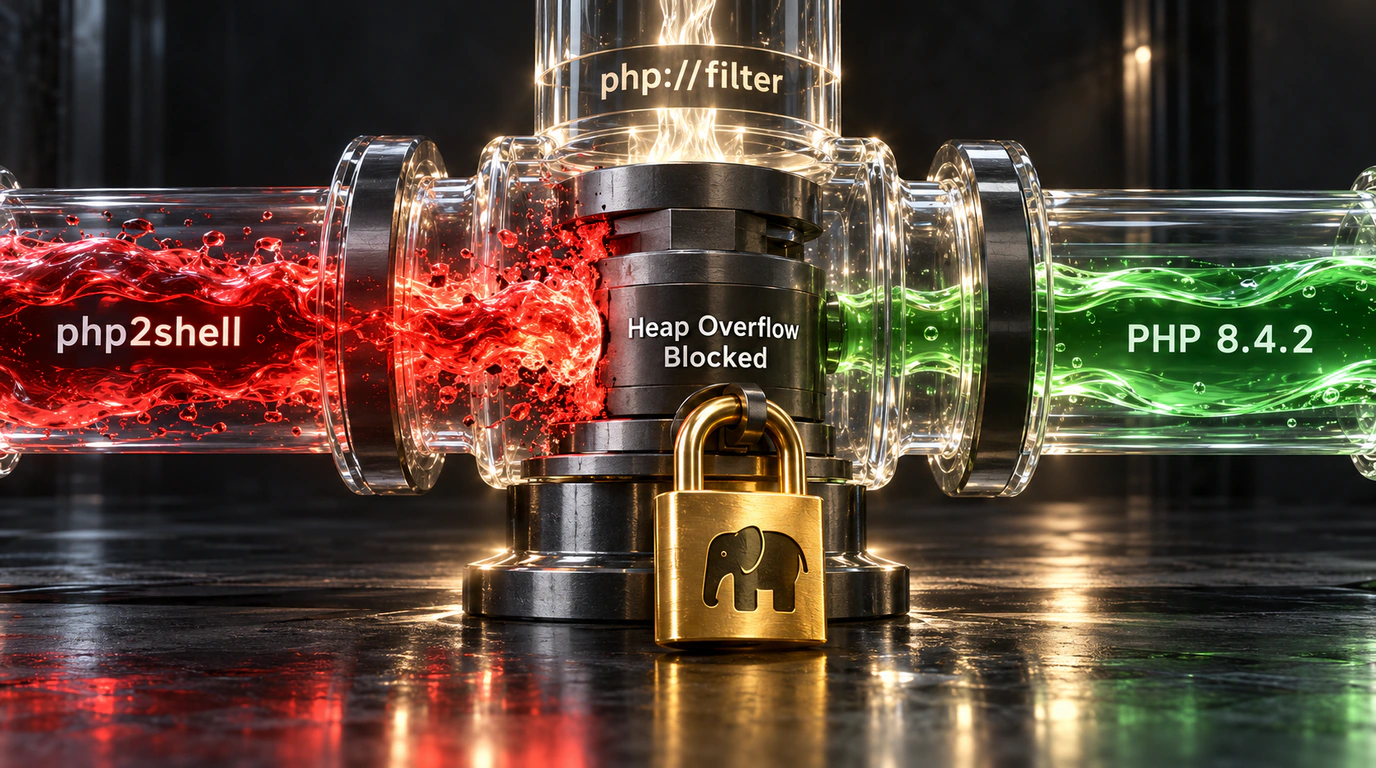
PHP core just shipped coordinated security updates across every supported release branch. The trigger for the scramble is a critical vulnerability the community dubbed php2shell, putting millions of web servers worldwide at risk.
The flaw strikes at PHP's built-in Stream Wrappers and data filters—machinery that has been baked into the language since forever.
Let's unpack how the exploit works and how to lock down your production servers.
How Does the Stream Filter Attack Work?
PHP ships with a powerful stream system that lets you transform data on the fly during I/O operations using the php://filter pseudo-protocol.
For example, you can read a file while automatically converting its encoding:
php://filter/read=convert.iconv.utf-8.utf-16le/resource=input.txt.
php2shell exploits a subtle flaw between the built-in iconv decoder and heap buffer allocation in the Zend Memory Manager:
- Filter chains: An attacker strings together a long chain of encoding conversion filters.
- Miscalculated buffer capacity: Given a carefully crafted sequence of invalid bytes, the decoder misjudges how large the output memory buffer needs to be.
- Heap Buffer Overflow: That overflow overwrites system function pointers on the PHP-FPM process heap, hijacking control flow and letting the attacker execute arbitrary shell code.
What makes this especially nasty is that an attacker only needs a single place in your app where a file path is user-controlled—think an unvalidated file_get_contents($path), include($file), or a temporary file handler during image uploads.
Emergency Releases and Mitigations
The PHP core maintainers released patched builds across the board:
- PHP 8.2.27
- PHP 8.3.16
- PHP 8.4.2
- Patches for the in-development PHP 8.5 branch
Under the hood, the engine now enforces strict guardrails:
- Capped maximum nesting depth for stream filter chains.
- Added strict buffer boundary checks during
iconvencoding conversions. - Blocked unbounded memory expansion when processing malformed byte sequences.
What Developers and DevOps Should Do Now
- Update your system PHP packages immediately: On all servers running PHP-FPM or Apache, upgrade to 8.2.27, 8.3.16, or 8.4.2.
- Audit your file operations: Scan your codebase for patterns like
include $pageorfile_get_contents($url). Never pass user-supplied strings straight into file functions without validating against a strict allowlist. - Disable unused stream wrappers: If your app doesn't need remote URL wrappers, turn off
allow_url_fopenandallow_url_includeinphp.ini.
Timely system patching is still the only reliable shield against automated exploits.