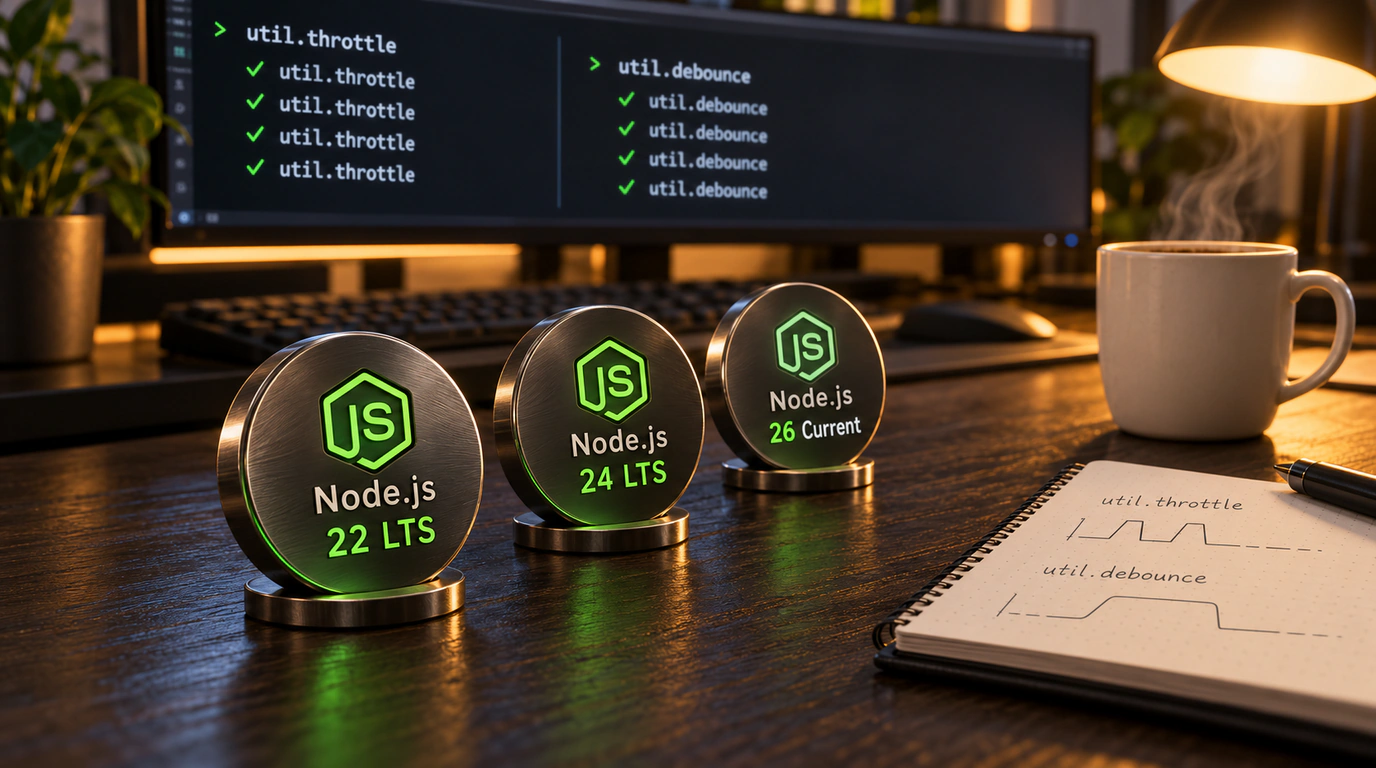
Node.js developers just got a big reason to audit their dependencies: the OpenJS Foundation and the core maintainer team dropped coordinated updates across all three active release lines at once.
The wave covers the battle-tested long-term support line Node.js 22.23.4 (LTS Jod), the current production workhorse Node.js 24.22.1 (LTS Krypton), and the bleeding-edge Node.js 26.12.1 (Current).
Together, these releases pair urgent security patches and libuv thread-pool tuning with a long-awaited standard library addition that finally lets you delete a few legacy packages.
Let’s break down what landed in each branch.
Node.js 22.23.4 LTS
Node.js 22 is in Active LTS—the backbone of countless enterprise backends where stability, backward compatibility, and predictable behavior under heavy load matter most.
Release 22.23.4 focuses squarely on security and stopping resource leaks:
- HTTP/2 protocol patches: closes a denial-of-service (DoS) vulnerability where crafted packets containing empty
CONTINUATIONframes could trigger runaway memory consumption. - Descriptor leaks in
node:fs: fixes a subtle bug infs.createReadStreamwhere an unexpected client disconnect could leave a file descriptor open in the OS pool. - libuv stabilization: updates the underlying asynchronous I/O library
libuv, improving task balancing in the system thread pool whenUV_THREADPOOL_SIZEis overridden.
If you’re running Node 22 in production, slot this update into your next maintenance window.
Node.js 24.22.1 LTS
Node.js 24 is the flagship line for new projects, and it brings the most practical everyday gift in this release wave: native throttle and debounce utilities right inside node:util!
Think about how many years JavaScript developers had to pull in lodash or micro-packages just for two rate-limiting helpers. Now they’re built straight into the platform:
import { throttle, debounce } from 'node:util';

// Example of using throttle to limit how often metrics are sent
function sendMetrics(payload) {
  console.log('Metric sent to server:', new Date().toISOString(), payload);
}

// Call the function at most once every 500 milliseconds
const throttledSendMetrics = throttle(sendMetrics, 500);

// Example of using debounce to handle user input
function onSearchQueryChange(query) {
  console.log('Database search:', query);
}

// Execute the query only after the user pauses for 300 ms
const debouncedSearch = debounce(onSearchQueryChange, 300);
Implemented in C++ with tight integration into the Node.js event loop, these utilities handle argument forwarding, timer cleanup via .clear(), and avoid allocating extra closures on the V8 heap.
Release 24.22.1 also upgrades the built-in test runner (node:test) with support for parallel test suites using isolated timer mocks. If you want a deeper look at how crypto evolved in this branch, check out our earlier piece on new cryptography horizons in synchronized Node.js 24 and 26 releases.
Node.js 26.12.1 Current
The 26 Current line is where bold platform experiments get battle-tested before graduating into future LTS releases.
Key highlights in 26.12.1:
- V8 engine upgrade: brings Inline Cache optimizations for polymorphic objects and up to 15% faster regular expression execution on ARM64 chips (Apple Silicon, AWS Graviton).
- Experimental WebGPU support: advances server-side WebGPU for general-purpose compute and local neural network inference right inside the JS runtime—no custom C++ addons needed.
- Import Attributes support: stabilizes
import data from './config.json' with { type: 'json' }in line with the ECMA standard.
// Modern JSON import syntax in Node.js 26 Current
import appConfig from './appsettings.json' with { type: 'json' };

console.log('Service started:', appConfig.serviceName, 'version:', process.version);
Summary and Upgrade Strategy
Shipping all three releases in lockstep shows just how mature and predictable the Node.js release train has become.
For production teams, the playbook stays straightforward:
- Apps on Node 22 should take the
22.23.4security bump. - New services belong on
24.22.1 LTS, where you can happily striplodash.debounceandthrottle-debounceout ofpackage.json. 26.12.1 Currentis your playground for side projects, server-side WebGPU experiments, and checking compatibility with upcoming standards.

