The web framework landscape around React is undergoing a fundamental shift. For years, the industry pushed toward heavier tooling: complex compilers, monolithic file-system conventions, opaque server rendering, and lock-in to specific cloud platforms.
In 2026, though, the pendulum has swung back toward modularity, Vite-level speed, and respect for browser standards.
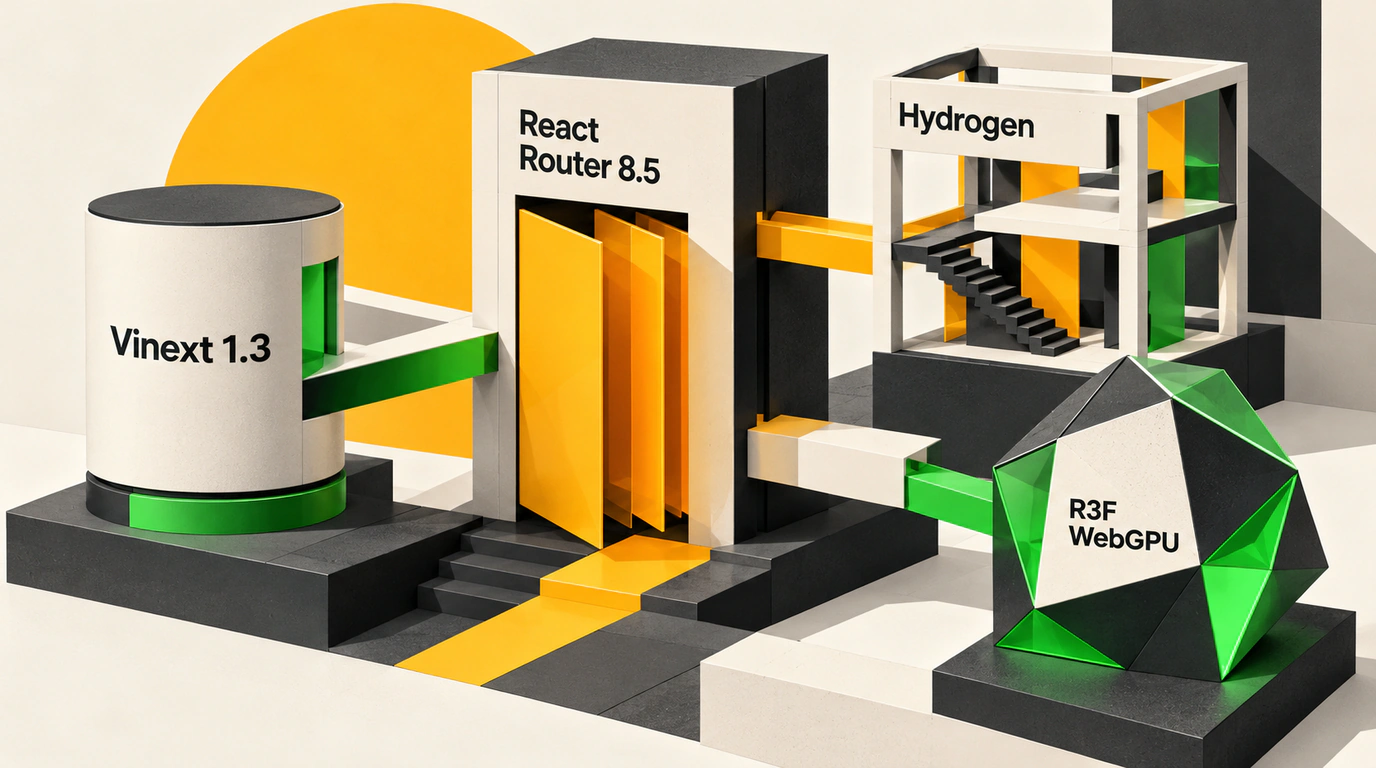
In today's roundup, we're unpacking four key releases of the week: React Router 8.5 with View Transitions support, the architectural transformation of Shopify Hydrogen 2026-10, the lightweight Vinext 1.3 framework, and the alpha release of React Three Fiber 10.
Let's see how these tools are reshaping modern web app architecture.
React Router 8.5
Following the merger of Remix and React Router, the maintainers keep refining how routing and state work together.
Version 8.5 brings long-awaited native integration with the ViewTransition specification introduced in React 19.3's experimental branch:
// Configuring seamless page transitions in React Router 8.5
import { createBrowserRouter, RouterProvider, Link } from 'react-router';

export function NavigationBar() {
  return (
    <nav>
      {/* The viewTransition prop automatically wraps navigation in document.startViewTransition */}
      <Link to="/catalog" viewTransition>
        Product Catalog
      </Link>
      <Link to="/profile" viewTransition>
        Profile
      </Link>
    </nav>
  );
}
Previously, building cinematic page transitions—where a product thumbnail smoothly flies from a grid into a detail view—meant writing finicky wrappers around document.startViewTransition. Now React Router coordinates async data loaders and CSS transition animations out of the box.
Hydrogen 2026-10
Shopify's Hydrogen framework originally started life as a monolithic e-commerce storefront solution layered on top of Remix.
In the 2026-10 release, the team announced the completion of a major architectural shift: Hydrogen is no longer a rigid framework. It is now a modular suite of independent libraries (@shopify/hydrogen-react) you can drop into any stack:
- Cart, analytics, and checkout components have zero server-runtime lock-in.
- You're free to pair them with any router or bundler—Vite, Next.js, or Astro.
- Client bundle size dropped by more than 30%.
Vinext 1.3
If you're tired of Turbopack's complexity and Next.js App Router quirks, the open-source Vinext 1.3 project offers a breath of fresh air:
- Compatibility with Next.js conventions (file-based routing, Server Components, API routes).
- Powered by blazing-fast Vite instead of proprietary compilers.
- Near-instant dev server startup (HMR under 50 ms).
// vite.config.ts — Vinext 1.3 configuration
import { defineConfig } from 'vite';
import vinext from 'vinext';

export default defineConfig({
  plugins: [
    vinext({
      rsc: true, // Enable React Server Components support
      prerender: ['/', '/about', '/pricing'],
    }),
  ],
});
React Three Fiber 10 Alpha 6
React Three Fiber (R3F) just took a major leap forward: version 10.0 alpha is built on an updated Three.js core with first-class WebGPU support:
- Compute Shaders for simulating physics across thousands of particles directly on the GPU.
- Lower CPU overhead when rendering complex 3D scenes.
- Declarative control over materials and lighting in familiar JSX.
Framework synthesis
The evolution of these frameworks points to one clear trend: the future of the web is built on open, modular standards. We also dug into choosing the right production architecture in our piece on the modern React developer stack.