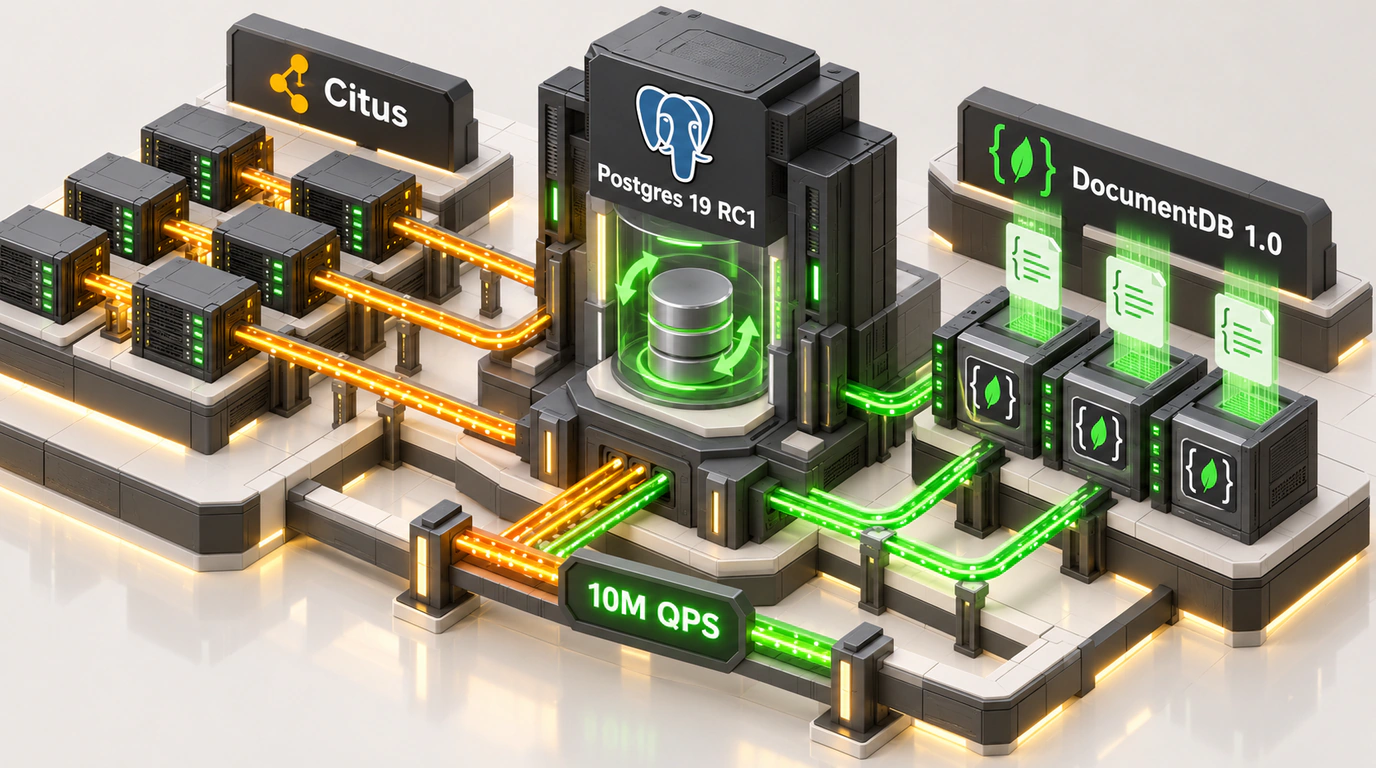
The PostgreSQL ecosystem is in the middle of one of the most dynamic stretches in its history. Our trusty relational elephant is steadily turning into a universal data platform—one that can replace dedicated NoSQL stores, scale across hundreds of nodes, and spin up thousands of micro-databases for integration tests in milliseconds.
Today’s roundup covers four standout milestones: the first release candidate of Postgres 19 RC1, the open-source MongoDB-compatible engine DocumentDB 1.0, a jaw-dropping 10 million QPS benchmark from distributed Citus, and the lightweight PGX runtime.
Let’s look at what each of these brings to real-world engineering teams.
Postgres 19 RC1
Reaching RC1 means the Postgres 19 feature set is officially frozen, and the community is in final stability testing ahead of GA.
The headline feature DBAs have waited years for is native online table repacking:
-- Native reorganization of a bloated table without an exclusive lock in Postgres 19
REPACK TABLE sales_orders CONCURRENTLY;
Previously, fighting table bloat meant installing the third-party pg_repack extension or swallowing the exclusive table lock of VACUUM FULL. In Postgres 19, the mechanism lives in core: the server builds a shadow copy, streams changes via WAL, and swaps page pointers on the fly without halting reads or writes.
Branch 19 also speeds up parallel index vacuuming and optimizes B-Tree scans for UUID keys.
DocumentDB 1.0
Plenty of teams keep MongoDB around solely for a flexible JSON document store—paying double in ops overhead, monitoring, and backups to maintain two separate database clusters.
Open-source DocumentDB 1.0 offers a clean way out: a full protocol gateway that accepts standard MongoDB client connections (port 27017) and translates them into optimized PostgreSQL queries backed by jsonb:
# Running the DocumentDB container on top of PostgreSQL
docker run -d --name documentdb-gateway \
  -p 27017:27017 \
  -e POSTGRES_URI="postgres://user:secret@pg-master.corp.local:5432/app_db" \
  documentdb/gateway:1.0.0
Your application code keeps using the official mongodb driver for Node.js or Python, while your data sits safely inside PostgreSQL tables with full ACID transactions and targeted B-Tree indexes on document fields.
Citus
The StackGres team ran an independent benchmark of the distributed Citus extension and clocked an eye-popping 10,000,000 transactional queries per second (QPS).
Even better: Citus hit that mark using half as many data nodes as PlanetScale’s proprietary Neki system. The secret comes down to streamlined distributed query execution and keeping transactions localized within shards.
If your monolithic PostgreSQL instance is hitting CPU and disk ceilings on a single box, sharding with Citus lets you scale linearly without rewriting your SQL.
PGX
In CI/CD, unit and integration tests always force an awkward choice: slow Docker containers running real Postgres, or flaky in-memory mocks like SQLite.
PGX offers a third path: a lightweight PostgreSQL core micro-runtime that spins up thousands of isolated, disposable databases inside a single OS process. Initializing a database takes under 15 milliseconds, and memory is freed the instant the test finishes.
Ecosystem Takeaways
Between Postgres 19 RC1, DocumentDB, and Citus, the PostgreSQL tools ecosystem now covers almost every workload on an engineer’s plate—from fast local test isolation to multi-node sharding at massive scale.