Every designer or visual content creator knows that feeling of quiet fury: a neural network generated a nearly perfect ad banner or piece of concept art. Ideal lighting, stunning composition, cinematic texture... yet a sign in the background has a silly typo, or a character has six fingers on one hand, or the brand logo is skewed by three pixels.
Previously, trying to fix this with classic Inpainting (brushing over an area in Midjourney or Stable Diffusion) turned into a lottery. The model didn't just redraw the selected zone—it shamelessly bled into neighboring pixels: blurring crisp edges, shifting the frame's color temperature, and turning sharp textures into muddy jelly.
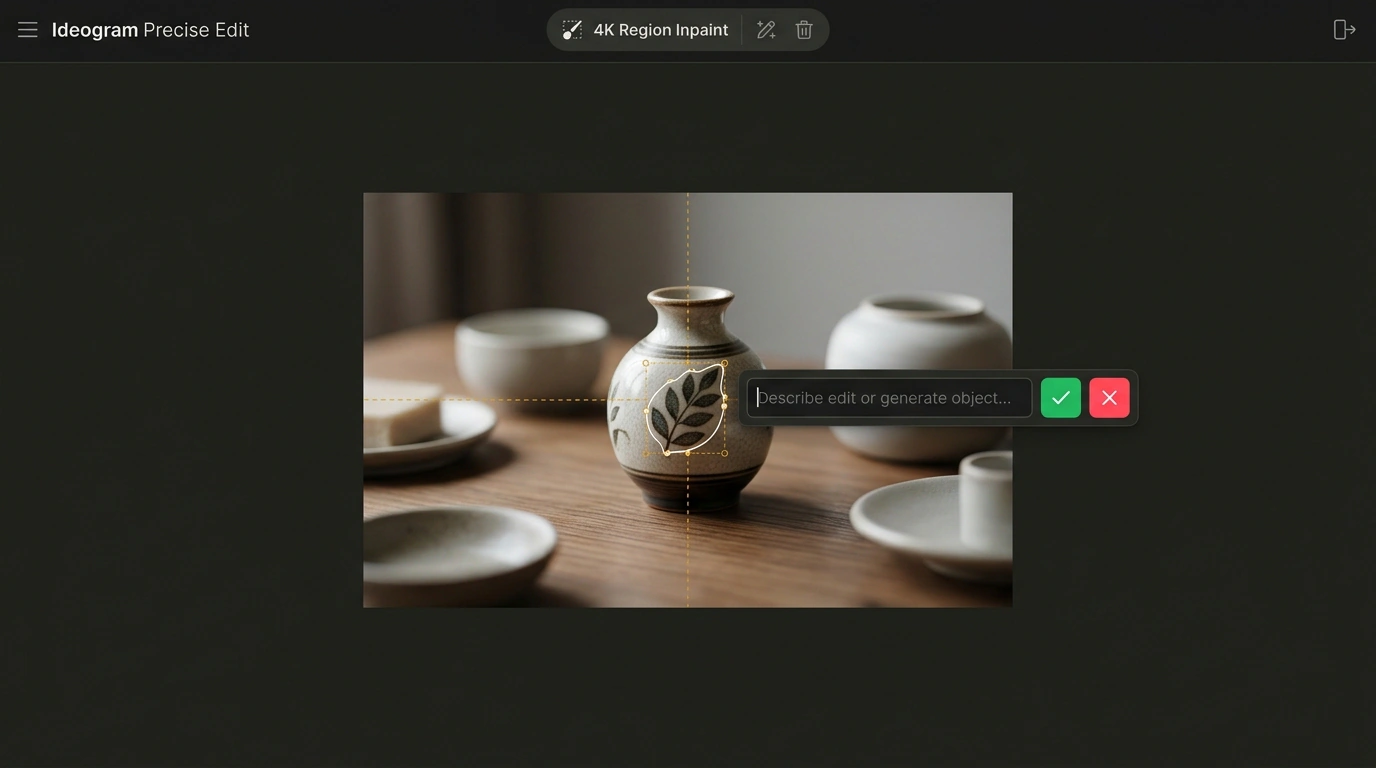
The developers of Ideogram, which earned a reputation as the champion of generating readable text inside images, rolled out a major update—Precise Edit mode featuring an adaptive context-window masking architecture for ultra-high-resolution 4K images.
Earlier, we explored the capabilities of multimedia AI in visual tasks, and today we will look at how Ideogram solves the problem of surgical graphics editing.
What's Wrong with Naive Inpainting: A Look Under the Hood
To appreciate Ideogram's technological breakthrough, you need to look at how a diffusion model sees an image in latent space.
In the classic approach, when filling a mask, the model either recalculates the Cross-Attention map for the entire image or uses a rigid square crop around the cursor. In both cases, a parasitic effect occurs:
- Seam edge blurring: At the boundary between the mask and the original image, high-frequency detail (film grain, skin pores, fabric micro-relief) is lost. As a result, the edited patch looks like a sloppy band-aid.
- Perspective distortion: If you cut out a rectangle around a street sign and regenerate it without accounting for global scene geometry, the model will very likely miss the tilt angle and perspective vanishing point.
Precise Edit Mechanics: Floating Context Window and Spatial Attention
The Ideogram team solved this dilemma using Adaptive Context Window Masking technology.
Instead of a flat raster mask, engineers implemented a two-tier algorithm:
- Global structural anchor: The model retains a compressed topology of the entire frame—global lighting direction, color palette, and perspective lines. This ensures any new object blends seamlessly into the scene's physics.
- Local high-resolution 4K buffer: Diffusion noise calculations are concentrated exclusively inside a dynamic masking window with subpixel edge smoothing. Model weights are projected to preserve noise-spectrum continuity at the border between original and new pixels.
- Attention Tiling: To save VRAM when processing 4K textures, the attention matrix is split into compact overlapping tiles, preventing VRAM from crashing with an OOM error.
In practice, this yields a striking result: you can select a single letter in a word on an intricate neon banner, write a prompt to swap the character—and Ideogram replaces that exact letter while preserving reflections from neighboring lamps, the brick wall texture behind it, and the lens depth of field.
Practical Scenarios for Commercial Design
Adopting Precise Edit fundamentally changes the economics of commercial graphics:
- Localizing creatives for different markets: You create one base 3D product illustration and in a couple of clicks swap label text from English to Russian, Arabic, or Chinese without regenerating the bottle or packaging itself.
- Fixing anatomy artifacts: Removing extra fingers, adjusting gaze direction, or fixing pupil shapes now happens in a single iteration without risking smudging the model's makeup or hair.
- Integrating corporate identity: Embedding exact slogans and brand names into complex photorealistic scenes no longer requires manual clipping in graphics editors.
Capability Boundaries and Professional Trade-Offs
Despite a massive leap forward, the technology still has engineering limitations:
- Challenges with translucency: If the edited area touches thin smoke, water, glass, or wispy translucent hair, the masking algorithm occasionally leaves a faint high-contrast halo. In such delicate scenarios, final mask touch-ups in Photoshop remain indispensable.
- High compute costs: Generating in Precise Edit 4K mode consumes 2.5x more server credits than a standard diffusion pass, making it uneconomical for rough composition exploration.
Ideogram's Precise Edit finally turns generative AI from a temperamental generator of random pictures into a predictable, pro-grade retouching tool.
