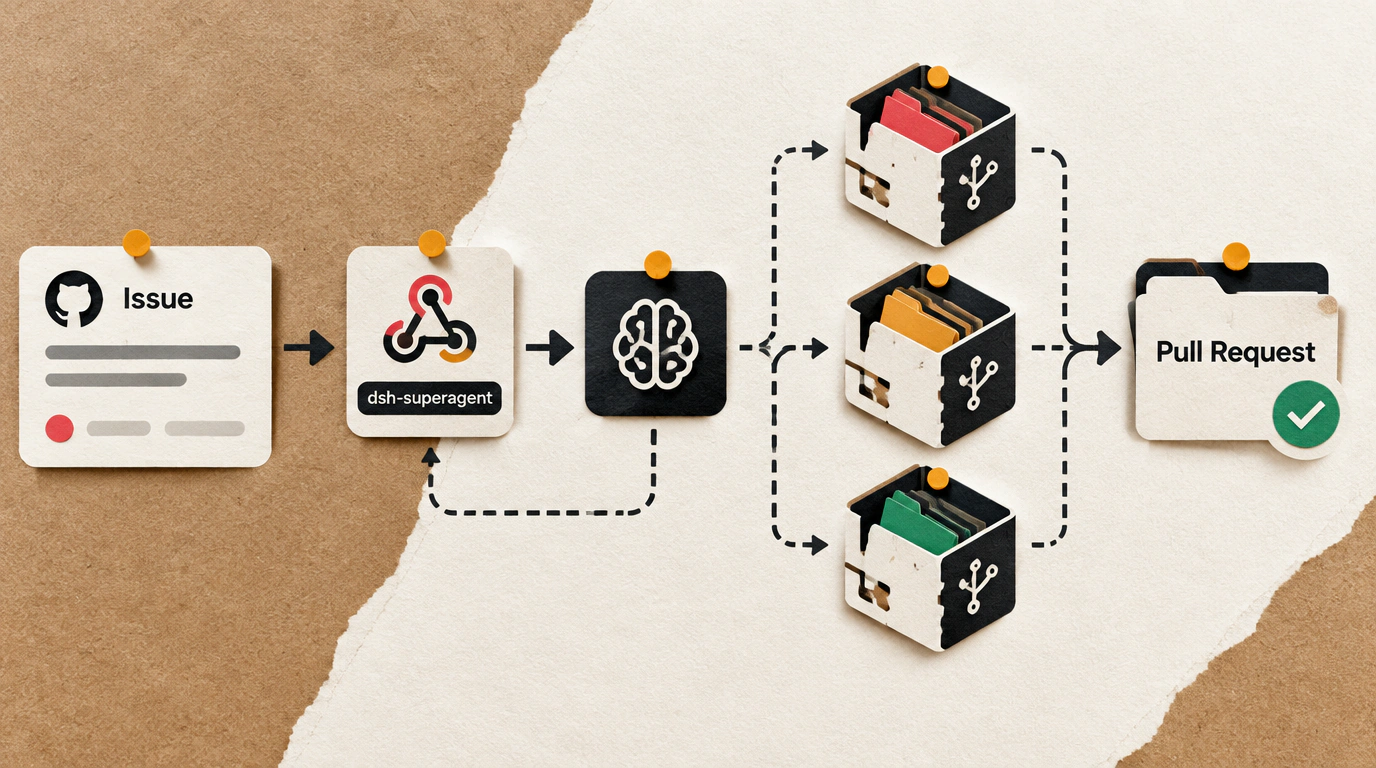
Most modern AI programming tools — from autocomplete plugins to chats like Cursor or Claude Code — operate synchronously. The developer sits in front of the monitor, formulates a task, waits for a response, fixes errors in a dialogue, and manually applies changes. That works well for local coding, but barely scales to a team's routine background workflows.
The DeepSeek AI research lab unveiled a project expanding on the ideas of their foundational paper "Exploring Super-agent Design: Towards a More Autonomous Agent System". Published under the open MIT license, the dsh-superagent-prototype moves development into a fully asynchronous loop, turning the neural network into an autonomous participant in a GitHub repository.
Architecture of the DSH multi-agent pipeline
The system is designed as a layer on top of the agent execution runtime evolving in the DeepSeek Harness framework, whose modular principles we covered in earlier issues.
Instead of a monolithic bot, the architecture is split into five specialized role modules:
- Policy: declarative repository rules, an allowlist of trusted maintainers, and safety filters for destructive commands.
- SourceRegistry: a GitHub Webhooks receiver tracking Issue creation, new comments, and Pull Request openings.
- MasterAssessor: an analytical decomposition module. Upon receiving a ticket, it assesses task complexity and breaks it down into independent stages.
- DshExecutor: an execution loop that spins up an isolated Git worktree (
git worktree) for each agent to prevent file collisions. - Outbox Sessions: an asynchronous queue of outbound actions through which progress comments are posted and final Pull Requests are created.
Repository configuration is described in a policy file:
{
  "repository": "my-org/core-backend",
  "engine": "deepseek-coder",
  "permissions": {
    "allowedUsers": ["lead-dev", "architect"],
    "autoCreatePR": true,
    "requireHumanApprovalFor": ["db-migration", "delete-files"]
  },
  "workspaces": {
    "baseDir": "/tmp/dsh-worktrees",
    "cleanupOnComplete": true
  }
}
Launching and managing the Human-in-the-Loop workflow
When an authorized developer mentions the bot in a GitHub issue description, the system picks up the context, clones the branch, writes code, and runs local tests. If solving the task requires a risky operation (deleting files or applying a DB schema migration), the task pauses and sends a request to the built-in Human-in-the-Loop approval web panel.
Launching the prototype uses standard TypeScript and Node.js ecosystem tools:
# Clone the prototype and launch the agentic pipeline
git clone https://github.com/deepseek-ai/dsh-superagent-prototype.git
cd dsh-superagent-prototype
pnpm install
pnpm build
pnpm start --config ./examples/repo-config.yml
DeepSeek's maintainers emphasize that the codebase grew out of internal company research experiments (with a significant share generated by the models themselves) and serves primarily as a testbed for studying multi-agent interaction.
Never run autonomous agents with shell execution privileges directly on a server host machine. Autonomous code requires strict isolation inside disposable Docker containers or micro-VMs (Firecracker) with restricted network access to prevent accidental damage to system or repository files.
The project clearly shows where the industry is heading: from interactive chatbots, we are moving toward background agentic pipelines where humans simply approve finished solutions.
