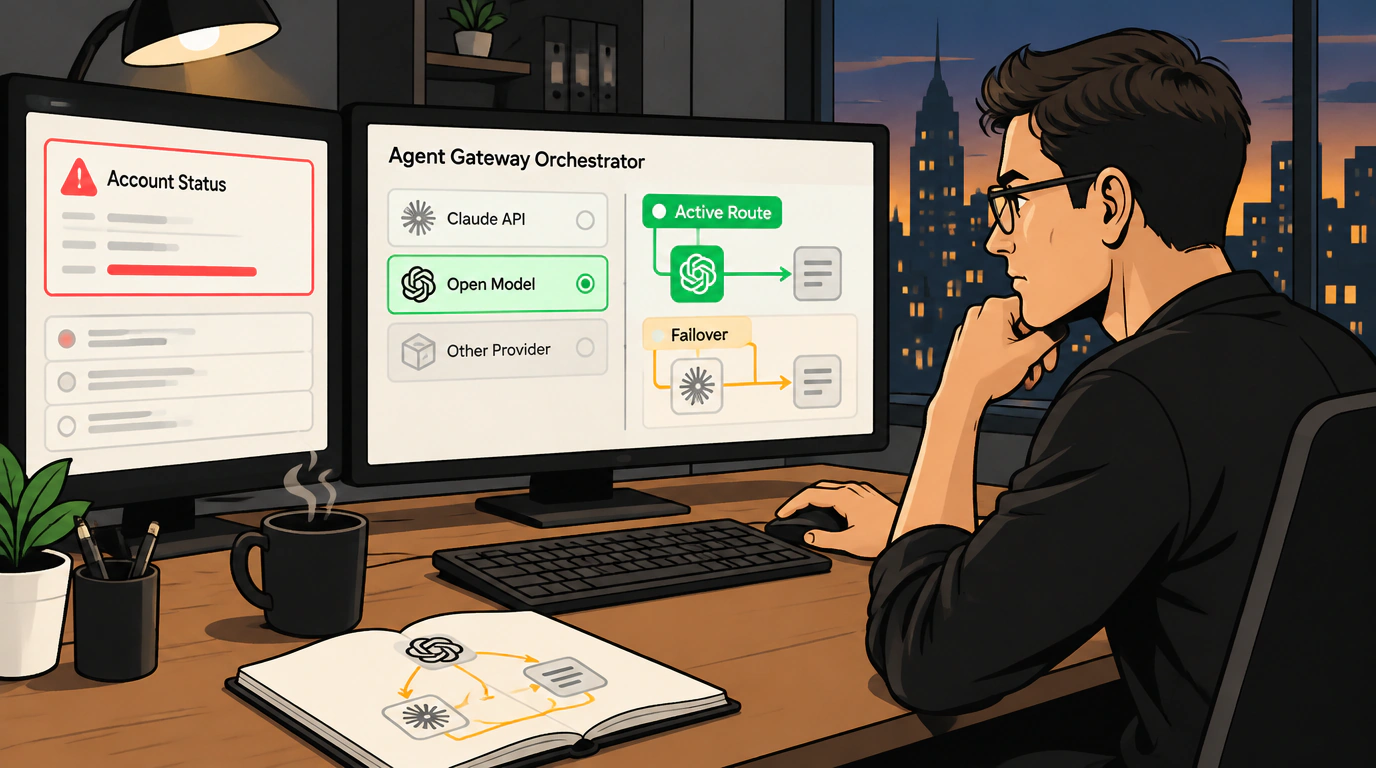
Late October and the first days of November 2026 will be remembered by many engineering teams as a cold shower: another massive wave of sudden account bans swept through the developer community for Anthropic Claude. Caught in the sweep were not only individual Claude Pro subscriptions paid via foreign virtual cards, but also entirely legitimate corporate accounts with paid API access.
The scene for any tech lead is a nightmare: mid-sprint, half the team's Claude Code sessions drop in the console, Cursor stops generating edits, and an email sits in the inbox with a dry automated notice of profile deactivation for "Terms of Service violation" with no right of appeal.
Conspiracy debates immediately erupted in engineering chats about sysadmin meddling and tightened sanctions filters. However, well-known systems design educator Alexey Rybak (System Design & Highload channel) offered a sober look at the situation — through the lens of the harsh unit economics of modern LLM giants.
The economics of overselling: why an active agent bleeds the provider
To understand the real reason behind the customer base purge, you have to take off the rose-tinted glasses and look at the AI business model through the eyes of an Anthropic or OpenAI CFO.
Practically all flat-rate plans — whether $20 a month for personal Claude Pro or base quotas for team workspaces — are built on the classic overselling model. That's the exact same way budget airlines have made money for decades (selling more tickets on a flight than physical seats in the cabin) and hosting providers (selling "unlimited" bandwidth on virtual servers).
The math is simple: 90% of ordinary users ask a neural network five to ten questions a day, translate short texts, or generate birthday wishes for colleagues. They consume pennies' worth of tokens and form a steady financial cushion.
But when a modern autonomous coding agent enters a project, the overselling math falls apart with a crash:
- The agent operates in a continuous loop (loop engineering): it reads dozens of project files, builds dependency trees, runs tests, hits a compiler error, and goes around for a second, fifth, tenth pass.
- Every iteration feeds the model a gigantic context of tens and hundreds of thousands of tokens on flagship models like Claude 3.5 Sonnet or Claude 3.7 Sonnet.
- In a couple of workdays, an active developer burns through a volume of NVIDIA H100 server compute whose cost to Anthropic runs into hundreds of dollars.
Any engineer utilizing available limits at 100% generates a pure operating loss for the provider. Inside vendors' antifraud systems, scoring algorithms track continuous generation spikes and flag such accounts as "toxic." And any suspicion that someone is trying to train a competing model through the API (prohibited model distillation) acts as an instant trigger for a permanent ban.
Geopolitical and network scoring
The second component of scoring is network hygiene. If a profile is registered from a "gray" jurisdiction, ban risks rise exponentially.
Many try to get by with cheap residential proxies or public VPN services. Yet vendor detection systems have long known how to analyze a client's digital fingerprint: real IP leaks via WebRTC in the browser, mismatches between OS time zone and network location, and using "dirty" datacenter IP ranges immediately drop an account's trust score to zero. In that state, a single suspicious request is enough for antifraud to pull the trigger.
The three-tier strategy: architecture against vendor lock-in
The main engineering takeaway formulated by Alexey Rybak: never tie your company's critical business processes to a single AI provider. Blind faith that Claude will always be available costs businesses far too much.
Instead of a single-model monopoly, a resilient architecture should rest on three independent tiers:
- Strategic analysis tier (Claude / Anthropic): the gold standard for reasoning quality, architectural synthesis, and delicate adherence to complex prompts. Use it surgically: for system architecture design, deep core refactoring, and complex debugging scenarios.
- Stable production tier (Codex / OpenAI): more predictable moderation policies, stable enterprise gateways, and strict contractual SLA commitments. Well-suited for everyday code review and routine automation.
- Open-models and sovereign perimeter tier (OpenCode): an open agentic environment that lets you plug in third-party and open models (DeepSeek V3, DeepSeek R1, Qwen 2.5 Coder). This handles high-volume, low-cost tasks — generating boilerplate tests, documenting code, and catching typos. This perimeter doesn't depend on the whims of US platforms at all.
Failover and context switching
So switching between providers doesn't require manually reconfiguring every editor on the team, proxy gateways (LiteLLM, OpenRouter, or internal company proxies) are deployed at the infrastructure layer.
Combined with the engineering practices built into the AI Harness system wrapper, the gateway intercepts 429 Too Many Requests or 403 Forbidden errors from one provider and transparently routes the prompt to a backup model.
The hardest part of switching from Claude to open models like DeepSeek is how differently they react to instruction wording. Don't hardcode system prompts directly inside tool code. Extract them into versioned configuration files, separating shared task business logic from model-specific formatting suffixes.
Ultimately, the ban wave became a great catalyst for professional maturity. The era of naive trust in "unlimited" subscriptions is over. The teams that come out ahead in the agentic race will be those that know how to calculate the unit economics of someone else's compute and design fault-tolerant multi-model pipelines in advance.