Voiceover options for videos and podcasts usually force a tough trade. You either pay for multiple tools—separate ones for narration, dubbing, and cloning—or bet everything on a small startup. PlayHT showed how that can end: Meta acquired the team in July 2025, and by December 31, 2025, the service shut down along with user accounts and saved voices.
Against that backdrop, the free Google AI Studio sandbox stands out. On September 23, 2026, Google added Gemini 3.8 Flash TTS and Gemini 3.8 Flash-Lite TTS. No code required: sign in with a Google account, paste your script, and generate speech with sighs, laughs, and two-person dialogue.
How Flash TTS and Flash-Lite TTS work
TTS (Text-to-Speech) turns written lines into spoken audio. In Gemini 3.8, Google split the job across two engines. Gemini 3.8 Flash TTS focuses on expressive delivery for YouTube videos, characters, and audiobooks where a voice shouldn't drift over long stretches. Gemini 3.8 Flash-Lite TTS is lighter and faster, built for bulk dubbing and real-time voice agents.
The web UI is straightforward: pick a model on the right, then build speech blocks with speakers and styles in the center. You get 30 studio voices out of the box (Corey, Puck, Zephyr, and others), while the full library covers regional accents like Mexican Spanish, Quebec French, and Scottish English.
Need a custom narrator? Describe the role, accent, and personality in plain text and the model builds a new voice. Each project can store up to 200 custom voices: every voice lasts a year, and using it resets the clock. You can also replicate a real voice from a 30-second clip, while Voice Remixing (tweaking pitch and pace) is marked "coming soon."
Gemini 3.8 Flash TTS speech quality comparison on the Hume AI benchmark (Source: blog.google)
Google reports that Flash TTS took first place on the Hume AI voice design benchmark. The numbers look great, though it's Google's own report—trust your ears on your own script.
Emotion tags, mini-podcasts, and how it stacks up to ElevenLabs
The standout feature of Flash TTS is line-by-line directing. You can set emotion and pace per line, use ALL CAPS for emphasis, and rely on punctuation for pauses or hesitation. Emotion and reaction tags go straight into the text: <sigh>, <laugh>, and <short pause> trigger sighs, laughter, or beats, while vertical bars (|oh really|, |mm-hmm|) add quick interjections. Note that tags must always be written in English, even if your script is in another language.
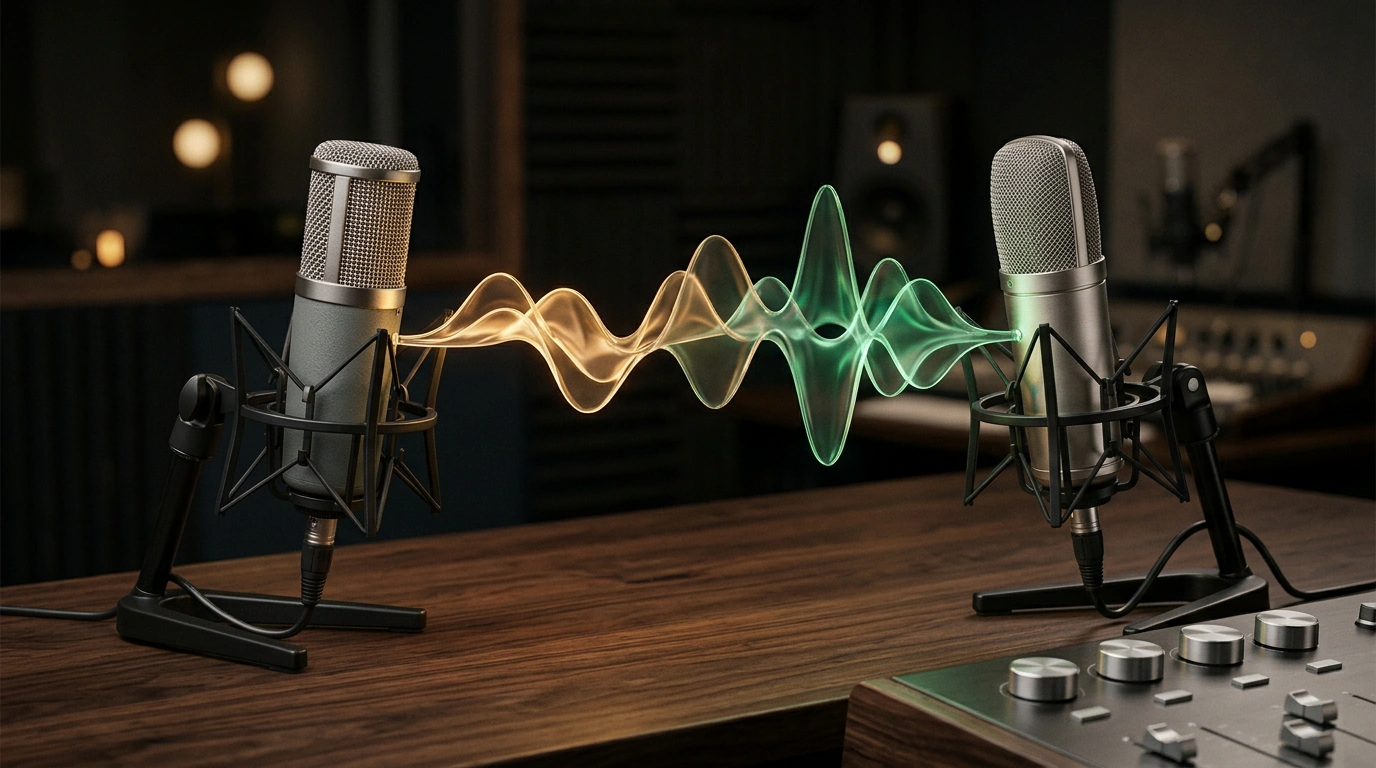
In multi-speaker mode (conversational), two voices act out a scene in a single clip. One live test paired a warm, higher-pitched Vader (using <sigh> and <short pause>) with a deep Rami (style amazed, <gasp>, <chuckles>, an interjection, and the filler words toggle). Clicking Download gives you a clean 24 kHz mono WAV ready for your timeline, and Get code exports ready-to-run Gemini API code.
| Tool | Entry price | Voice library | Languages | Key strength |
|---|---|---|---|---|
Google AI Studio (Flash TTS) | Free | 2,000+ | 100+ | Line-by-line directing, tags, 2 speakers |
ElevenLabs (Eleven v4) | Paid | 17,500+ | 90+ | Dubbing studio, [laughs] / [sighs] tags |
| Murf AI | Paid | 200+ | 35+ | Slide voiceovers and simple dubbing |
Lovo (Genny) | Paid | 500+ | ~100 | Built-in timeline video editor |
AI Studio wins on intonation control and a free starting line, but it remains a sandbox with no timeline. When you need a full dubbing suite and a massive voice library in one place, ElevenLabs is still easier to work with.
Four limits of the free tier
Before moving your workflow into AI Studio, keep four strict rules in mind. First, rate limits and privacy: on the free tier, Google may use submitted text to improve its products. Never paste NDA scripts, client drafts, or personal data here.
Second, the multi-speaker ceiling. Each request supports at most two speakers, and you can't mix custom voices together in that dialogue. A three-person scene has to be stitched together in an audio editor.
Third, the invisible SynthID watermark: Google automatically embeds this acoustic mark into every WAV file. Fourth, strict cloning rules: 30-second voice replication requires recorded consent from the speaker and is blocked in AI Studio across the UK, EEA, Switzerland, India, Illinois, and Texas.
For YouTube narration, two-host mini-podcasts, and testing before buying a subscription, free AI Studio is more than enough. For confidential client work, large-scale dubbing, or scenes with three or more voices in one take, stick with ElevenLabs or switch to the paid Gemini API.