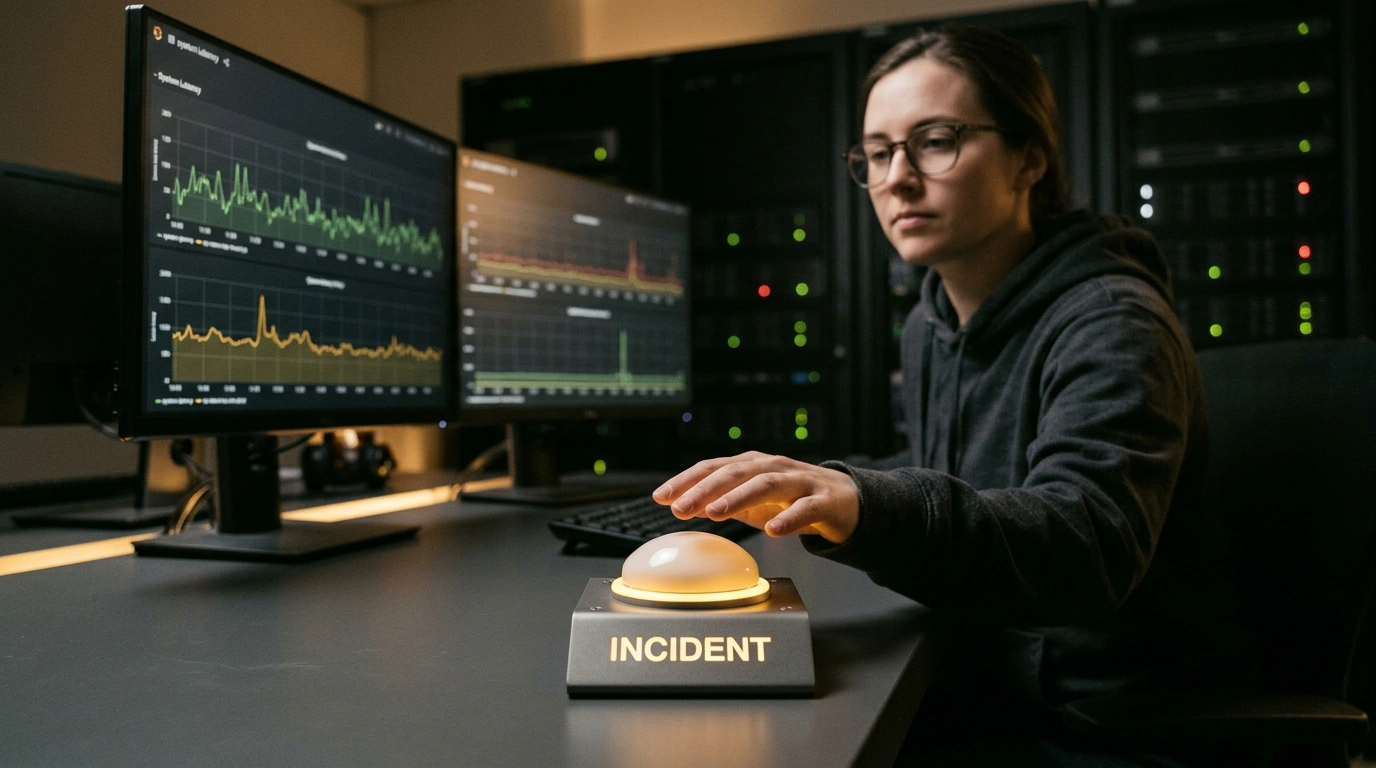
How many minutes are you willing to poke at a weird graph alone on call before hitting the "Declare Incident" button?
You know the scene. You're on your on-call shift, first in line for production surprises. You tweaked a dashboard two days ago and just opened it to check the metrics. A strange kink in the line catches your eye. Alerts are quiet, the service is usually rock-solid, yet if it's silently breaking right now, things will blow up fast.
Your first instinct is to spend ten more minutes checking logs on your own—maybe it's nothing, maybe it'll clear up. Hugo van der Horst, former Adyen SRE and incident manager (now founder of Recoverable), explains this hesitation simply in an essay for The Postmortem newsletter (originally published on Uptime Labs and reprinted on October 30, 2026). It isn't laziness. The on-call engineer knows all too well what one click will cost them.
The Hidden Price Tag of One Button
Every field on an incident form was added with good intentions. Pick a severity level that decides who gets paged and how urgently things move. List affected products and estimate the damage. Become the incident commander. Schedule a postmortem—the written breakdown of root causes and prevention tasks—and track follow-ups. In banking and other regulated industries, strict reporting deadlines pile on top.
Each step looks small on its own. Dump all of them onto one person in the first minute, though, and the price of pressing "Incident" skyrockets. A mental calculator kicks in: I'll trigger a ton of bureaucracy, wake people up, and what if it's a false alarm? Do I really have to run the postmortem if I've never led one? Van der Horst points out how quickly teams slip into absurdity: "Let's estimate revenue loss right now, before anyone has even confirmed something is broken."
Paying Twice for Silence
If that chart really did signal an outage, every quiet minute hurts the team. While one engineer scrolls through logs alone, teammates who could spot the bug in two minutes have no idea anything is wrong. Support doesn't know what to tell customers, and people pulled in later start blind and behind schedule.
There's a second, sneakier cost too. When declaring an incident is expensive, people route around it. That's how shadow fixing starts: production bugs get patched in DMs or private chats, outside the tracker. Incident charts look clean, management is happy, and the team stops learning from real failures.
Three Rules for a Cheap Start—and One Honest Metric
The obvious pushback: if we lower the barrier, won't we drown in false alarms, and what about fintech compliance? You don't need to delete the process—just move the paperwork out of the first five minutes into the stage where an outage is actually confirmed. That's the same principle in Google SRE: Managing Incidents: declare early and often, while keeping coordination lightweight.
Van der Horst boils a cheap start down to three rules. First, make it one step: a single chat command or button plus one short line on what you see. Severity and impact estimates can wait—if declaring takes longer than describing the symptom, the process is bloated. Second, decouple the alert from mandatory postmortems; decide how deep the review goes after the fire is out. Third, separate the person who spots a problem from the person who leads the response. Even a junior engineer on their first shift can notice a weird graph, so "flag it and hand it off" should be normal.
That leaves one simple question in your head: Could something be wrong, and could I use help checking? If yes, hit the button.
Engineer Callen Hebert added a sharp closing point to the October 30, 2026 discussion. Standard MTTR (time from formal declaration to fix) misses the most dangerous delay—the gap between the first noticed symptom and the moment help can jump in. Splitting statuses into suspected and confirmed impact closes that gap. The first lets you call in backup right away without guessing loss numbers, while the second triggers heavy compliance workflows only once the failure is proven.