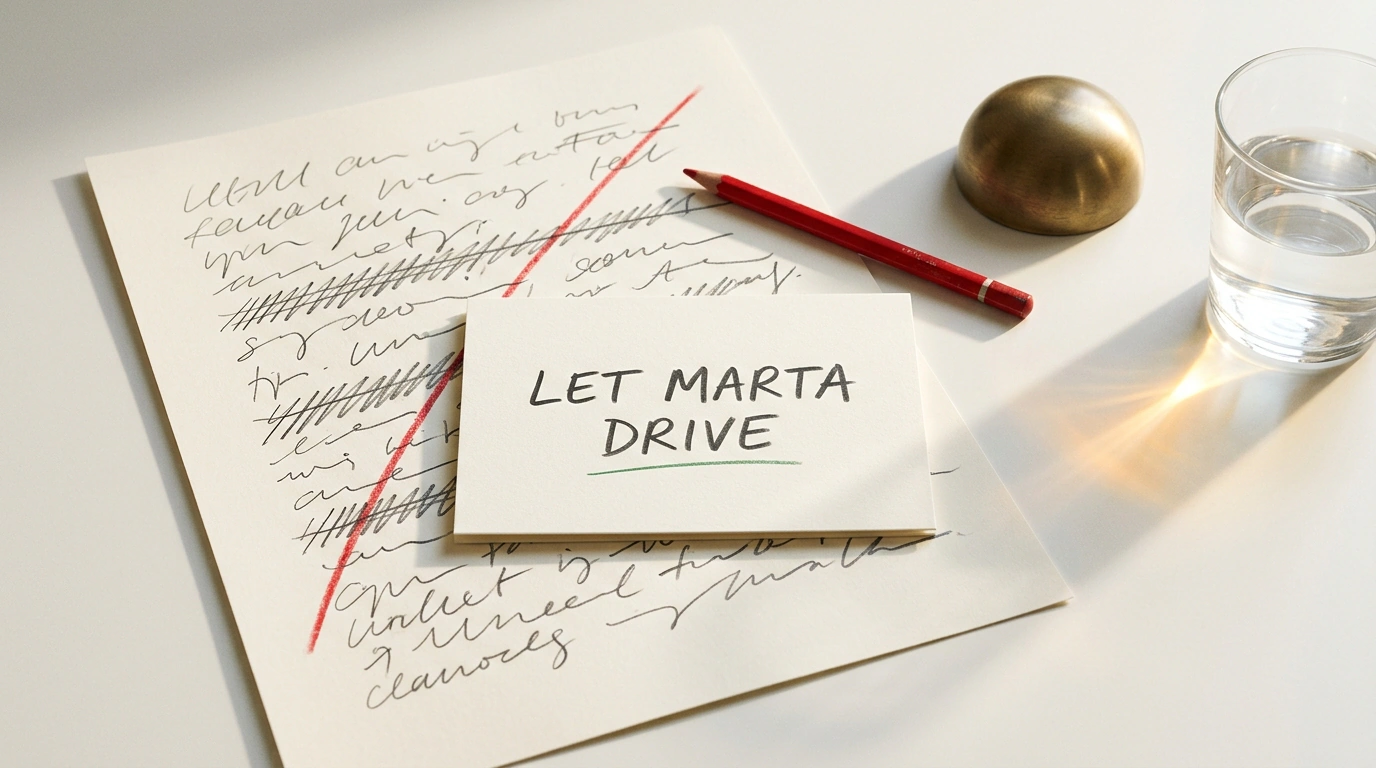
"You used to have to know how to write. Now you have to know how to teach a robot to write. You have to turn from a good copywriter into a ruthless New York Times editor."
Building a StoryBrand author Donald Miller dropped that line on the Marketing Against the Grain podcast right after describing his breakfast. In one hour over eggs and sourdough toast, he and an AI built an entire funnel: a lead webinar, nurture emails, a second webinar, a client worksheet, a sales proposal, and a follow-up sequence.
It sounds amazing until cold math kicks in. "The biggest mistake is thinking you're the only one with access to this," Miller warns. "The moment everyone moves that fast, speed stops being a competitive advantage." Feeds and inboxes are now flooded with copy written fast, smooth, and completely identical. Here is how Miller manages AI and the four filters he puts between a model's draft and the reader.
Why copywriters became editors—and when Miller turns AI off
Miller calls AI a "savant intern"—a fast, eager assistant that churns out ten pages in a minute, yet defaults to bland averages without strict supervision. It never argues and never gets tired, but it thinks in recycled internet clichés.
You have to micromanage an intern like that. Ask a model to "write a high-converting landing page" and you'll get neat copy indistinguishable from a hundred rivals. Miller says AI only amplifies people who already know the craft and can point at a paragraph and say: "This is garbage, rewrite it. Cut the fluff, keep one point." Without an editor's eye, you're just hiring the same ghostwriter as everyone else in your market.
Donald Miller, author of StoryBrand and the one-page marketing framework (Source: storybrand.com)
Miller is no anti-AI purist. Before AI, he wrote 15 books (editing his first New York Times bestseller 54 times, he says). He wrote his new book, The StoryBrand Your Business Field Guide (out January 12, 2027, from Authors Equity), alongside AI—and included a disclosure page at the back explaining how they worked together. Even so, editing out robotic phrasing took more time than writing from scratch.
When starting a fresh idea, though, Miller turns AI off completely. Sitting down for the opening pages of his next book, he closed the chatbot to find an angle "AI wouldn't come up with in a million years." The robot joins later as a copy desk: checking logic, spotting missing arguments, and pulling supporting facts.
Rules 1 and 2: zero cognitive load and survival triggers
The first two filters attack AI's worst habit: trying to say everything at once while sounding clever.
Rule 1. Zero cognitive load. Cognitive load is the mental calories a reader burns figuring out what you sell and why it matters. The harder the puzzle, the faster they close the tab.
One company came to Miller with the slogan "Success made easy." You'd never guess they sold aquariums. Miller changed it to "Kids love aquariums." In a Phoenix, Arizona test market, he says that lifted sales by +99%: a parent walking into a pet store didn't have to decode a riddle.
Miller had the same moment in a grocery aisle staring at 37 drain-cleaner bottles bragging about "pro-enzyme technology." His hand automatically grabbed the bottle with two words: "dissolves hair." "If you want an ad award, be clever," Miller laughs. "If you want to make money, aim for zero cognitive load."
Small businesses fall into this trap by copying giants like Nike, Coca-Cola, Apple (Think Different), or M&M's with Rosser Reeves's "Melts in your mouth, not in your hands." Everyone already knows what soda and candy are—giants only need to remind you. Small brands have to introduce what they do first. Near Miller's office sits a 75-mph highway billboard for fence builders: "Sitting the fence? Hire a Kowboy." "Do you really expect a driver to pull over, pour a whiskey, and solve your wordplay?" Miller jokes.
William Zinsser's rule from On Writing Well fits right here: "Commas are not your friends." Every extra item in a list weakens the punch. In 1958, David Ogilvy pulled a single fact from The Motor for Rolls-Royce: "At 60 miles an hour the loudest noise in this new Rolls-Royce comes from the electric clock." Pure silence, no feature list. Miller notes Oura Ring saw sales accelerate too when it dropped steps and heart-rate lists to focus on one idea: a sleep lab on your finger. Left alone, AI talks too much, gets cute, and strings endless comma lists.
Rule 2. Tie to survival resources. People see roughly 4,000 marketing messages a day, yet their brains notice fewer than a hundred—only the ones linked to survival resources. Today that means money, sleep, time, safety, status, respect, and belonging to a tribe. If your copy doesn't connect your product to one of those, the brain tunes it out.
Rules 3 and 4: three repeatable words and the guide role
Rule 3. Memorable and repeatable. Strong lines get repeated in everyday conversation. Atlanta's transit network MARTA used to run an agency slogan: "Smarter, better, faster next-gen bus network." Riders don't care about a "next-gen network"—they just want to get there on time without traffic.
The StoryBrand team cut it down to three words: "Let MARTA drive." Launched around the 2026 World Cup (with rapper Big Boi and five-minute match-day train intervals), the line stuck for every trip—from commuting to getting home from a bar. It works at home too: Miller repeats "Millers don't give up" to his five-year-old daughter, who used that exact line at a friend's house when refusing help opening a bag of chips.
Rule 4. The customer is the hero; your brand is the guide. Every great story has a hero (Luke Skywalker) and a wise guide (Yoda). When a brand casts itself as the hero, the customer's brain reads it as a rival for resources. According to Miller, that sank "I'm with her" for Hillary Clinton and "Jeb can fix it" for Jeb Bush (casting the politician as hero without saying what he'd fix). Miller says that after Bush changed his slogan on their advice, his polling ahead of the South Carolina primary jumped 10%.
| Case | Before (heavy load / self-hero) | After (clear and direct) | Why it worked |
|---|---|---|---|
| Aquariums | Success made easy | Kids love aquariums | Cut the abstraction—meaning is instant |
| Drain cleaner | Pro-enzyme technology | Dissolves hair | Named the real problem without fake science |
| Fence billboard | Sitting the fence? Hire a Kowboy | Need a fence? We build it | Puns fail at highway speed |
| MARTA transit | Smarter, better, faster next-gen bus network | Let MARTA drive | Three words anyone can repeat |
| Politics | I'm with her / Jeb can fix it | A better life for country | Shifted focus onto voter benefit |
Scrubbing AI tells and one page for 95 AWS teams
Even with four rules, models sneak AI signatures into drafts. Miller immediately loses trust in a YouTube speaker the moment they say "and here's the best part" or "this is the part that nobody understands." You can hear them reading a robot's script. Ban those phrases explicitly in your prompt.
To avoid drowning in dozens of prompts, Miller's new book packs the "4–5–6" system onto one sheet (StoryBrand Messaging Canvas). On the left sit core messages: five soundbites, a clear offer line, an elevator pitch, and a brand story. On the right sit assets for three funnel stages:
- Curiosity — hook attention with one clear thought and zero clutter.
- Enlightenment — explain the details on your site, in a PDF, or on video.
- Commitment — make a concrete offer and close the sale.
Cover of Donald Miller's book The StoryBrand Your Business Field Guide (Source: storybrand.com)
Even before publication, AWS VP Steve Sloan brought Miller in to work with four executives, then gathered 95 AWS teams and partner companies in Seattle. They filled out 95 one-page sheets with sharper slogans, after which Sloan, according to Miller, replaced AWS's previous internal marketing tool with that sheet. The workshop took place about three months ago; final numbers are still coming in, though Sloan expects swapping 95 vague slogans for clear offers could be worth billions of dollars.
Editor's filter for AI prompts and drafts
- The offer sells one main thing with no comma lists or clever riddles.
- It's obvious which survival resource the buyer gets (money, time, sleep, safety, status).
- The core line fits in 3–5 words anyone can repeat to a friend.
- The customer's problem and win sit at the center, not bragging about an 'innovative' company.
- AI tells like 'and here's the best part' or 'what nobody understands' are scrubbed out.
- AI stays turned off at the start of a new campaign until you find an original angle.