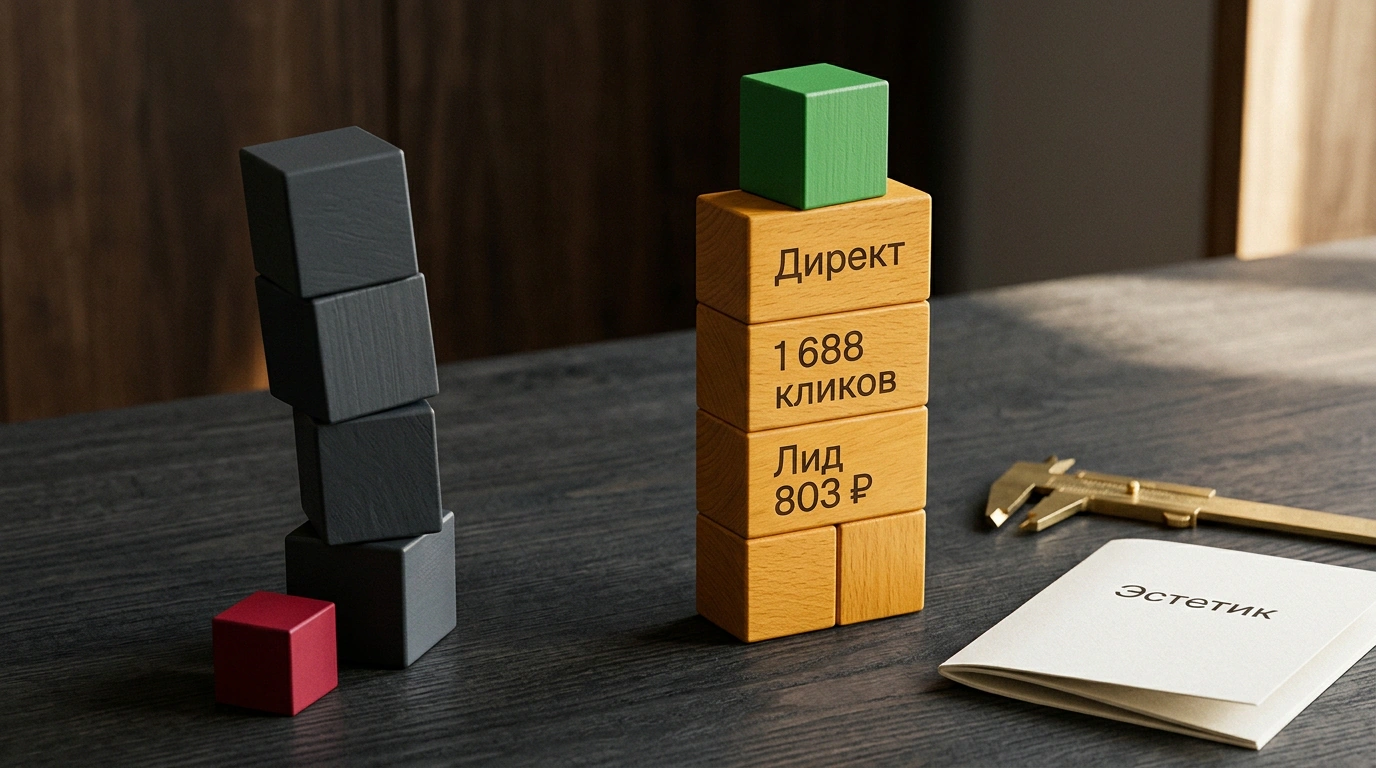
Tomsk cosmetology clinic "Estetik" achieved verified leads at 803 ₽ in Yandex Direct product campaigns, while an on-site quiz brought in over half of all spring inquiries. They pulled this off in a capped local market with a monthly budget under 80,000 ₽, strictly without discounts or free consultations.
That turnaround only worked after two tough changes: the team ditched granular segmentation across dozens of narrow campaigns and bypassed a stalled main-site redesign. Using numbers from agency owner Alexander Svistunov's talk at Vitamin.tools' "Clients Nearby" conference and his case study on vc.ru, let's see where local search ads break and how to fix them.
Why the First Launch Failed and 37 Query Groups Starved the Algorithms
Estetik has operated in Tomsk since 1999. It had plenty of repeat clients, yet new patients made up no more than 15% at the start. Its target audience is women aged 35 to 55 with above-average income. These clients care about doctor credentials, equipment, and a medical approach, and the clinic refuses to run discounts or free visits.
Its first try with Yandex Direct in January–February 2024 nearly killed any desire to try again: 1,688 clicks yielded just 6 recorded conversions. One campaign in the Yandex Advertising Network (RSYa) alone burned through 1,472 clicks and roughly 13,000 ₽ without a single inquiry.
The new agency stepped in during autumn 2025 at peak season, launching ads on December 4 with an 80,000 ₽ monthly cap. Right there, the team nearly stepped on a classic local-marketing rake. During keyword research, they gathered 37 potential query groups: general cosmetology, RF lifting, biorevitalization, lesion removal, and other treatments. Even after merging a few rare procedures, the structure stayed far too fragmented.
By textbook logic, narrow landing pages for specific queries should boost relevance. In Tomsk's real market, those clusters simply lacked search volume, whereas general cosmetology ran much steadier. Later, the agency admitted openly: if they launched from scratch today, they wouldn't build half of those narrow pairings and pages.
The reason for that failure is spelled out in Yandex Direct's documentation. Automated strategies like "Maximize Conversions" or target CPA need at least 10 conversions per week per campaign, and the weekly budget must exceed 10x your real cost per lead. If your regional cap is 80,000 ₽ a month, that's about 20,000 ₽ a week. Spread that across a dozen tiny campaigns, and none of them can physically collect ten leads in seven days, so the algorithm stops learning.
In a city with limited search demand, don't slice your budget into ten narrow campaigns just for a tidy structure. First calculate with the 10 x CPA rule how many weekly leads one campaign can afford, and group services into broader clusters.
Site in Redesign: How They Launched Traffic Without Waiting for Developers
In December 2025, another hurdle got in the way: the clinic's main website was stuck in a redesign. Building new ad landing pages on it was impossible, and waiting months for completion meant missing high season.
A simple distinction helps here. Having no website at all is one thing; lacking dedicated pages for paid traffic is another. Estetik fell into the second group, so they didn't freeze the launch.
The team built standalone landing pages on Tilda and hosted them on subdomains of the main domain. The clinic's designer handled visuals and layout, while the agency structured the blocks, answered patient questions, and framed the offer. That workaround let them launch fast in December and test hypotheses on live traffic right away.
Quiz, Price Before the Click, and RSYa's Comeback: What Turned Things Around After March
The real shift began in spring after a weak March. In the text of the case study, the agency cites monthly numbers: 7 inquiries in March, 23 in April, and 31 in May. Handle these figures carefully, because the same article also cites the clinic's March–May log showing 103 verified inquiries. Counting methods differ, so you shouldn't add or mix those numbers directly. To filter out accidental triggers and verify real phone calls, the team connected call tracking.
The first strong move was replacing a blunt "book now" form with a quiz. Picture a 35–55-year-old client: she often doesn't know upfront whether she needs biorevitalization or another method, so asking her to pick a procedure and time slot immediately creates friction. They added a quiz where she described her goal and left a contact for a tailored recommendation. Per the clinic's log, 57 of the 103 verified March–May inquiries came through the quiz—more than half the total flow.
The second move was product campaigns showing the price right in the ad. Services were packaged as individual offers with real prices visible in search results. It works as a simple pre-click filter: people see the cost range before clicking, then land on the quiz page. For a clinic with no discounts or free consults, that barrier instantly filtered out "just browsing" clicks. This pairing delivered 33 inquiries at an average CPL of 803 ₽.
The third move was reviving RSYa. After 2024's flop of 1,472 clicks with zero leads, they didn't ban the network forever—they rebuilt placements and audiences. They connected CRM segments and launched retargeting to a separate landing page for people who had already shown interest. At one stage, retargeting drove about a quarter of monthly inquiries. Meanwhile, they tested geo-targeting near the clinic and shopping malls, and later expanded impressions to nearby Seversk.
Before and After, an Honest Channel Breakdown, and Limits of the Method
Putting the first launch next to the rebuilt system shows which exact pieces changed.
| Parameter | Failed Launch (2024) | Rebuild (2025–2026) |
|---|---|---|
| Campaign structure | Narrow segmentation, separate RSYa wasted | Consolidated around general cosmetology, product ads, retargeting |
| Landing pages | No dedicated pages for paid traffic | Tilda subdomains, quiz, and retargeting landing page |
| Pre-click filtering | Direct CTA with no price shown | Service prices in product ads + call tracking |
| Result | 1,688 clicks and 6 conversions; RSYa 1,472 clicks / ~13,000 ₽ / 0 leads | Mar–May: 7 → 23 → 31; 57 of 103 inquiries via quiz; 33 leads at 803 ₽ |
Comparing average CPL across formats in the rebuilt setup shows a stark gap: product campaigns with the quiz cost 803 ₽ per inquiry, Search cost 2,472 ₽, and RSYa came in at 2,890 ₽. Still, you shouldn't jump to the conclusion that product ads always win. The agency notes honestly that formats reach different user intents: here, the product feed won because it showed prices before the click and paired tightly with the quiz.
Several tested ideas predictably flopped. Promoting via Yandex Maps inside Direct and via Yandex Services brought almost no inquiries. Narrow individual procedures lacked minimum demand in Tomsk, and laser hair removal hit a wall of price competition.
One last caveat concerns the CPL metric itself in clinics and repeat-visit businesses. When clients come back regularly, a cheap lead for a one-off procedure isn't always more profitable than a costlier lead for comprehensive treatment or ongoing care. Reallocate budgets between campaigns only when you can see the full chain: inquiry, booking, completed visit, and total patient lifetime value.