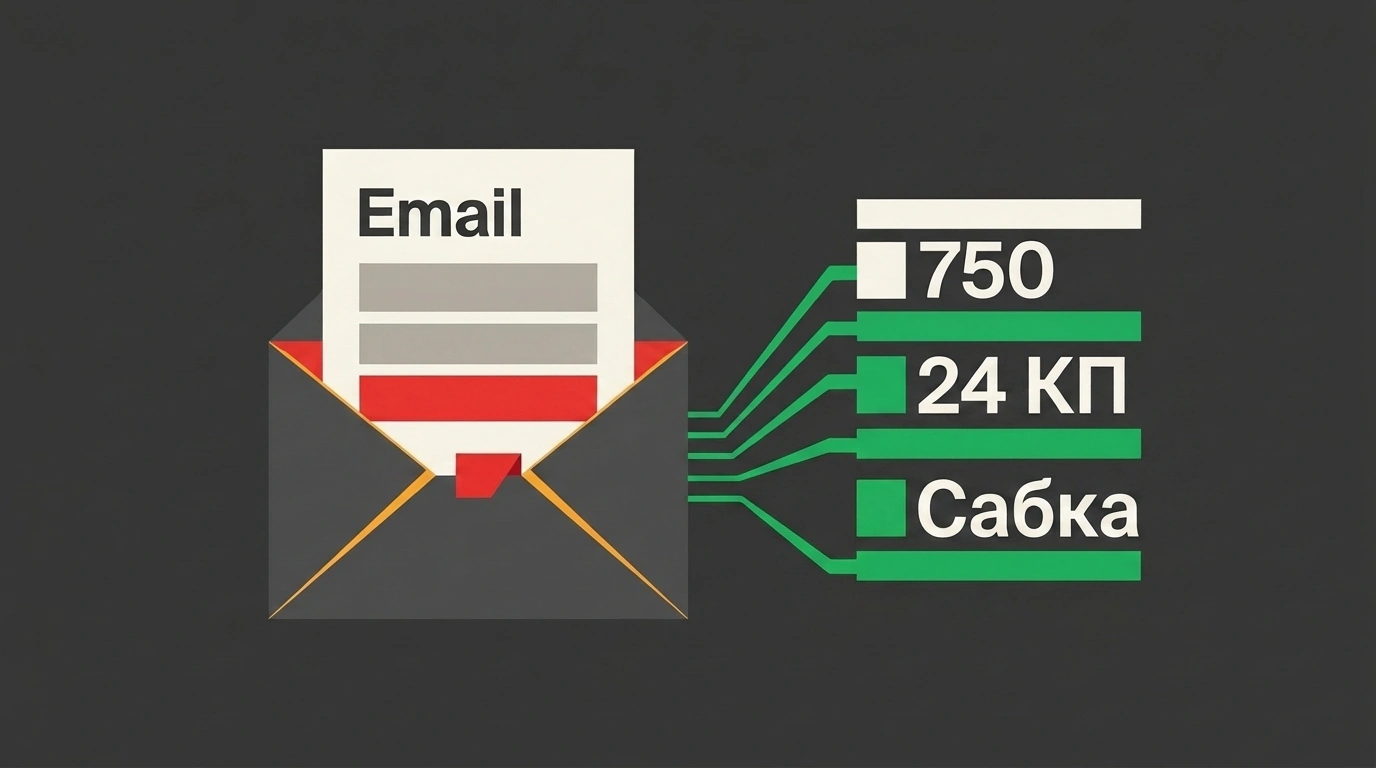
"If employees are each using ChatGPT on their own, the team already has something to discuss. For example, who pays for the subscriptions and how to book those expenses in accounting." That is how agency Gusarov explained the launch of its September campaign in a case study on vc.ru. In autumn 2026, the team tested demand for Sabka, a corporate service offering a shared AI subscription with official invoice billing.
Cold outreach—first-touch emails to unfamiliar companies—rarely earns high response rates. Recipients usually close an upfront sales pitch by the second sentence. In this test, 3.2% of recipients asked for a commercial proposal or a call themselves, with no long decks or hard follow-up pressure. Let's break down step by step where the exact pain point worked and where email tech tripped them up.
A Narrow Segment With an Existing Accounting Headache
For the launch, they targeted advertising, marketing, SMM, and SEO agencies. Their staff work with copy, visuals, video, and analytics daily, so ChatGPT and similar tools are already part of their workflow.
The seller didn't need to convince executives that AI is useful. The headache already sat in daily operations: who pays for scattered foreign subscriptions, how to avoid losing access, and how to put those costs on the books. When a client already wrestles with the task in practice, a shared team plan paid by invoice hits the exact need.
To make recipients recognize their own routine, the team checked company websites before sending and filled two columns in a spreadsheet: agency profile and typical AI tasks. Marketing agencies got examples for copy, ads, and analytics, while SMM teams saw posts, images, and short videos. Similar agencies shared similar examples, yet even that light customization immediately set the email apart from mass spam.
Three Email Blocks and a 750-Contact Funnel
Emails went out from the service founder's name and followed a stripped-down structure.
Email Structure From the Gusarov Case
- The first line asks one direct question: 'Hello! Do your employees use ChatGPT in their work?'
- The main paragraph connects access and billing hassles with the solution: a shared team subscription paid by invoice.
- The closing line offers a simple choice: have AI tools become part of the whole team's workflow, or does everyone use them individually?
That ending doesn't ask you to clear half an hour on your calendar—you can reply in one line straight from your phone. First-touch friction drops when you don't demand a call right away.
The database held 769 contacts, and 750 of them were emailed. Including follow-up reminders, they sent 1,744 emails total, averaging 2.3 emails per contact.
The reply rate reached 3.9%, bringing 29 responses. Out of those, 24 turned into requests for a commercial proposal or a call: 83% of respondents and 3.2% of all 750 contacts. One agency asked for terms and pricing immediately, another asked about a five-seat pilot, and several recipients forwarded the thread to their director.
Deliverability, Missing Metrics, and Limits of the Method
Near the end of the campaign, replies dipped due to a delivery glitch into Yandex Mail. By the team's estimate, 80–90% of inboxes in the list ran on Yandex.
As noted in Yandex's DKIM setup guide, passing filters on Yandex and Yandex 360 domains requires three DNS records: SPF, DKIM, and DMARC. They prove sender authenticity to the receiving server and protect the address from spoofing. In cold outreach, teams use a separate subdomain so they don't burn the main domain's reputation, clean lists to keep bounce rates under 1–2%, and cap new inboxes at 30–50 emails per day.
The case also has honest data gaps. The authors didn't share open rates or final paid conversions: they planned to scale the list after the pilot, but Sabka's promotion paused when the project was sold. If you run outreach for your own product, an ultra-short format works best in a narrow niche with a mature operational problem. Without existing demand or when sending from an unwarmed domain, reply rates will drop fast.