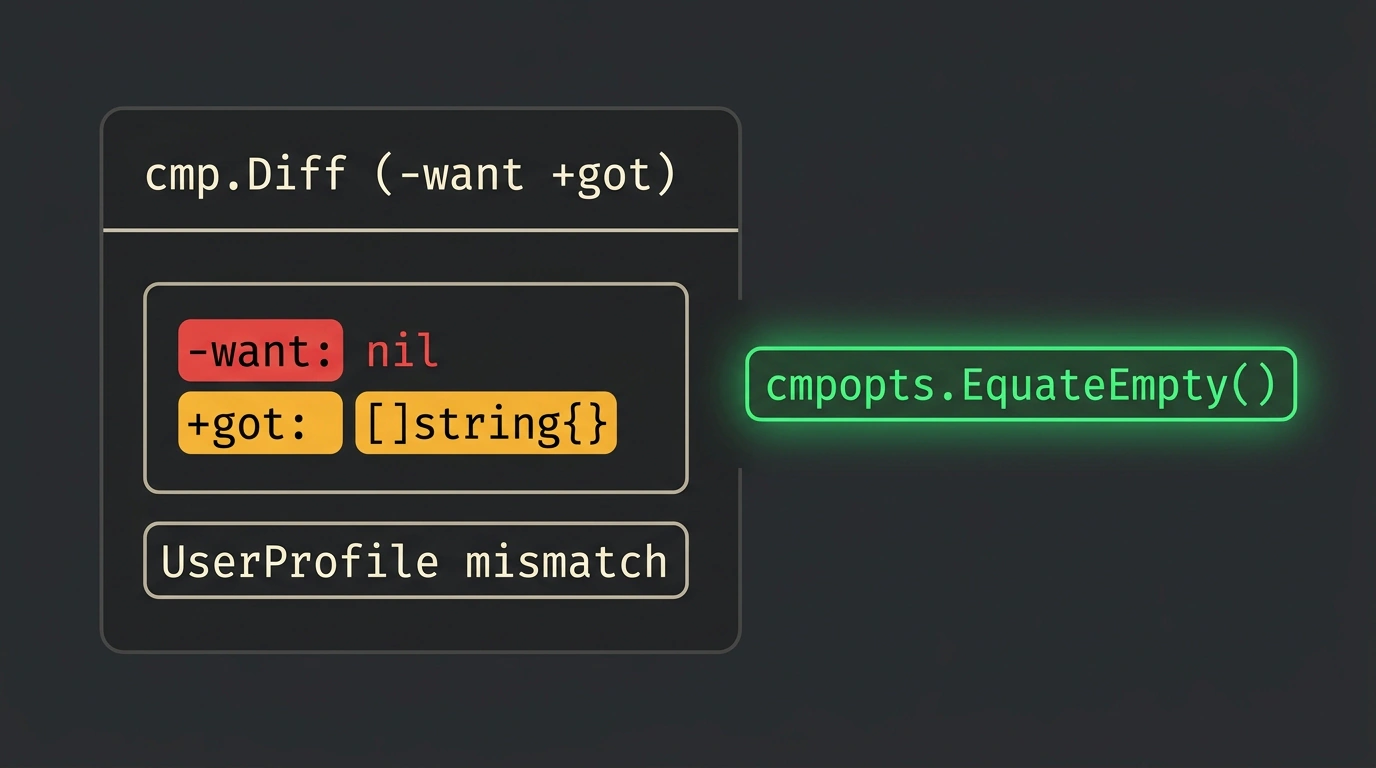
Picture a familiar moment: you run the test suite in a Go project, and one test fails with a terse expected true, got false. You open the test file and see the classic reflect.DeepEqual(want, got). The input is a nested API response struct with thirty fields, embedded slices, timestamps, and metadata. Which field actually mismatched? No clue.
So you start adding fmt.Printf("%+v\n") debug prints, marshaling objects to pretty-printed JSON, and eyeballing two wall-of-text dumps side by side. What should have been a two-second fix turns into fifteen minutes of squinting for a typo in a single boolean flag.
That pain has haunted Go's standard library for years: reflect.DeepEqual gives you a binary yes/no and zero context. Google's engineers built the official go-cmp library (currently at v0.7.0) specifically for tests, turning failure output into a surgical comparison.
Anatomy of cmp.Diff: Reading -want and +got Markers
The workhorse of the package is cmp.Diff(want, got). When two values match, it returns an empty string. When anything differs—even deep inside nested structs—it returns a compact, human-readable report highlighting only the mismatched fields.
Add the package to your project with the standard command:
go get -u github.com/google/go-cmp/cmp@v0.7.0
The diff output uses an intuitive notation:
- Lines starting with minus (
-) show the expected value (want); - Lines starting with plus (
+) show what your code actually returned (got).
Look how clean and expressive your test assertions become:
package user_test

import (
    "testing"
    "github.com/google/go-cmp/cmp"
    "github.com/google/go-cmp/cmp/cmpopts"
)

type UserProfile struct {
    ID       int64
    Username string
    Roles    []string
    authHash string // private unexported field
}

func TestUserProfile(t *testing.T) {
    want := UserProfile{
        ID:       42,
        Username: "alex",
        Roles:    nil, // nil slice
    }
    got := UserProfile{
        ID:       42,
        Username: "alex",
        Roles:    []string{}, // empty zero-length slice
    }

    // Configure comparison rules: ignore private fields and equate empty collections
    diff := cmp.Diff(want, got,
        cmpopts.IgnoreUnexported(UserProfile{}),
        cmpopts.EquateEmpty(),
    )

    if diff != "" {
        t.Errorf("UserProfile mismatch (-want +got):\n%s", diff)
    }
}
Remove those options, and the test immediately pinpoints the exact nested difference without cluttering the output with matching fields. It fits right into TDD practices and reliable Go testing: a failing test should tell you why it failed at a glance.
The Empty-Slice Trap and Unexported Fields
Most developers trying go-cmp for the first time run into two deliberate design quirks:
- Strict distinction between
niland an empty slice: in Go,var s []string = nilands := []string{}are semantically different even though both have length zero. By default,go-cmptreats them as unequal! If your business logic doesn't care about the difference, passcmpopts.EquateEmpty(). Just be careful: if your JSON serializer is supposed to emitnullrather than[], blindly equating them will hide a contract bug. - Panicking on unexported fields: if a struct contains lowercase private fields (like
authHash),go-cmpintentionally panics (panic: cannot handle unexported field) to protect type encapsulation. You have to state your intent explicitly: either skip them withcmpopts.IgnoreUnexported(Type{})or inspect them withcmp.AllowUnexported(Type{}).
Custom Comparers and Where Not to Use It
Another superpower of cmp.Diff is defining custom comparison rules via cmp.Comparer. A classic example is comparing time.Time values, where monotonic clock readings or nanosecond drift can trigger flaky failures:
// Comparer that truncates timestamps to seconds before comparing
var timeComparer = cmp.Comparer(func(x, y time.Time) bool {
    return x.Truncate(time.Second).Equal(y.Truncate(time.Second))
})
One important boundary to keep in mind: go-cmp is designed strictly for tests. Because it relies heavily on reflection, it isn't tuned for high-throughput production paths and can be slow on slices with tens of thousands of elements. Keep it out of production business logic.
For everyday unit and integration tests, though, go-cmp saves a ton of time and frustration by making test failures self-explanatory on the first read.