For a long time, the AI coding world operated under an unspoken consensus: if you need to design and build a working web app from scratch, forget cheap models. Conventional wisdom said only heavyweights like Claude 3.5 Sonnet or GPT-4o could deliver decent results—even if a single serious coding session burned through tens of dollars in subscriptions and tokens.
Right now, we are watching a tectonic shift: a new wave of Chinese lightweight "Flash" models is proving you can assemble a complete product prototype for literal pocket change.
Devhands founder and high-load systems veteran Alexey Rybak ran a revealing live engineering experiment. On stream, he gave two Chinese models—DeepSeek 4.1 Flash (build 1017) and MiMo 2.6 Flash—the exact same task: build from scratch a full-featured web app for learning English via spaced-repetition flashcards (a functional analog to Anki and Quizlet). Everything ran strictly on pay-as-you-go API billing, with no flat-rate subscriptions or hidden caps.
The results were sharp and telling enough to warrant a closer look.
The Metrics Battle: 118 Tokens per Second vs. 67, and a $0.60 Bill
The app required a real stack: user registration and sessions, a flashcard engine, progress stats, a deck editor, an admin panel for content moderation, and data export.
Here is how the numbers shook out by the end of the stream:
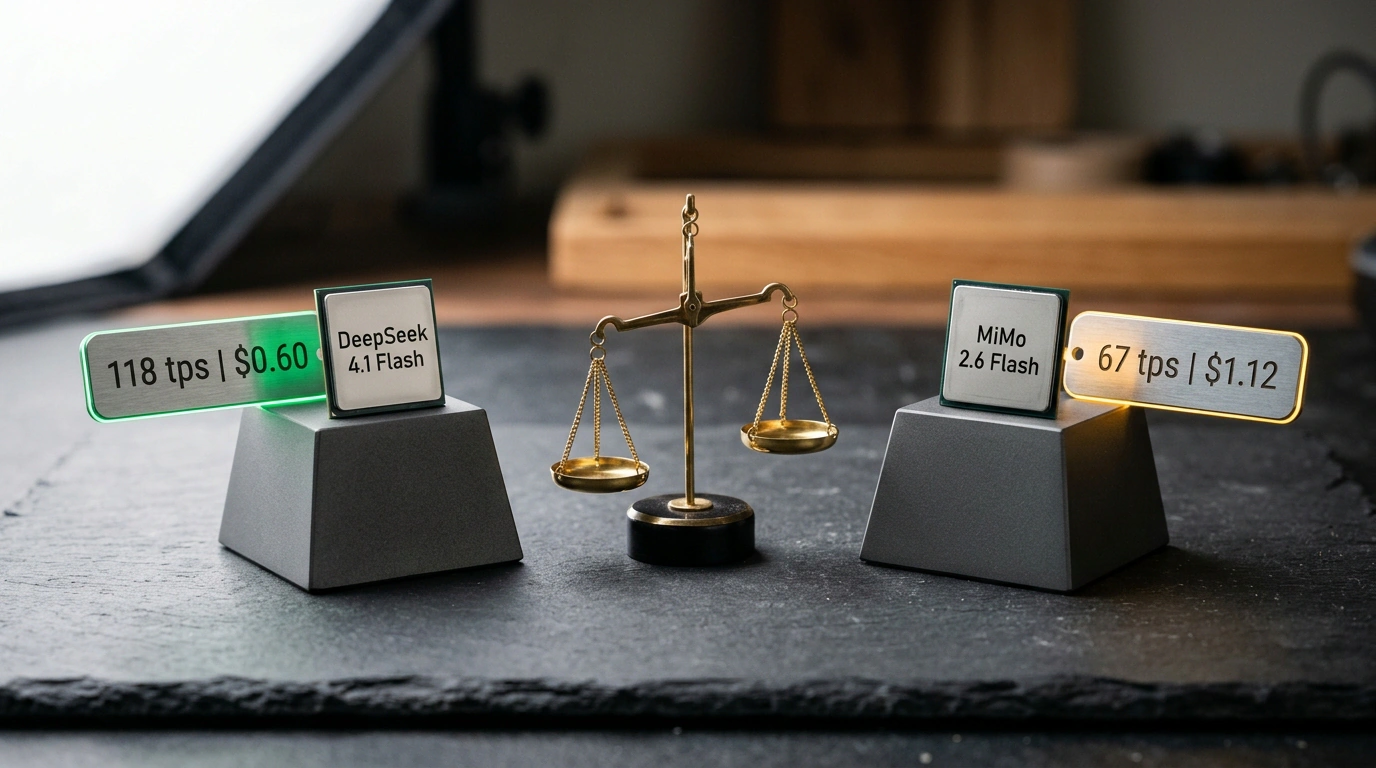
- DeepSeek 4.1 Flash: averaged 118 tokens per second (tps), completed the job in 298 network requests, and cost $0.60 total (sixty cents!). It finished the working app before the livestream even ended.
- MiMo 2.6 Flash: ran at 67 tokens per second, needed 515 network requests, and cost $1.12. Because of the slower pace, it only wrapped up after the broadcast was over.
Those throughput numbers line up with independent benchmarks on Artificial Analysis, where tuned DeepSeek deployments consistently hold above 120 tps at rock-bottom cost per million tokens.
And there is a huge Developer Experience (DX) angle here. The gap between 118 and 67 tokens per second feels night-and-day in real time. Below 70 tps, you inevitably start checking Slack, switching tabs, and losing flow. Above 100 tps, code streams onto your screen at reading speed, making the session feel like a continuous, live conversation.
Style Clash: Grilling vs. Direct Coding
Throughput was only half the story. The real contrast showed up during task decomposition.
At the start, DeepSeek leaned heavily into "grilling" the user. Given the prompt, it fired off dozens of meticulous clarifying questions: which database schema to pick, how passwords should be validated, what card animations to add. Great for a beginner, maybe, but an experienced engineer gets impatient watching the model stall instead of writing files.
MiMo 2.6 Flash took the opposite route: it locked in architectural boundaries quickly and started generating files almost immediately. For a while, it looked like MiMo would win the race. But once heavy coding began, its 2x slower token rate caught up with it: while MiMo was still writing out individual functions, DeepSeek generated the auth, admin, and UI modules in one breath and pulled ahead.
That contrast highlights the trend we examined in our breakdown of price dumping in web development: output speed is becoming a decisive factor in autonomous coding.
The New Reality: Do You Still Need $20 Flagship Subscriptions?
This experiment neatly buries the myth that you need expensive Western subscriptions just to validate an idea or spin up a prototype. Sixty cents buys a working monolith with a database, routes, and a frontend.
Still, don't get carried away. Lightweight Flash models excel at "happy path" code: CRUD endpoints, standard forms, and boilerplate UI components. They still need a sharp human architect watching over edge cases:
- Proper database transaction handling;
- Protection against race conditions under concurrent requests;
- Strict input type validation at API boundaries.
Even so, the market balance has shifted for good. Chinese models like DeepSeek, MiMo, Qwen, and MiniMax have shown that the era of pricey coding monopolies is over—and prototyping costs are trending toward the price of electricity.