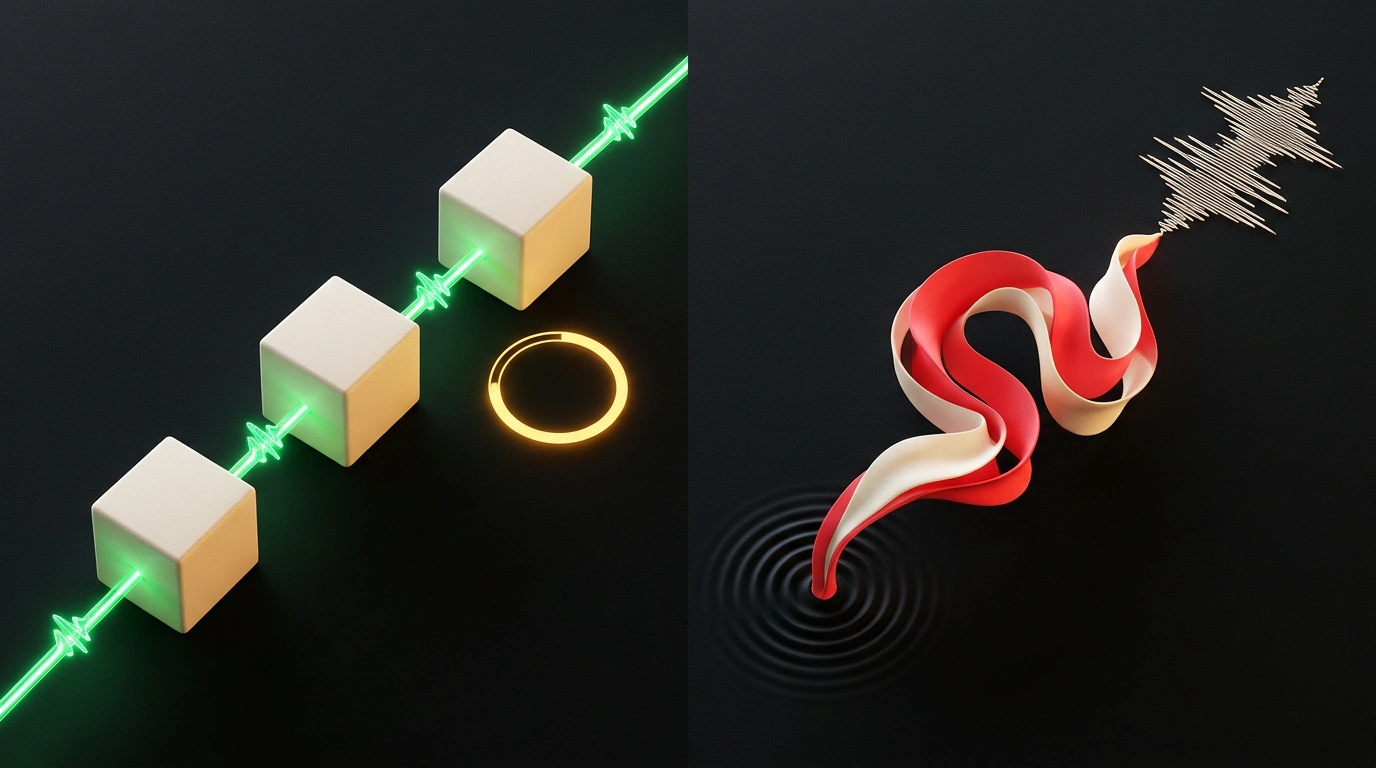
The biggest headache with last-generation voice assistants has always been the agonizing pauses. You ask a question out loud, and an awkward three- or four-second silence hangs in the air while a classic pipeline transcribes your speech to text, runs tokens through a language model, and synthesizes audio back. There is nothing natural about it: you feel like you are talking to a sluggish answering machine, not a conversation partner. In October 2026, the industry offered two radically different engineering answers to this latency crisis.
Hermes Apollo
Nous Research released the open-source agent Hermes Agent v0.2.0.0, codenamed Hermes Apollo. Instead of inventing a brand-new neural architecture, the developers perfected the traditional pipeline through aggressive buffer optimization.
Rather than waiting for the language model to finish an entire paragraph or even a full sentence, Hermes Apollo's speech synthesizer starts playing audio as soon as the buffer collects a complete syntactic chunk as short as 20 characters. That slashes response latency from several seconds down to fractions of a second—the assistant jumps into the conversation almost immediately.
The second pillar of natural conversation is seamless interruption handling (barging). In older systems, once an assistant launched into a long monologue, you couldn't stop it without hitting a button. Hermes Apollo keeps a local speech recognizer listening continuously: say "wait" or "stop," and voice playback cuts off instantly without corrupting the context.
User speech transcription runs locally on the CPU via the lightweight Faster Whisper model, ensuring full privacy and zero third-party API fees. Every conversation outcome and takeaway is automatically synced to a local Obsidian vault, making it immediately accessible to other autonomous scripts.
While Nous Research was busy polishing the modular text-driven pipeline, Jack Dorsey's fintech giant Block took the radical route of cutting text out of the loop entirely.
Dessa by Block
Block unveiled Dessa, an experimental end-to-end audio-native neural network that completely eliminates separate speech-to-text (ASR) and text-to-speech (TTS) stages.
In Dessa's architecture, raw audio goes straight into the neural network and comes out as a continuous acoustic signal—without a single intermediate text token. Trained exclusively on recordings of real human conversations, the model picks up subtle acoustic cues that get wiped out when speech is flattened into letters: rising question inflections, sarcasm or warmth, sighs, ragged breathing, and mid-word chuckles.
The model operates in full-duplex mode, listening to the microphone and generating audio simultaneously. While you speak, Dessa can drop in natural short backchannels ("uh-huh," "listening," "yeah") to signal attention, then smoothly pick up the thread the moment you pause. Physiological response latency sits at 200–300 milliseconds—right in line with natural human conversation. Better yet, local inference has already been demonstrated running on a MacBook Pro with an Apple Silicon M4 Max chip.
If you are tracking how voice AI and agentic systems are evolving, check out our breakdowns of five upgrades in Hermes Agent OS and the Apollo voice module and local multi-agent architecture with shared memory.
Putting Hermes Apollo and Dessa side by side highlights a clear fork in the road for voice interfaces. Hermes Apollo delivers a practical, open-source tool you can deploy today on existing hardware to build local agents. Dessa sketches out tomorrow's standard—where AI stops being a text-reading robot and becomes a listener that genuinely hears you.
