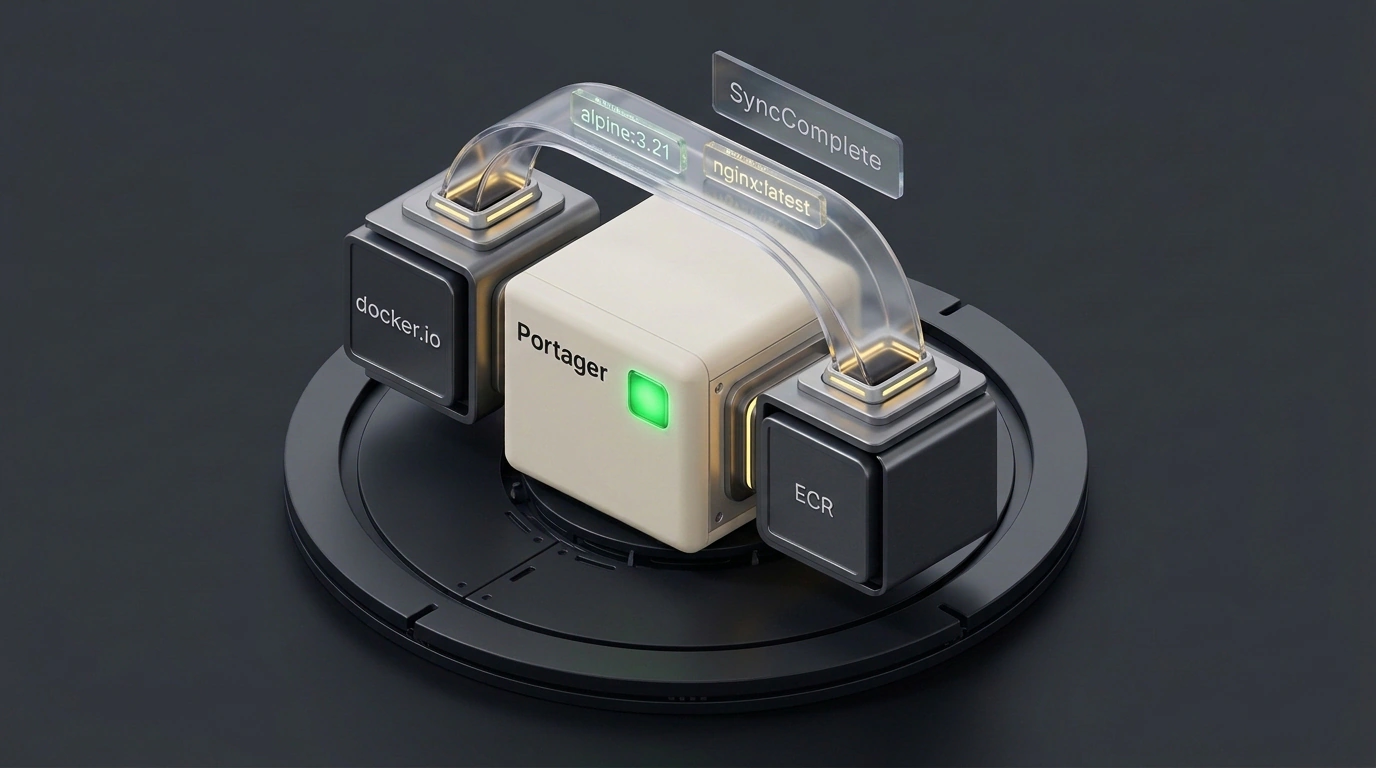
Anyone who has administered Kubernetes clusters inside closed corporate networks or air-gapped environments knows this pain firsthand: worker nodes are strictly forbidden from reaching public registries like Docker Hub or GitHub Packages directly. Security policies require every container image to live inside trusted internal repositories—whether that's a local Harbor instance, AWS ECR, or Nexus.
Usually, teams solve this the old-fashioned way: sprawling bash scripts inside CI/CD pipelines, fragile cron jobs on a build server, or cloud pull-through caches that only work within a single vendor's ecosystem. The moment a runner goes down or an auth token expires, base-image delivery grinds to a halt and on-call engineers are left digging through logs in the dark.
The open-source Kubernetes operator Portager v0.5.0 tackles this natively. It moves image-sync logic directly into the cluster's Control Plane, turning container mirroring into a clean, transparent GitOps workflow.
Operator Anatomy: The ImageSync CRD and Scheduled Reconciliation
The project's name nods to the historical practice of portage—carrying boats and cargo overland between rivers. In the container world, the operator carries OCI artifacts across isolated registries.
Instead of spaghetti scripts, you declare the desired state using an ImageSync Custom Resource Definition (CRD). The operator's controller runs on a defined cron schedule (say, every 6 hours) or responds to manual annotation triggers:
- Manifest checks without pulling layers: the controller sends a lightweight HTTP
HEADrequest to both source and destination registries and compares SHA256 manifest digests. If the digests match, no image layers are downloaded over the network. - Dynamic SemVer tag filtering: rather than hardcoding every patch release (
1.27.1,1.27.2), the operator supports version ranges like~1.27.0or^22.0.0, automatically pulling in fresh security patches. - Automatic repository creation (
createDestinationRepos: true): when syncing to AWS ECR or Harbor, the operator creates the target repository if it doesn't exist yet, preventing push-rejection errors.
All activity streams into standard Kubernetes Events (kubectl describe imagesync), so you can monitor mirroring status without poking around in someone else's CI pipelines.
Hands-On Setup: From Helm Chart to AWS ECR
Installing the operator takes just a couple of minutes using the official Helm chart published in GitHub's public OCI registry:
# Install Portager v0.5.0 operator from the official OCI registry
helm install portager oci://ghcr.io/jarodr47/portager/charts/portager \
  --version 0.5.0 \
  --namespace portager-system \
  --create-namespace

# Verify the controller pod is ready
kubectl get pods -n portager-system -l app.kubernetes.io/name=portager
Once the controller is up, you create a declarative manifest to sync your base system images:
apiVersion: portager.portager.io/v1alpha1
kind: ImageSync
metadata:
  name: corporate-base-images
  namespace: default
spec:
  schedule: "@every 6h"
  source:
    registry: docker.io/library
  destination:
    registry: 123456789012.dkr.ecr.us-east-1.amazonaws.com
    auth:
      method: ecr
    repositoryPrefix: mirror
    createDestinationRepos: true
  images:
    - name: alpine
      tags: ["3.21", "latest"]
    - name: nginx
      tags: ["latest"]
      semver: "~1.27.0"
Apply the resource with kubectl apply -f base-images.yaml. In the describe events section, you'll immediately see the execution phases: RepoEnsured (target repo verified in ECR), ImageSynced (layers copied), and SyncComplete (final transfer summary).
Supply-Chain Security and Production Caveats
The biggest win of running directly inside Kubernetes is tight integration with enterprise security policies. For private registries, you can use standard kubernetes.io/dockerconfigjson secrets, and on AWS you can bind permissions via IAM Roles for Service Accounts (IRSA) with zero static credentials.
On top of that, Portager supports verifying Cosign cryptographic signatures before mirroring. That pairs nicely with the practices we covered in container image integrity verification in Kubernetes with Cosign and Kyverno: images aren't just copied—they are verified before ever entering your closed perimeter.
Keep the caveats in mind, though: the project is at v0.5.0 with a v1alpha1 API. The initial sync of dozens of heavy images will demand solid network bandwidth. And if you pull anonymously from Docker Hub, frequent cron polling will hit rate limits fast—so an auth secret is a must.
For small and mid-sized teams, Portager plugs a longstanding gap in infrastructure tooling, replacing homemade bash scripts with predictable, declarative image delivery.