The classic mistake when building RAG search pipelines looks all too familiar. You set up a vector database, run an embedding search, pull out ten full text chunks, and dump all of them straight into an expensive generative model's context. Most of that context ends up filled with irrelevant noise, your token bill climbs, and the LLM suffers from the "lost in the middle" effect—missing the one crucial line buried inside pages of boilerplate.
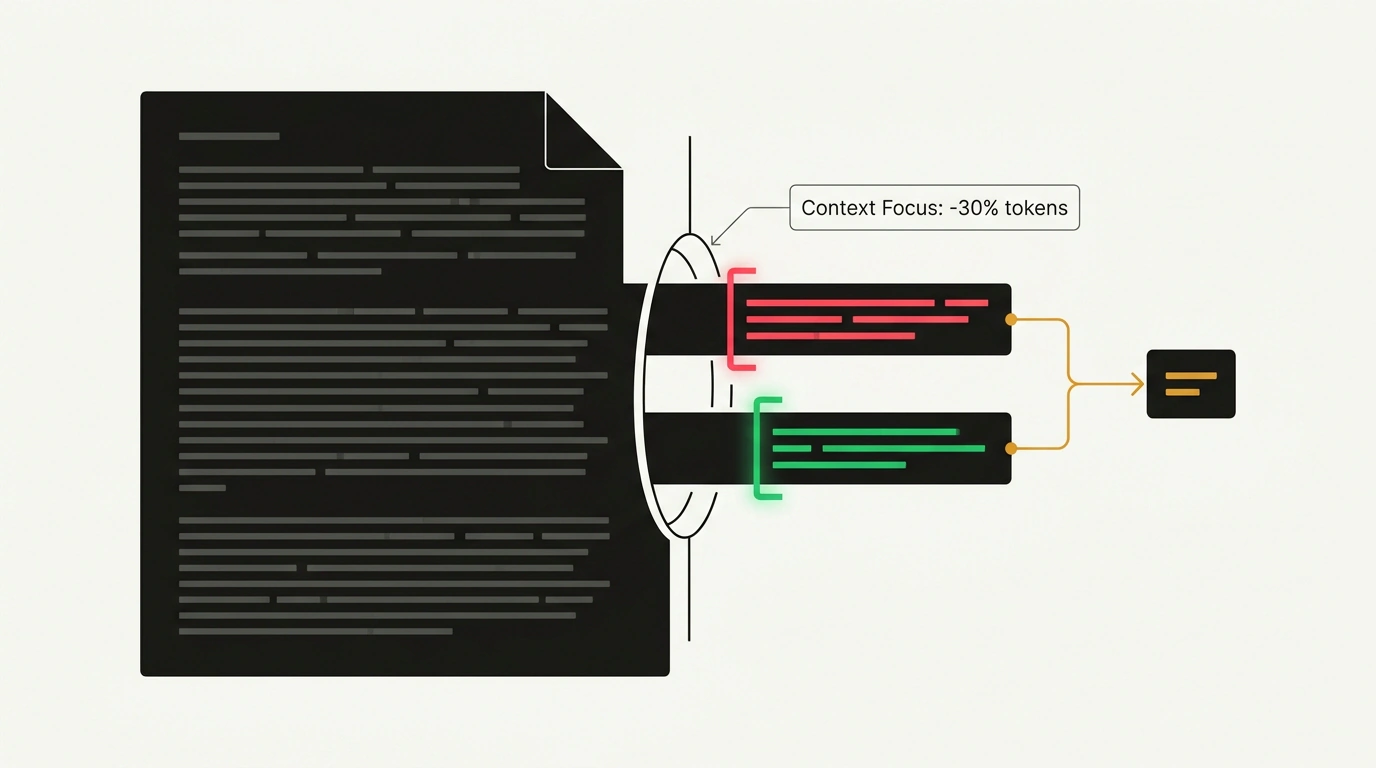
The Cohere Rerank 5 model family tackles this problem at the root. Its headline feature is Context Focus, a mechanism that doesn't just reorder documents by relevance—it surgically carves out the exact meaningful spans, cutting context token usage by more than a third.
Two Contenders: Pro and Fast for Different Workloads
In its fifth generation, the Rerank lineup splits into two specialized models tailored to different workloads:
rerank-v5.0-pro— the flagship model built for maximum accuracy. It handles dense technical documentation, regulatory filings, financial reports, and semi-structured tables.rerank-v5.0-fast— a lightweight, low-latency model. It is tuned for high-throughput agent loops where reranking fires dozens of times a minute in the background.
Both models expand the context window to 32,000 tokens (up from just 4,000 in the previous generation), natively support over 100 languages, and parse JSON and YAML structures directly without flattening them into plain text.
Rerank 5 also introduces calibrated relevance scores. Previously, developers had to guess and pull a fixed number of documents via top_n. Now scores are normalized and comparable across queries, letting you set a strict cutoff threshold (for example, keeping only snippets with score > 0.35).
Context Focus: Trimming Noise Before It Hits the Generator
The biggest architectural leap in Rerank 5 is Context Focus. A standard reranker takes a list of retrieved documents and returns them sorted in a better order, but the documents themselves stay untouched. If a 2,000-word policy doc contains only one useful sentence about warranty deadlines, the entire block still gets shipped to the generator.
Context Focus works differently: the model reads the document and returns exact character ranges (start and end) holding the direct answer to the query. When assembling your final generator prompt, you pass along only those extracted passages. According to Cohere's benchmarks, this shrinks context volume by over 30% while lowering the risk of hallucinations.
If you are systematically optimizing infrastructure costs, take a look at our guides on strategies for cutting API request expenses and Ponytail context compression techniques. Pairing pre-filtering with pinpoint reranking delivers real savings in production.
Integration in Practice: Python SDK and LlamaIndex
Enabling Context Focus in Python takes just a relevant_spans parameter in the official Cohere API v2 client:
import cohere

# Initialize the Cohere API v2 client
co = cohere.ClientV2(api_key="COHERE_API_KEY_HERE")

documents = [
    "Equipment return policy: customers must notify support within 14 days of delivery.",
    "Company founding history: the first office opened in Toronto in 2019 by a group of researchers.",
    "Warranty service terms: breaking the security seal voids the hardware warranty."
]

query = "What is the deadline for reporting an equipment return?"

# Call rerank-v5.0-pro with pinpoint answer span extraction
response = co.rerank(
    model="rerank-v5.0-pro",
    query=query,
    documents=documents,
    top_n=2,
    relevant_spans={"mode": "enabled", "threshold": 0.15, "max_spans": 2}
)

for rank, result in enumerate(response.results):
    doc_text = documents[result.index]
    print(f"Rank {rank + 1} | Score: {result.relevance_score:.4f}")
    if hasattr(result, "relevant_spans") and result.relevant_spans:
        for span in result.relevant_spans:
            print(f"  -> Context Focus: {doc_text[span['start']:span['end']]}")
In a LlamaIndex search stack, the model plugs right in as a node post-processor:
from llama_index.core import VectorStoreIndex
from llama_index.postprocessor.cohere_rerank import CohereRerank

# Configure the reranking node with the fast Rerank 5 Fast model
reranker = CohereRerank(
    model="rerank-v5.0-fast",
    api_key="COHERE_API_KEY_HERE",
    top_n=3
)

# Build the query engine with initial retrieval followed by compression
query_engine = index.as_query_engine(
    similarity_top_k=15,
    node_postprocessors=[reranker]
)

response = query_engine.query("What are the penalties for missing Q2 SLA targets?")
print(str(response))
The mechanism delivers its best results on large text chunks between 1,000 and 10,000 characters—think articles, policy manuals, and reports. On tiny snippets under 100 characters, the overhead of computing spans outweighs any token savings.
Trade-Offs and the Cost Equation
The main limitation of Cohere Rerank 5 is network dependency: it runs as a cloud service, so you have to budget for API latency. Also, Context Focus is off by default, meaning you need to turn it on explicitly in code via the relevant_spans dictionary.
Even so, adding a dedicated reranker easily pays for itself in any enterprise knowledge base. The cost of calling Rerank 5 is orders of magnitude lower than pushing extra noise tokens through a generative LLM, and your answer accuracy stops suffering from random clutter in the retrieval set.

