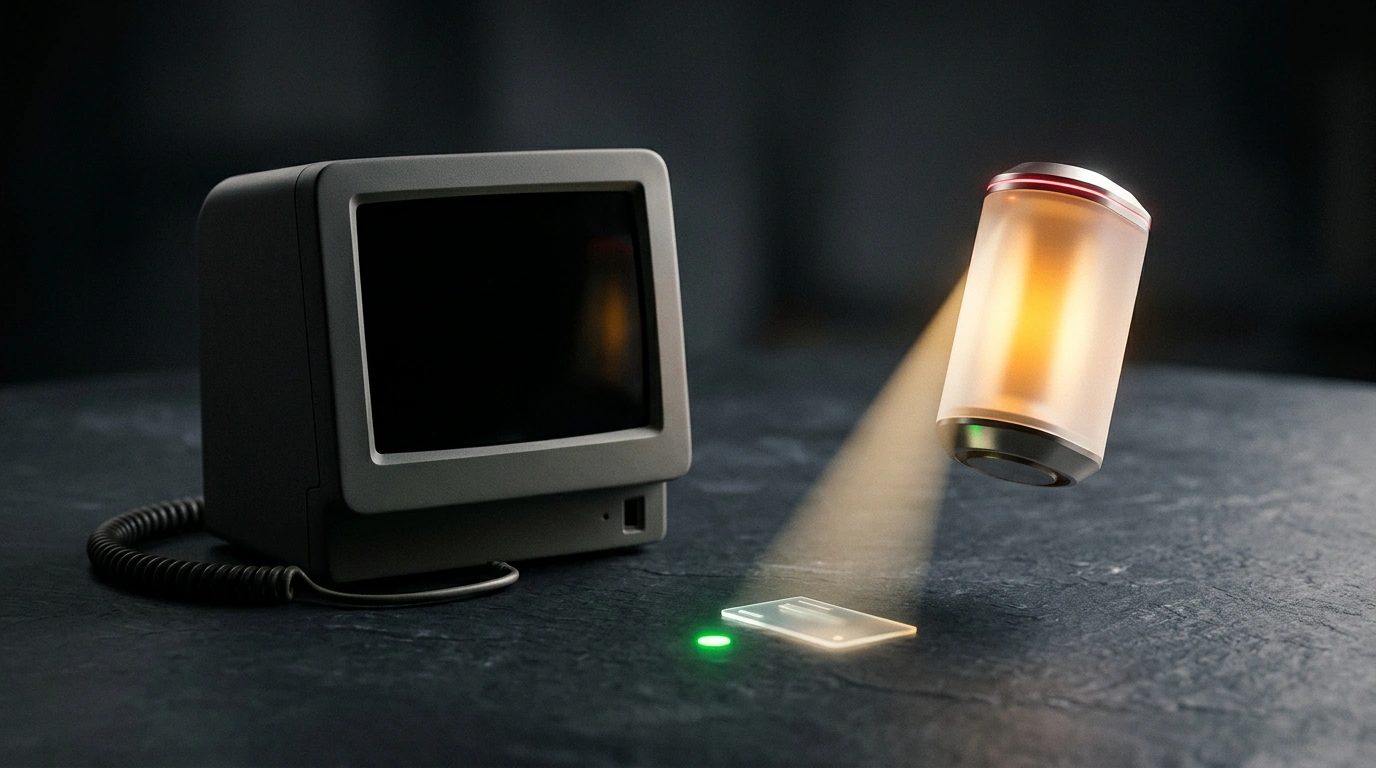
Think about how we have interacted with computers for the last thirty years. Whether it was the MS-DOS command line, the Windows graphical interface, or the ChatGPT chat box, the underlying principle always remained strictly reactive: the machine sits quietly and waits for a human to press a key, click a mouse, or type a detailed text prompt. All initiative, all planning, and all responsibility for keeping track of time rested solely on your shoulders.
If you needed to know whether a nightly project build had finished, whether servers had gone down, or whether competitors' prices had changed, you had to open a tab yourself and check the status. But the emergence of the Claude Duet concept from research lab Anthropic marks a fundamental tectonic shift: for the first time, artificial intelligence transforms from a passive tool into a proactive partner capable of acting on its own initiative.
What excites me most about this concept is how quietly it buries the cult of "prompt engineering." Let's unpack how proactive agents work under the hood and why the habit of chatting with a neural network will soon look just as anachronistic as dialing a phone number on a rotary dial.
Paradigm Shift: From Waiting for a Question to Taking Initiative
What is actually the most irritating thing about modern neural networks? Having to constantly hold context in your head and remind the model about everything under the sun. You assign a task to run a complex code audit or gather analytics across a hundred competitors. The process takes half an hour. All that time, you either stare hypnotized at a scrolling progress line or get distracted by other work, forget about the task, come back two hours later, and discover the script tripped on minute five over a missing environment variable.
Claude Duet's proactive architecture is built on a model of equal partnership (Duet). The agent doesn't just execute a one-off command; it takes continuous ownership of the task's context:
- It runs in the background as a system service without requiring an open browser tab;
- It autonomously tracks key metrics and the lifecycle of external processes;
- It reaches out to the human only when a significant anomaly appears in the data that requires a strategic decision, or when a complex compute chain completes successfully.
The difference here is the same as between a careless intern whom you have to watch over their shoulder every minute, and a seasoned lead engineer who quietly takes a task, smooths out the rough edges along the way, and comes back to you with a finished solution and three options for action.
Event-Driven Model and Background Monitoring Without Spam
The main engineering challenge of any proactive system is how not to turn into an obnoxious source of spam. If an agent pings you with push notifications over every trivial detail ("I read line 45," "I checked the ping"), you'll disable it within ten minutes.
Claude Duet implements an event-driven architecture with multi-layered trigger filtering:
- Passive observation layer: the agent listens to a stream of system events—Git commits, payment gateway webhooks, file changes in a project directory, incoming emails. At this layer, the model doesn't burn expensive tokens on reasoning; lightweight local filters do the work.
- Cognitive significance assessment: when an event occurs (say, a build fails with a package compilation error), the agent activates a compact model to gauge the severity of the incident. If the error is trivial and the algorithm knows how to fix it (for instance, clearing and restarting a cache), it resolves the issue itself.
- Proactive Ping: the agent disturbs a human only when a fork in the road appears where the cost of a mistake is high or human intuition is required. Moreover, the notification doesn't arrive as a dry error message, but as a complete synopsis: "Auth test failed due to an external API update. I checked the docs: the token format changed. Here's a ready two-line patch—click 'Accept' for me to merge it into the branch."
This is the exact mechanism we explored earlier in our piece on the proactive mode of Claude Duet background agents: the agent initiates task execution on its own without a direct prompt, freeing the human from the role of perpetual dispatcher.
Permissions, Privacy, and Boundaries of Autonomy
Naturally, any sensible person immediately has a security question: "If the agent runs in the background and decides for itself when to act, won't it cause havoc behind my back?"
Safety in the Duet concept is guaranteed by three strict architectural barriers:
- Principle of Scoped Delegation: the agent does not get access to your entire computer or cloud. You delegate a specific working perimeter to it with a clearly defined list of allowed actions and a cap on the token budget per task.
- Separation of reversible and irreversible actions: all operations that can be safely rolled back (running tests, reading logs, building artifacts, creating a local Git branch) are performed fully autonomously by the agent. Any actions with irreversible consequences (sending an email to a client, transferring money, deploying to production, deleting data) require mandatory physical human confirmation (One-Click Approval).
- Local context storage: agent triggers and action history are aggregated on the user's device, avoiding continuous transmission of sensitive metadata to unverified third-party clouds.
How Everyday Work with Neural Networks Will Change
We are gradually moving from the paradigm of "write a long, perfect prompt" to the paradigm of "set the rules of engagement and live in peace."
In the near future, your workday won't be built around endless chat threads with a dozen different models. You will formulate goals, define boundaries of autonomy, and divide areas of responsibility among background agents. One agent quietly watches server health, a second analyzes research papers in your field and compiles an evening digest of what matters most, and a third drafts sprint completion reports.
Artificial intelligence stops being an exotic toy that demands constant babysitting. It finally becomes what it was meant to be from the start—a reliable, discreet, and unobtrusive partner that protects your attention and lets you focus on genuinely creative and hard problems.