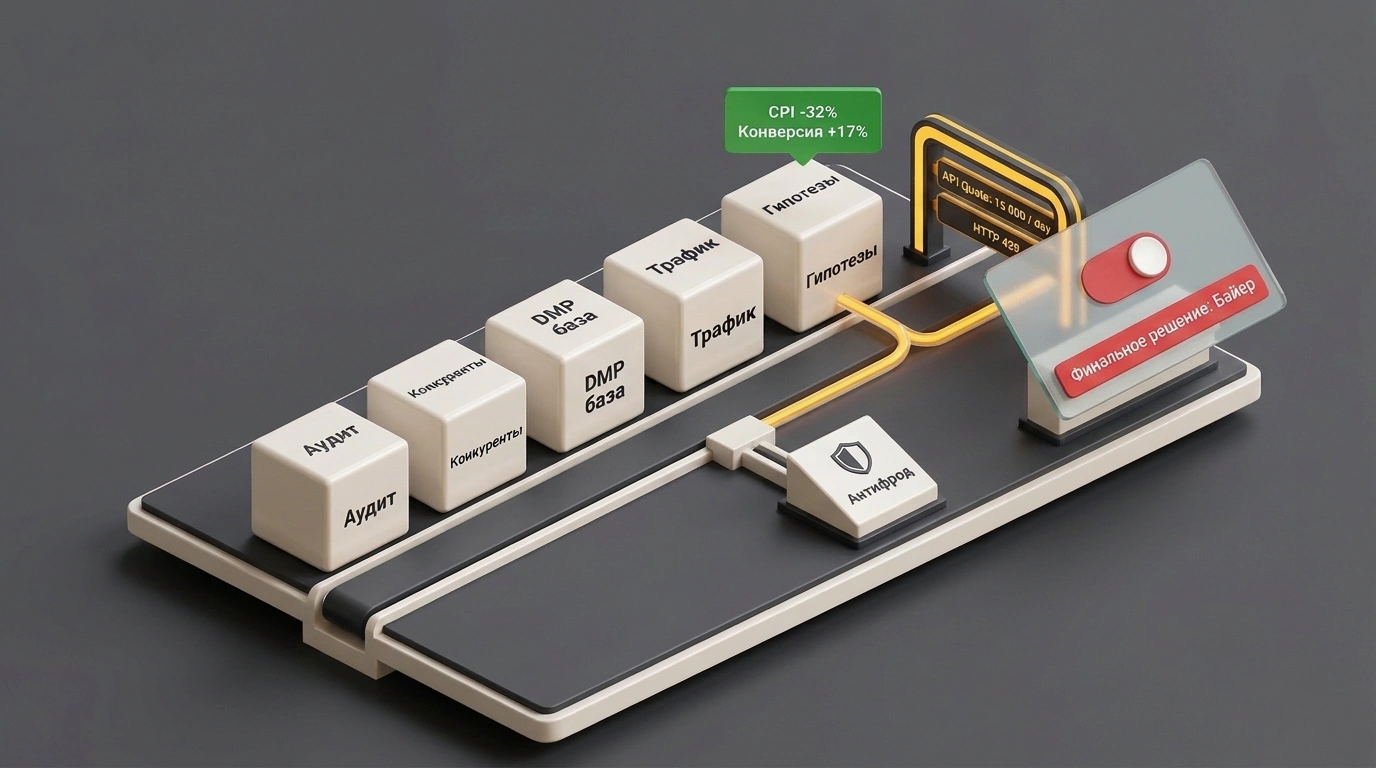
On paper, it sounds like every founder's dream: plug an AI agent into your ad accounts, set a budget and target cost per lead, and go grab a coffee while the algorithm launches campaigns, adjusts bids, and cuts losing placements 24/7.
Real life works differently. Put that setup on real money, and the agent either hits ad platform rate limits or optimizes bids around bots and burns through your budget in two days. In a breakdown on Cossa, Sasha Danilov, co-founder of mobile performance agency TopTraffic, showed which media buying tasks agents already handle well and why you still cannot take humans out of the loop.
What AI Already Handles in Traffic Acquisition
Media buying is the professional purchase of ad traffic with constant control over acquisition cost and payback. Agentic media buying does not rely on one all-powerful bot. Instead, it runs as a chain of narrow AI agents where each handles one short step.
TopTraffic tested this setup while promoting the O'STIN mobile app. Competition was fierce, users were tired of repetitive banners, and testing dozens of ideas blindly is expensive because mass tests quickly inflate CPI (cost per install).
The team built a five-agent cascade: the first analyzes the product and audience, the second studies competitor campaigns, the third pulls past agency cases, the fourth evaluates traffic sources, and the fifth builds ready-to-use hypotheses for creatives, targeting, and KPIs. Then a human media buyer steps in: filters out off-brand ideas, writes briefs for designers, and launches the campaign. After launch, a separate monitoring agent watches the numbers. As long as metrics stay on track, it stays quiet and avoids spamming. Alerts only hit Telegram when something shifts: above target means scale up, a mild dip means check the creative, and a sharp drop means stop.
The O'STIN case results: +35% installs, +17% install-to-purchase conversion, and −32% CPI on tested hypotheses. Weak ideas got filtered out early, while humans made every final call.
Why a 'Quick Agent' Stalls Without Data and Hits API Limits
'You can build an AI agent quickly, but without campaign history, integrations, and data on competitors, sources, users, and their behavior, it won't work effectively.' — Sasha Danilov, TopTraffic.
Built-in machine learning at Google, Meta*, AppLovin, or Moloco works so accurately because it draws on years of data across millions of users. An external agent starts with an empty head. TopTraffic spent years building its own DMP (Data Management Platform — a historical database of campaigns, audiences, and creatives), trained its own models on it, and only then layered agents on top. Without ad account data, an MMP (Mobile Measurement Partner — a mobile tracker like AppsFlyer or Adjust), network postbacks, and end-to-end analytics tied to CRM sales, an agent is just guessing.
Another path is partner access to platforms via API or an MCP server (Model Context Protocol — a gateway where an AI model requests data from external systems). That is how international tools like Madgicx (Meta* campaign analytics) and AdScale (connecting Google, Meta*, and e-commerce store data) operate.
Even with APIs, the fantasy of an agent tweaking bids every minute crashes into strict quotas:
- Google Ads API:
Basic Accessis capped at 15,000 operations per day (up to 10,000 mutations per request) before throwingHTTP 429. - Meta* Marketing API: score-based limits (60 points per 300 seconds at entry, 9,000+ at standard tier) and a ceiling of 100 POST requests per second, or else a 60–300 second pause.
- AppsFlyer Pull API: reports covering 0–2 days allow at most 1 call per minute, while 3+ day reports cap at 24 calls per day per app (120 per account). Adjust similarly throttles heavy queries with
HTTP 429.
You cannot run an agent directly against live APIs. You need your own data warehouse, caching, and batch processing underneath.
Dashboard for configuring ad fraud protection rules before and after attribution (Source: AppsFlyer)
Fraud and Distorted Signals: How Bots Trick Algorithms
Even with clean data, traffic buying hides another trap: ad fraud — bots, device farms, click hijacking, and fake installs. An autonomous algorithm takes numbers literally. It sees cheap installs on a shady placement and pours budget straight into it. One static rule will not stop it because fraud tactics shift constantly. Anti-fraud tools cross-check dozens of signals at once: device IDs, IPs, geo, click-to-install time, click ID, MMP logs, and post-install behavior.
According to recent AppsFlyer and Adjust reports, fraud sits around 14–15% on Android and 11.7% on iOS, with fake installs driving 87% and 92% of losses respectively. Large self-reporting networks (SRNs) see roughly 1% fraud, while affiliate networks can hit 40%.
Disguised traffic is even trickier: in an AppsFlyer sample of 106 billion installs, 52% of fraudulent traffic pretended to be organic, warping model baselines. Fraudsters use AI too, spinning up fake apps with reviews, simulating human scrolling, and shifting to physical device farms (+72% in Android games). Letting an agent touch your wallet without an anti-fraud layer is like leaving the cash register keys on the counter.
Interface for AI ad fraud detection and install anomaly analysis (Source: AppsFlyer)
Economics, Five Autonomy Barriers, and the New Division of Labor
So why adopt agents at all? They lower campaign management costs, speed up filtering weak ideas, and take over hourly monitoring. They also shrink middleman chains: in a pilot by Butler/Till and PubMatic (for Clubtails on AgenticOS and the AdCP protocol), an agent sourced inventory from a brief for team approval. Supply-chain costs dropped 82%, CPM (cost per 1,000 impressions) fell 30%, and impressions rose 40%. Even there, humans pressed the final launch button.
Try TopTraffic's monitoring rule simulator below to see when the agent stays silent and when it pings the buyer.
AI Agent Rule Simulator: What It Will Suggest to a Media Buyer
Even with clear thresholds, a human keeps the final say. Sasha Danilov highlights five barriers to full autonomy. First, risk vs. templates: AI learns from the past, whereas advertising often rewards a bold move that defies past stats — something only a human buyer will dare try. Second, infrastructure cost and brand context: wiring ad accounts, MMPs, and CRM together while baking in brand guidelines, laws, and safety rules is slow and expensive. Third, walled-garden data limits across platforms. Fourth, client communication: a bot cannot defend a risky hypothesis in a client meeting. Fifth, lack of market experience with custom models rather than off-the-shelf templates.
In practice, responsibilities split like this:
| Area | What to Hand to AI Agents | What to Keep for Media Buyers |
|---|---|---|
| Launch prep | Product, competitor, and past hypothesis analysis | Selecting on-brand angles, designer briefs, launch |
| Campaign control | Hourly CPI/CPA tracking and threshold alerts | Scaling, strategy shifts, manual stop |
| Budget protection | Spotting hidden fraud patterns across dozens of signals | Investigating incidents and deciding on gray traffic |
| Strategy & clients | Rough forecasts from past launches | Non-standard tests, client calls, budget ownership |
Roll this out starting with one clear task, and never hand an agent direct control of your budget on day one.
5 Steps: How to Launch an AI Agent Without Burning Your Budget
- Pick one routine task with clear rules (such as checking CPI once an hour).
- Prepare input data: ad accounts, MMP, CRM, and past campaign history.
- Set response thresholds: below target -> scale; mild dip -> check creative; severe drop -> stop.
- Build integrations: store data in a warehouse and send short alerts to Telegram or CRM.
- Keep manager sign-off: let the agent only recommend at first, granting actions only after stable results.
*Instagram and Facebook are banned in Russia; they belong to Meta, which is designated as an extremist organization in Russia.