'If you want to win an advertising award, write clever and pretty. If you want to make money, drop cognitive load to zero.' StoryBrand CEO Donald Miller dropped that line on the Marketing Against the Grain podcast with Kieran Flanagan — and nailed the biggest problem in modern marketing.
AI did not break the market by writing genius copy. It writes 'okay' copy — fast, cheap, and identical for everyone. When a competitor spins up ten landing pages in Claude or ChatGPT in one evening, average text stops selling.
A 'Savant Intern' at Breakfast: Why AI Speed Is No Longer an Edge
Miller shared a fresh example from his own morning. Over a one-hour breakfast at Sally's Stay A While (eggs and sourdough toast), he used AI to assemble an entire launch: a lead webinar, nurture sequence, second webinar, invite emails, ideal customer profile, sales pitch, and follow-up emails.
That sounds impressive until you remember everyone can do it now. Speed is no longer an advantage. Miller says you have to treat AI like a 'savant intern': it types at lightning speed, yet without strict supervision it churns out gray clichés. Being a copywriter is no longer enough for a marketer. You have to become a ruthless New York Times-level editor and cut drafts without mercy.
Donald Miller, founder and CEO of StoryBrand (Source: storybrand.com)
Flanagan added an important caveat: you cannot learn to write through AI. Without your own taste, you are just hiring a ghostwriter who sounds like someone else. Miller wrote 15 books before the AI era, edited his first NYT bestseller 54 times from start to finish, and is drafting the opening of his next book with AI turned off so he can find angles a model would never invent.
Rule 1: Zero Cognitive Load and Banning Extra Commas
The first and biggest of Miller's four filters is zero cognitive load. Put simply, readers should not burn mental 'calories' figuring out what you sell.
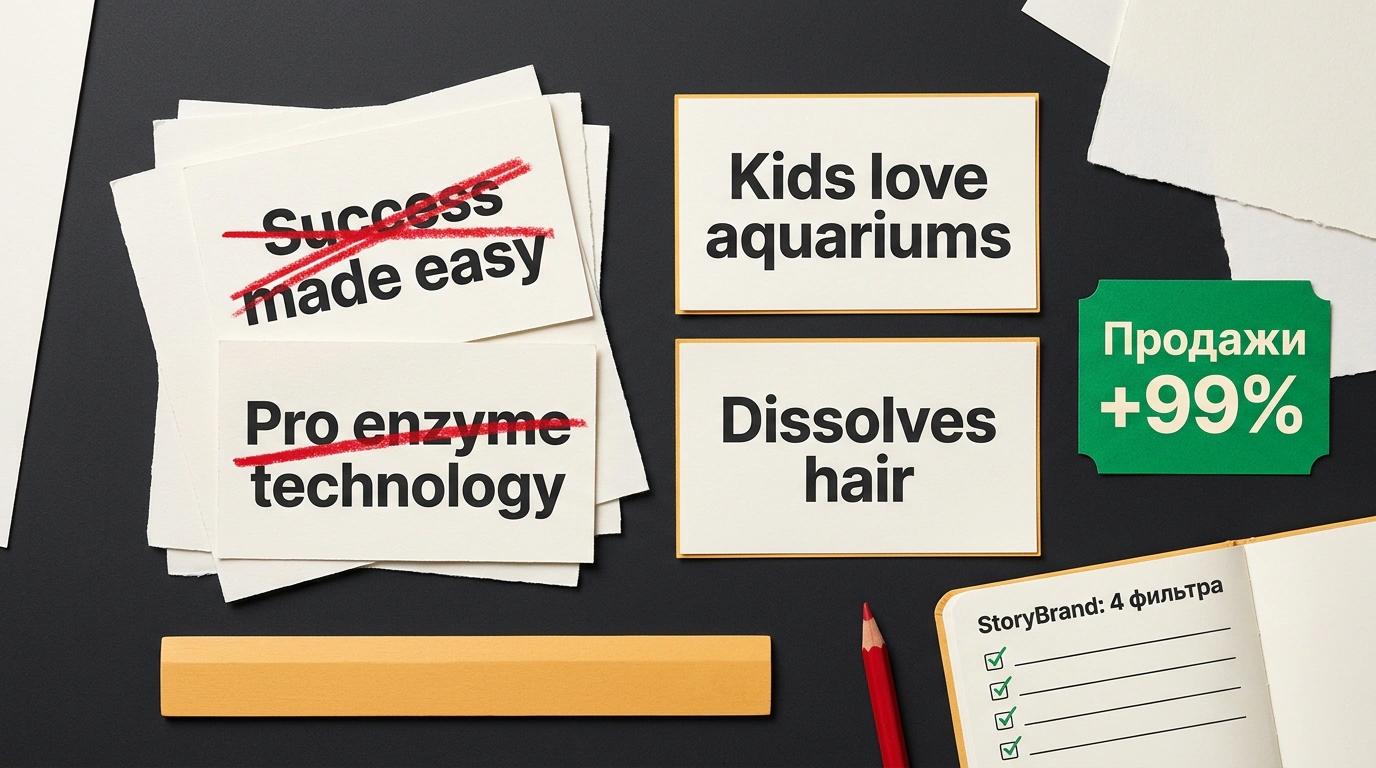
Take this real case: an aquarium maker selling through PetSmart and Petco printed 'Success made easy' on its boxes. Good luck guessing what was inside. Miller replaced the slogan with three simple words: 'Kids love aquariums'. According to him, sales in the Phoenix, Arizona test market jumped 99% because parents did not have to decode anything.
The grocery aisle tells the same story. Miller stood in front of 37 drain cleaners boasting phrases like 'pro enzyme technology' — and grabbed the bottle that said two words: 'Dissolves hair'.
Then there is the opposite failure: a billboard near Miller's office on a 75 mph (120 km/h) highway reading 'Sitting the fence, hire a Kowboy' (with a K and a pun on 'sitting on the fence'). The company simply builds wooden fences. 'A driver isn't pulling onto the shoulder with a glass of whiskey to solve your riddle,' Miller joked. His unsexy, sales-ready fix: 'Hire a cowboy to build your fence — Cowboy Fence Company'.
Small businesses often copy giants like Coca-Cola ('Have a Coke and a smile'), Apple ('Think Different'), or Rosser Reeves' M&M's ('Melts in your mouth, not in your hand'). Global brands are only reminding people they exist. You have to introduce your product from scratch.
The second half of Rule 1 is selling one thing at a time. On the show, they brought up David Ogilvy's 1958 Rolls-Royce ad (Miller briefly wondered if it was Jaguar, though it was definitely Rolls-Royce). Ogilvy spent three weeks reading engineering docs and pulled out one fact: 'At 60 miles an hour the loudest noise in this new Rolls-Royce comes from the electric clock.' US sales rose 50%.
Dashboard of the 1957 Rolls-Royce Silver Cloud — for David Ogilvy's famous electric clock headline (Source: Wikimedia Commons, CC BY 2.0)
Quoting William Zinsser (On Writing Well), Miller repeats: commas are not your friends. Every extra benefit tacked on after a comma weakens the punch. Write short, like Hemingway. Smart ring maker Oura Ring did this when it stripped steps and HRV off its hero section, called itself a 'sleep lab for your finger', and saw sales climb sharply.
| Case | Before (High Load) | After (Zero Load) |
|---|---|---|
| Aquariums | 'Success made easy' | 'Kids love aquariums' |
| Drain cleaner | 'Pro enzyme technology' | 'Dissolves hair' |
| Fence billboard | 'Sitting the fence, hire a Kowboy' | 'Hire a cowboy to build your fence' |
| MARTA transit | 'Smarter, better, faster, next-gen bus network' | 'Let MARTA drive' |
| Oura Ring | Steps, heart rate, HRV separated by commas | 'Sleep lab for your finger' |
Rules 2 and 3: Tie It to Survival and Make It Repeatable
Clarity alone is not enough — the brain must see personal benefit. Rule 2: anchor your offer to survival.
By Miller's estimate, a person sees around 4,000 ad messages a day and notices fewer than 100 — only the ones that register as a 'survival asset': money, sleep, health, status, relationships, or belonging. In a political campaign Miller advised, they spent three months hunting for three words uniting healthcare, the economy, and safety, and landed on 'A better life for country' (drawing 17,000 people to a healthcare rally). By contrast, he pointed to Hillary Clinton's weak 'I'm with her' and compared it to the affordability message that won in New York.
Rule 3: make the phrase memorable and repeatable. Atlanta's transit network MARTA (serving a 4–5 million metro area) used to advertise itself as 'Smarter, better, faster, next-gen bus network'. Nobody dreams about a 'next-gen network' — people just want to get there on time. Miller cut it to 'Let MARTA drive'. Launched for the World Cup, it stuck so well they kept it permanently: for commuting, games, or getting home from a bar. Miller notes the same works for a family rule with his five-year-old daughter: 'Millers don't quit.'
Rule 4: The Customer Is the Hero, and AI Clichés Give Away the Parrot
The core of StoryBrand (built on ideas from Carl Jung, Joseph Campbell, and storytellers Robert McKee, Blake Snyder, and Nancy Duarte) is simple: the customer is the hero, and the brand is only the Guide. Your customer is Luke Skywalker; you are Yoda. When a company acts like the hero, the buyer's brain sees a rival for resources.
A classic flop was Jeb Bush's slogan 'Jeb can fix it': he put himself at the center without explaining what 'it' meant. His polling stalled at 3%, then rose 10 points by the South Carolina primary after Miller's team helped change the slogan.
Even a strong offer dies if you leave AI signatures in the copy — stock phrases models love like 'and here's the best part' or 'this is the part that nobody understands'. Miller says those lines kill trust instantly because the writer sounds like a parrot repeating a bot.
Click through five cases from the episode below to see which rule broke and how it got fixed.
Practice Drill: Miller's 4 Rules on 'Before / After' Cases
The pattern is the same every time: 'before' copy hides the point behind a riddle, piles on commas, or brags about the company. Run any AI draft through these four filters before publishing, and the fluff disappears in two edits.
One-Page Messaging Plan: How 95 AWS Teams Replaced Their Old Marketing Doc
In The StoryBrand Your Business Field Guide (280 pages, out January 12, 2027), Miller condensed all positioning onto a single sheet of paper.
On the left sits the core from the 7-part BrandScript (Hero -> Problem -> Guide -> Plan -> Call to Action -> Avoid Failure -> Success): five core sound bites, a zero-load tagline, an elevator pitch, and a brand story. On the right are assets for three buying phases: Curiosity (where most teams lose traffic), Enlightenment (website, PDF, video), and Commitment.
According to Miller, AWS VP Steve Sloan first brought four executives to map out four campaigns, then gathered 95 AWS teams in Seattle — and every team rewrote its tagline on that one sheet. Afterward, Sloan replaced Amazon's previous internal marketing tool with this document and, as Miller claims, estimated the impact in the billions of dollars.
Donald Miller's AI Draft Editing Checklist
- Zero load: Can a visitor tell in 3 seconds what you sell and why it helps them?
- No commas: Did you keep one main benefit in the headline instead of a feature list?
- Survival asset: Does the offer tie directly to money, sleep, health, time, or status?
- Guide role: Does the customer's problem lead the story instead of company awards?
- Strip AI clichés: Did you cut filler lines like 'and here's the best part' or 'what nobody understands'?