On November 19, MTS Ads hosted its conference at Moscow's Khudozhestvenny cinema. They leaned into the cinema setting right away: the market needs a 'director's cut instead of scattered clips'. Behind the metaphor sat two blunt numbers: in the first half of 2026, budgets among the top 150 advertisers fell 11%, while digital cost per result rose 17%.
When budgets shrink and every lead costs more, running five disconnected ad accounts eats your margin. During the panel 'Changing Scenery: Where the Market Is and Where We Are', opened by MTS Ads commercial director Artem Pulikov, experts from VK, Avito, and Ozon agreed on one point: no major new ecosystems are appearing, existing ones are getting more complex, and their audiences overlap more than ever. One person scrolls Telegram, browses a marketplace, and watches YouTube and social feeds all in the same evening, under tighter regulation. Showing them the same ad from three unlinked accounts means overpaying.
Three Platforms in One Window: What 'MTS Marketolog 2.0' Delivers
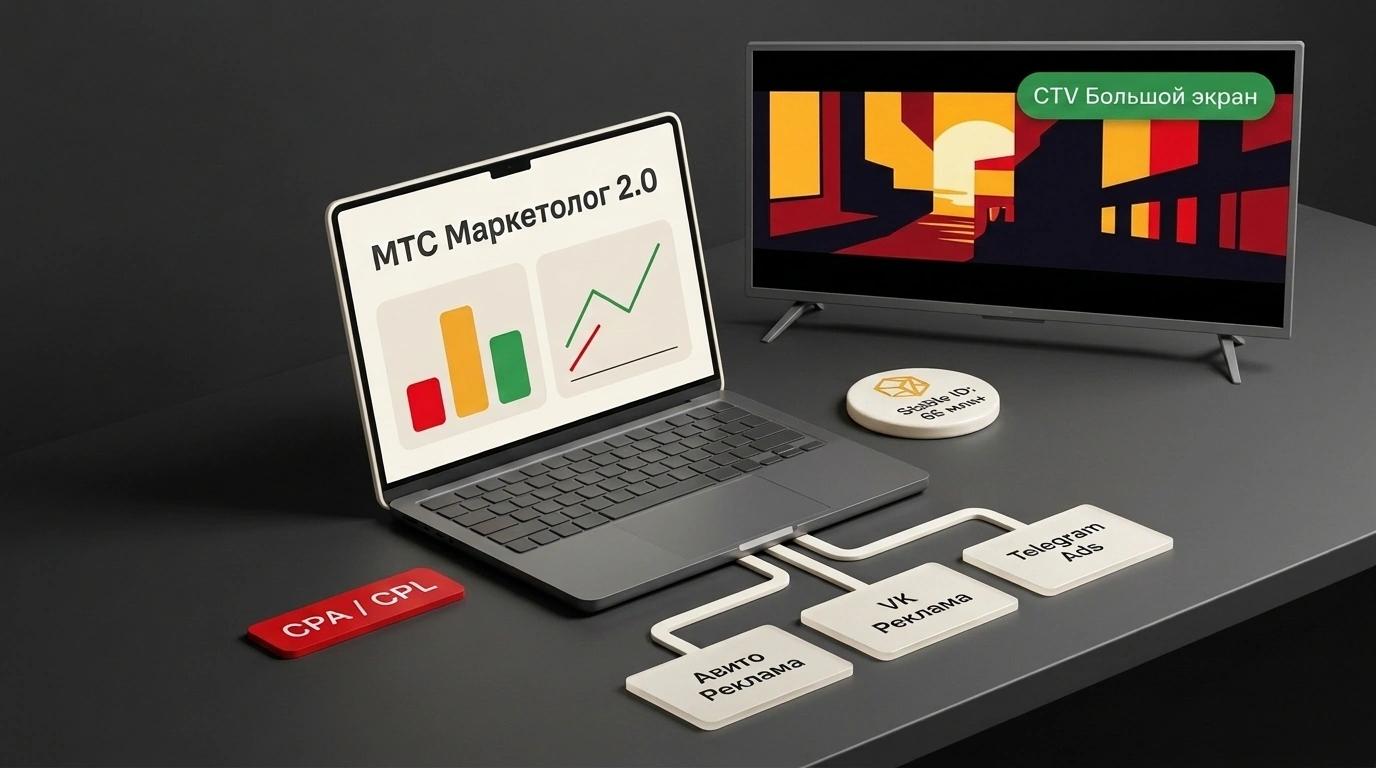
MTS Ads responded by launching MTS Marketolog 2.0, a single dashboard for Avito Ads, VK Ads, and Telegram Ads. DNative author Alexey Tkachuk joked about 'one ring to rule them all'. Let's skip the hype and check what is actually there — and what is still missing.
On paper, a unified dashboard sounds like a magic button: put budget in one window and traffic gets cheaper. In reality, the first benefit is much more down-to-earth: one contract and unified closing paperwork across all three platforms. The second is cross-channel sequencing. If someone in an MTS audience segment already saw your creative in one campaign, you can exclude them from seeing it again on another platform or follow up with the next funnel step.
Four technologies power this under the hood:
| Technology | Role in Campaign |
|---|---|
| MTS Stable ID | Anonymized cross-platform operator ID: links touchpoints across devices and platforms without third-party cookies, caps frequency, and lifts response |
| MTS Big Data | Enriches platform targeting with segments built on anonymized data from 65M+ subscribers |
| Bidder | Automated bidding engine that finds the working price per impression or click |
| RecSys | Recommendation ML model that finds matching audiences and lifts CTR |
One caveat to know before testing: the public announcement did not list exact ad formats supported inside each of the three platforms or minimum budget thresholds. You will need to check available placements inside the dashboard manually. On the upside, product director Maxim Zenin promised to add more platforms soon along with MTS SMS inventory for sequential messaging and retargeting.
The Big Screen and SMS: Where to Find Growth When Auctions Overheat
'Hold on,' a performance marketer glued to lead spreadsheets might ask, 'the unified dashboard makes sense, but what do TV and old-school SMS have to do with it?' Those exact two channels were spotlighted at the conference as overlooked growth levers.
Start with CTV (Connected TV) — digital video ads running on smart TVs and streaming boxes inside online cinemas, not traditional broadcast TV. Xiaomi deputy director of digital sales Devon Zhang shared a striking gap: Russia already has 60.6 million smart TVs (+11.6% year-over-year), up to 80% of online cinema viewing happens on big screens, yet CTV gets no more than 5% of total video budgets alongside linear TV. For comparison, streaming takes 49.6% of TV viewing time in the US, over 75% of linear TV budgets are shifting into CTV, and CTV ad spend is growing at double-digit rates (+15.6% in the US, +11.5% in China, +24.7% in France).
Why are local marketers hesitant about CTV? It comes down to last-click attribution. MTS Ads Premium Video CEO Alexandra Strelkova called out the blind spot directly:
'The big screen has a delayed effect: on average, more than five days pass between seeing a TV ad and making a purchase. Last-click reports only show the transaction in the app or on the retail site, so the big screen's contribution disappears. Yet it can be measured.'
A similar shift is happening in SMS. Acting head of martech development at MTS Ads Maxim Sinyakov named three changes turning SMS blasts into a true digital performance channel: full visibility from send to open, judging campaigns by business outcomes (CPA and CPL instead of send volume), and smart targeting that picks the right copy, timing, and segment. Once SMS inventory plugs into MTS Marketolog 2.0, marketers will be able to chain it directly with touchpoints in VK, Telegram Ads, and Avito.