A pricey venue, a cover band, and an MC running 2000s party games — the classic corporate party playbook. The budget is spent, the lights shine bright, and an hour later half the room is standing by the buffet scrolling their phones and calculating when it is polite to leave. Money spent, box checked, and by Monday nobody remembers why they gathered.
Today the cost of that miss is higher. In an article on Cossa.ru, Anna Kern — producer and founder of full-service agency JAZZUP — shares stark context: by her cited data, 25% of companies cut staff budgets, three-quarters of founders say business has gotten noticeably harder, and 87% of executives in 2026 report symptoms of burnout.
You might think it is time to slash event budgets. Yet skipping events is not an option. Effective event marketing (building and strengthening a brand through live experiences — from client dinners to MICE offsites, meaning Meetings, Incentives, Conferences, and Exhibitions) solves real business problems. Internally, it provides non-monetary motivation, lifts eNPS (employee willingness to recommend the company), and bonds hybrid teams. As Kern notes, losing a strong senior leader costs far more in the long run than hosting a team event. Externally, live gatherings showcase products, turn guests into brand advocates, help win investors, and give press something to cover.
The biggest shift is in what audiences want. Flashy scale and pomp fall flat now. Amid constant turbulence, people crave belonging, safety, and comfort — a chance to exhale, laugh, and feel a simple 'we're together and we feel good'. That is why psychology in events is no longer window dressing; it is how you build loyalty.
Scripting from Emotions: How to Nail the Format
Most teams start planning with the venue and menu. In Anna Kern's approach (she completed Gestalt therapy training at MIGIP in 2023 and has ranked in the MICE & Travel Top 100), the order flips: psychology kicks in long before guests arrive.
Everything starts with a deep client interview. Instead of dissecting the budget first, they unpack how people should feel afterward: what needs to shift? Do you need to unite a fragmented team, help colleagues meet outside work roles, recharge energy after a brutal project, or build trust? The script grows out of one question: 'What should a person feel at each stage?'
Next, they calibrate the audience: what people do outside work, whether they are open to experiments, what humor lands, and which topics are off-limits. Brainstorming, stress-testing ideas, and building several concept options takes the creative team one to two weeks.
You can see how this tuning works in a case for a major media company whose team JAZZUP took to North Ossetia. The crew was bold and loved edgy, sometimes dark humor — a standard mountain banquet would have put them to sleep. So the trip became a documentary film shoot in the style of director Zhora Kryzhovnikov. It kicked off before takeoff with voice auditions in chat and theatrical casting. On site, staff played Nart legends and little green men, snapped clapperboards, and lit smoke bombs on orders from 'crazy director Veniamin Trankovsky', ending with awards at a 'Cannes festival'. Bloopers and cringe went straight into the edit, matching the company's real DNA: making content.
First Touch, Three Acts, and the Peak-End Rule
Once the concept is locked, the team maps the guest's emotional journey — the chain of feelings from first contact to goodbye.
Stage design and presentation at a corporate event (Source: jazzupagency.com)
Events often start days before doors open. Before that same media company's trip to Kazakhstan, a fictional Akyn (folk poet) texted guests on Telegram with memes, local humor, and cultural notes. By flight time everyone was already buzzing, and actors in costume greeted them at the airport.
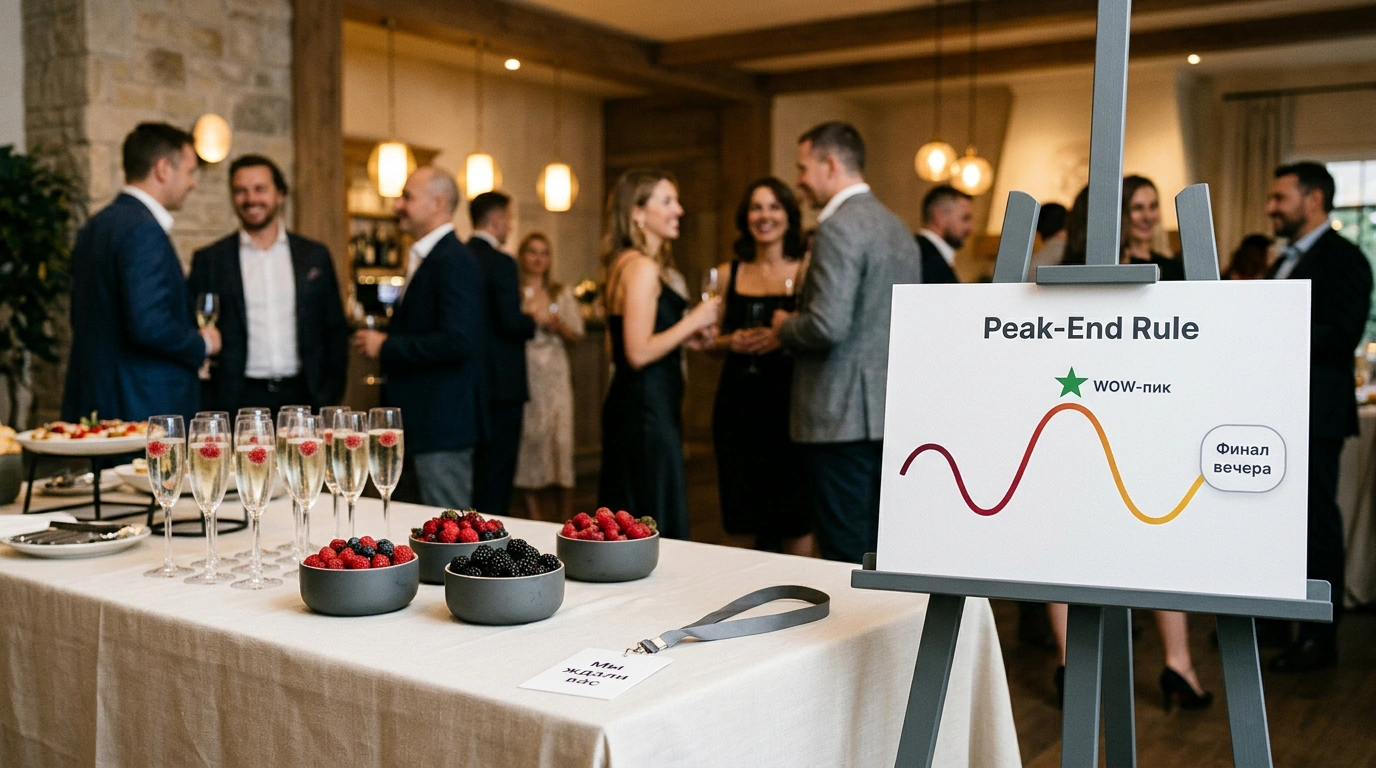
At a one-day event, the welcome zone does that job — the space and first few minutes before the main program. Fast check-in, a warm smile from hosts, an easy photo spot, bowls of berries, and glasses of crémant silently send one message: 'We were waiting for you.'
From there, it is easy to fall into one of two traps. The first is stuffing surprises into every five minutes. Imagine a dinner where fireworks go off with every dish: after half an hour your senses go numb, and you stop telling the main course from the appetizer. The second is a 'flat banquet' that reads like a flatline on a heart monitor.
Behavioral psychology explains why both fail. In 1993, Daniel Kahneman and Barbara Fredrickson described the Peak-End Rule (covered in detail by Nielsen Norman Group). Memory does not average every hour of an evening and barely tracks duration. The 'remembering self' — the part that drives future brand loyalty — records only the strongest emotional peak and the ending.
JAZZUP builds its pacing around this: multi-day trips feature one standout peak per day, leaving breathing room so guests experience moments rather than swallowing them on a conveyor belt. One-day events follow three acts.
| Event Act | Emotional Goal | Working Tools | Common Mistake |
|---|---|---|---|
| 1. Welcome zone | Ease tension, signal 'you're expected' | Pre-event warm-up, fast check-in, warm hosts, strong buffet visuals | Entry lines and awkward pauses with no signage |
| 2. Main program | Build to one on-brand WOW peak | Stage design, colleagues' faces on screen, live performance, key peak moment | Surprises every 10 minutes or spectacle for its own sake |
| 3. Closing | Lock in a warm aftertaste | Thoughtful finale, warm send-off, memorable keepsake | Letting the night fizzle out as the room quietly empties |
Crucially, the 'wow' must serve the brand's meaning. For 'Presidential Monavi' (a luxury residence and five-star hotel complex), they staged a gala for 250+ guests around heritage and passing down values. A choir, theatrical monologues, movement, lighting, and digital stagecraft built toward the climax: the choir's entrance and the project's story on giant screens. Right at that peak, the partners signed a strategic partnership agreement — turning a business deal into the emotional high point of the night.
Mosaic of Impressions: Location, Merch, and Care in the Details
The climax creates the spike, yet trust comes from the details around it. The first layer is using the location as part of the story.
Organizing a business and MICE event (Source: jazzupagency.com)
On the Kazakhstan MICE trip, the setting itself did the work: wine tastings at Arba Wine, cooking national dishes in an ethno-village, and outdoor lunches with custom set design. For one-day events, teams often rebuild the venue from scratch. At a media company's New Year party for 1,000 guests, the hall became the futuristic starliner FUTURA. A terminal, teleportation gate, robot races, phygital casino, digital oracle, cyber-fortune teller, boarding passes, Morse-code bracelets, and route maps guided guests toward a final mission.
The second layer is micro-details that never make the poster: transfers, drivers, music in the car, flowers in the hotel room. On a four-day Abu Dhabi trip for 40 people, care became tangible through useful merch: branded scarves for mosque visits, handheld fans for the heat, and beach gear. At a 'Family New Year' party for a media client, they set up red tables, a 'Morozko' ice bar, a Christmas tree hung with guests' own childhood Polaroids and custom baubles, and built a dedicated karaoke web app instead of paper songbooks. The environment tells people quietly: someone thought of you ahead of time.
That is why Kern calls the 'flat corporate party' — just a banquet 'whatever happens' — the industry's biggest enemy. Even a business conference needs a designed entrance, welcome, and pauses. And success is measured not by press-wall photos, but by mood surveys, HR metrics, and what people tell coworkers the next morning.
Guest Touchpoint Checklist: From Invitation to Aftertaste
- Goal and calibration before budget: Clear target emotion defined; guest interests, humor, and taboos checked.
- Pre-event warm-up: Personal invite or light chat interactive builds anticipation before doors open.
- Smooth entry (welcome zone): Zero queues at check-in, warm hosts, clear signage, and inviting food/drink visuals.
- One clear WOW peak: Climax ties straight into brand meaning or a business milestone rather than checking a box.
- Rhythm and pauses: Breathing room between big moments so guests can talk and absorb the experience.
- Tangible care and finale: Logistics, useful merch, and personal touches planned ahead, ending on a warm closing note.