A new coffee shop owner types one long question into Google: which espresso machine to buy for a shop with two baristas. Ten blue links used to settle that. In Google AI Mode (conversational AI search for complex decisions), a different engine runs behind the scenes: one question fires off several hidden searches in parallel, while in Google Ads, AI Max crawls your site and builds paid ads from old pages on its own.
Neil Patel and his agency NP Digital (managing over $1B in ad spend) checked recent Google documentation against client data and distilled six rules for winning leads. Let's trace them using that same coffee shop — from first question to closed CRM deal.
A Fan of Sub-Queries: How Query Fan-Out Works in Google AI Mode
When someone asks AI Mode a complex question, the system triggers query fan-out: it splits the task on the fly into multiple parallel sub-queries and merges the answers into one response. Google Search Central illustrates this with lawn weeds: behind the scenes, Search looks up top herbicides, chemical-free removal, and prevention.
Professional espresso machine for a coffee shop — the running example for query fan-out and AI Max (Source: Wikimedia Commons, CC0)
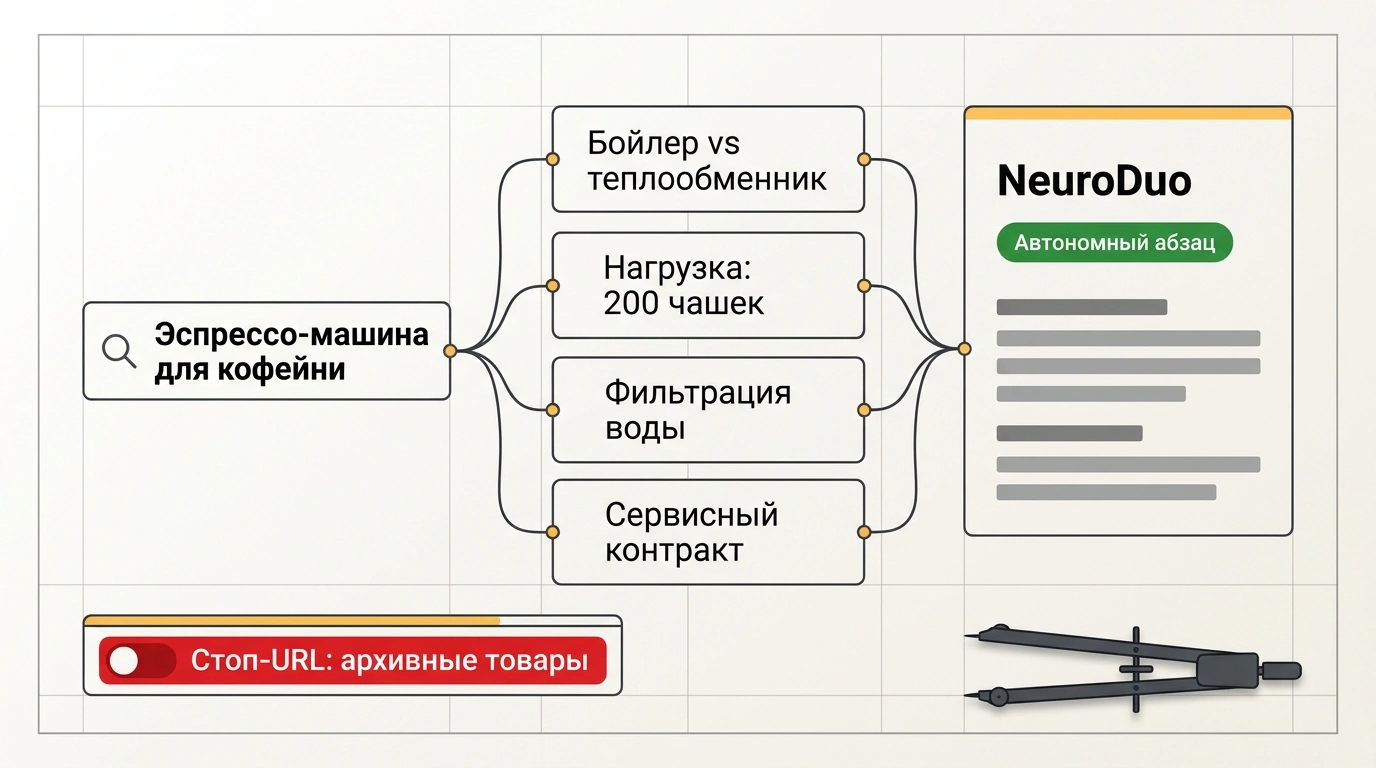
The coffee shop works the same way. The owner asks one question, and behind the curtain Google checks four sub-topics at once: dual boiler vs. heat exchanger, group heads needed for 200 drinks a day, water filtration, and service contract pricing. If your site only has one product card with a bare spec table, you get skipped. A competitor with a filtration guide and transparent maintenance pricing takes the spot unopposed.
Rule 1: map the buyer's decision. Write down the main commercial question and every pre-purchase doubt, then audit your site against each item. You can gather real sub-questions from search, social media, ChatGPT, and Gemini using free tools like answerthepublic.com (it is Patel's own tool, though still handy for phrasing research). Just skip the old SEO mistake: Google explicitly warns that spinning up 50 thin pages for every sub-query to chase AI answers violates spam policies. Two deep, genuinely helpful pages beat fifty thin stubs every time.
Self-Contained Paragraphs and Brand Reputation in AI's Eyes
Even when Google finds your page, it rarely pulls the whole article — it grabs one paragraph. That leads to Rule 2: your answer must make complete sense out of context. Google Search Central docs debunk two myths right away: you do not need to chop text into micro-snippets, and you do not need llms.txt or 'special AI markup', because Google Search ignores them. Anyone selling you an 'AI schema for Google' is selling thin air.
Compare these two lines. 'This model holds great stability and fits busy shops' means nothing on its own. Now look at a self-contained paragraph:
'NeuroDuo is a dual-boiler espresso machine built to hold steady temperature across back-to-back shots. It is sized for coffee shops serving 150–300 drinks a day and requires a dedicated 20-amp line.'
Product, target buyer, and technical requirement all sit in one block. You can lift it straight into a three-way comparison without losing meaning. SEO practitioners Mike King and Cyrus Shepard saw the same pattern in tests: standalone, specific paragraphs get cited more often. Auditing your site is simple: paste your 20 key paragraphs into a blank doc. Anything that needs the paragraph above it to make sense needs a rewrite.
Still, an accurate quote fails if AI attaches the wrong label to you. Rule 3: what matters is not whether AI mentions you, but who it recommends you to. Want to sell to 20-location chains, yet AI Mode and Gemini leave you off chain lists while recommending you as a budget home-barista machine? You got the mention and zero revenue.
SEO researcher Dan Petrovic tests this both ways: which ideas AI links to your brand, and which brands it links to your target use case. Build a 10-prompt test set across your buyer segments, run it in AI Mode, Gemini, and ChatGPT, log positioning and cited URLs, and re-run a week later (answers shift). Open the cited sources: often an old 2022 page, an outdated catalog, or one loud review skews the picture. Clean up everything you control and add hard facts. In an NP Digital survey of 100 companies over $10M in revenue, social proof ranked as the #1 buying factor (4.7 out of 5), while price came last (3.4 out of 5). Treat this test as a diagnostic for blind spots, not a guarantee that editing one page flips results overnight.
The AI Max Trap: Site Audits and Strict Exclusion Rules
Rule 4 hits your ad budget directly. AI Max for Search campaigns in Google Ads expands search term matching, writes headlines and descriptions from your site (Text Customization), and sends clicks to whichever page it picks (Final URL Expansion). Your entire website becomes ad fuel. If an old page for a discontinued two-group machine is still indexed, a buyer with a $12,000 budget might click an ad straight into a dead end.
Google cites an average +14% lift in conversions or conversion value at similar CPA, though Patel reminds advertisers that platform averages are not a forecast for your account. Before flipping it on, audit your site: block old price lists, discontinued models, low-margin SKUs, unserved regions, and outdated promises.
Query Fan-Out Simulator and URL Filter for AI Max
Google Ads docs hide a crucial technical catch: Final URL Expansion requires Text Customization to be on, and URL exclusions only work when both are active. You can block unwanted pages via exact URLs, custom labels in page feeds, or URL contains rules. Watch the syntax carefully: URL contains matches whole tokens split by /, -, or ., not underscores _, and spaces act as logical AND. Set up URL exclusions and brand controls, launch AI Max strictly as an experiment, and manually audit headlines, search terms, and landing pages every week for the first month.
Training Bids on Revenue and Why 'Cited' Doesn't Mean 'Bought'
Rule 5 governs what the ad algorithm learns from. If every website form submission counts as an equal conversion, Google brings you a crowd of cheap leads. A home barista hunting for a discount and a 40-shop chain worth 50x more look identical to a basic pixel.
The fix is connecting CRM and Google Ads through offline conversions (Enhanced Conversions for Leads with hashed data), funnel stage mapping, and Value-Based Bidding. The main roadblock is organizational: in NP Digital's survey of 600 marketers, 37% of insights stay trapped inside one channel and only 6% get applied cross-channel. Check four things this week: whether lead qualification flows back from CRM to Google Ads, whether timestamps are accurate, whether junk newsletter signups sneak into conversion goals, and whether values reflect real deal sizes. For long sales cycles (6 months, 10 deals a quarter), do not switch straight to bidding on closed revenue. Run the new conversion as a secondary goal for 2–3 weeks, verify the data, and optimize toward the deepest funnel stage with enough volume.
Rule 6: getting cited is not the same as getting chosen. AI might footnote your descaling guide while recommending three rival machines right next to it — as Cyrus Shepard puts it, you won the footnote and lost the sale. Separate three metrics: citations (Search Console's generative AI performance report), shortlist recommendations (your monthly prompt test from Rule 3), and actual revenue (CRM). In NP Digital's survey of 100 $10M+ companies, teams put 93% of their effort into traffic even though conversion drives 68% of revenue impact. A campaign with 500 junk leads wins the weekly slide deck, while a campaign with 80 leads closing at 33% brings in the money.
| Rule | Old Habit | New Action |
|---|---|---|
1. query fan-out | Fighting for one keyword or churning 50 thin pages | Map sub-questions and cover them with deep answers |
| 2. Standalone blocks | Buying llms.txt and writing context-dependent copy | Pack product, segment, and limits into one clear paragraph |
| 3. AI reputation | Counting total brand mentions | Check who AI recommends you to and clean old sources |
4. AI Max | Turning automation on site-wide at once | Audit pages, set whole-token URL exclusions, and run as an experiment |
| 5. Sales data | Treating every form fill as equal | Send CRM qualification and values via secondary goal |
| 6. Metrics | Stopping at traffic and citations | Separate citations, shortlist picks, and CRM deals |