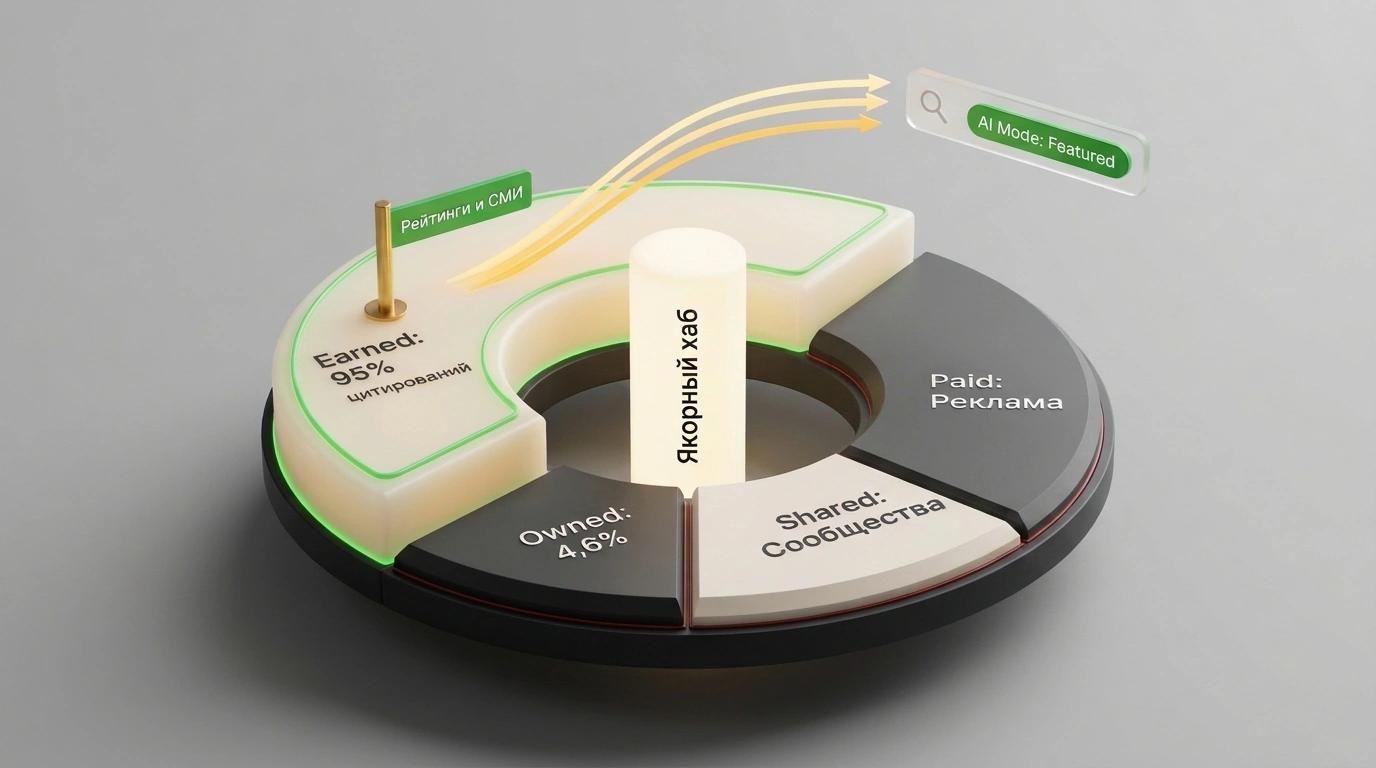
It is a familiar scene: a company decides to get into ChatGPT or Gemini answers and puts its entire budget where it always has — its own website. They rewrite pages, clean up markup, and expand the blog. Then they type a customer prompt into an AI assistant and see everyone except themselves in the recommendations.
The blind spot is simple: AI models barely trust what a business says about itself. They want outside proof. A local benchmark by Andrey Gusarov — founder of GUSAROV agency and the Edu Gusarov training center (in digital marketing since 2007) — showed this clearly. His team tested 30 buyer prompts like 'which SEO agency to choose in Belarus' and analyzed the cited links. Only a tiny 4.6% led to an agency's own site. The other 95% went to rankings, directories, media outlets, and third-party blogs.
Where AI Models Actually Pull Recommendations From
In GUSAROV's breakdown of the top 15 cited platforms (120 links), the split is even sharper. Almost 40% came from rankings — led by the Belarusian Rating of Bynet with 35 links across 14 prompts. Roughly a third came from websites and blogs, including market roundups by competing agencies. Next came news media, directories like vc.ru, and Telegram. GUSAROV's own website was missing from that top list entirely, even though the brand was often named in the text.
The same pattern repeated in a second niche — Edu Gusarov courses: course aggregators, rankings, business media, and directories. One phrasing detail stood out. Prompts using 'state certificate' steered answers toward state universities, even though Edu Gusarov's site explicitly says 'state-recognized certificate'. If external platforms do not describe you in the customer's exact words, AI will not connect your brand to their query.
Two global studies back this up. First, Muck Rack's analysis (What Is AI Reading?, with Generative Pulse) across more than 25 million links in ChatGPT, Claude, and Gemini.
Where AI Gets Its Links: Global Muck Rack Study (25M+ Links)
The chart leaves no room for illusions: earned media — third-party mentions on independent platforms you did not buy as direct ads (press, research, Wikipedia, social media) — takes the lion's share. Over a quarter comes from journalism, while paid ads are almost invisible to AI models. Gusarov fairly notes that Google and Alice were not in that dataset and earned media was defined broadly. The same report also reveals a shelf life: more than half of journalism links point to articles under a year old, and citations drop noticeably after six months. A three-year-old press hit barely helps; mentions need regular refreshing.
The second study comes from Ahrefs across 75,000 brands. The strongest link to visibility in ChatGPT, Google AI Overviews, and AI Mode was YouTube mentions (Spearman correlation around 0.737, with mention frequency mattering more than total views at 0.717) and brand mentions on other sites (0.66–0.71). Classic backlinks trailed far behind at roughly 0.218 in AI Overviews. Correlation is not causation, yet for GUSAROV it was reason enough to double down on YouTube.
Price vs. Substance: Why GEO Costs Anywhere from 800 to 18,000 Rubles
Whenever a buzzword arrives — right now it is GEO (Generative Engine Optimization) — quotes scatter wildly. Gusarov notes that in Belarus, GEO is sold for 800 Belarusian rubles a month on one end and 18,000 (converted from Russian agency rates) on the other. Comparing those price tags head-to-head makes no sense because they buy completely different scopes of work.
Once you know the citation numbers, vetting a proposal gets easy. If a low quote only covers editing copy, schema, and FAQs on your own website, you are paying to optimize those 4.6% of links. Systematic GEO costs more because the real work happens off-site: fresh profiles in rankings and directories, case studies, trade media, video, and community mentions.
There is also the opposite trap: burning a big PR budget with zero return. Tamara Sykes (14 years in earned media, host of Semrush's breakdown) puts it bluntly: landing a feature in an outlet your buyers never read looks nice in a report and delivers zero AI visibility. Instead of asking 'how many articles can we get?', ask which exact platforms will make your brand the most credible answer in your niche.
Two Approaches: Spraying Articles or Building a PESO Anchor Hub
In practice, you choose between two models. The first is pumping out disconnected posts and blasting generic press releases to a hundred newsrooms. The second is building a system of mutual proof around one strong topic.
In the Semrush video, Gini Dietrich — founder of Spin Sucks and creator of the PESO model (Paid, Earned, Shared, Owned) — explains the engine behind it. In the AI era, that engine is cross-verification.
Gini Dietrich's PESO Model (Paid, Earned, Shared, Owned): four media types working together to cross-verify a brand (Source: spinsucks.com)
AI models cross-check what you say on your site (Owned) against what independent media, newsletters, podcasters, and Google/Yelp reviews say (Earned), plus text-heavy communities like Reddit, Quora, and LinkedIn (Shared). When all layers tell the same story, your brand appears in AI answers in one of three states: mentioned, cited (with a link), or featured (highlighted as a top pick). The fourth state is absent. Only after that loop works does Dietrich recommend turning on Paid to amplify assets that already convert.
At the center of it all sits an anchor hub: one powerhouse page on your site that fully answers the buyer's core question. At Spin Sucks, that is their 'What Is the PESO Model?' page, packed with a direct answer, video, FAQ, reviews, and expert tips, updated continuously. For a cybersecurity firm, an anchor hub would be 'How to Tell If My Business Is Vulnerable to a Cyberattack' instead of ten short blog notes. Every external PR mention then reinforces that exact page.
You do not need a fresh content budget either. Tamara and Gini recommend repurposing existing assets: a regular webinar, a client interview, or internal data. One webinar turns into an anchor page, a journalist pitch, a short video, a podcast clip, and community discussions. The goal is not flooding the web with text, but pushing one strong idea through every channel.
A Four-Week Plan for a Small Team and Protecting the Budget
For a small team on a tight budget, Tamara Sykes suggests a four-week loop that pairs well with Gusarov's quick-start approach.
| Week | Stage | Hands-On Work | Outcome |
|---|---|---|---|
| Week 1 | Find the gap | Collect real buyer questions, test 3–4 AI assistants, log cited sites and gaps vs. rivals | Map of niche rankings, directories, and media |
| Week 2 | Build the story | Pick one high-value topic, upgrade a page or build an anchor hub with facts, FAQs, and buyer phrasing | Core page ready to pitch to media |
| Week 3 | Targeted outreach | Shortlist platforms AI actually cites and send tailored pitches instead of mass blasts | Priority articles and updated directory profiles |
| Week 4 | Measure and adjust | Review live placements, referral traffic, engagement, and run manual incognito checks | Clear impact view and plan for the next cycle |
In GUSAROV's real sprint, week one covered directories, a case page in Rating of Bynet, and Telegram; the rest of the month focused on articles on vc.ru, trade media, and Habr. They skipped other agencies' blogs and focused strictly on independent platforms.
When measuring results, do not trust software blindly. Tools like Semrush AI PR Toolkit (built from Prowly to find AI-cited media and journalist contacts) save hours, yet models tend to 'feed themselves': software reports visibility for its preset prompts, while real buyers ask differently. Dietrich recommends opening 3–4 AI assistants in incognito mode once a month, testing real human questions, and comparing your status (mentioned, cited, featured) against tool reports.
And if you need to defend your budget to leadership, tie it to revenue, since there is no single magic PR metric. On one of Dietrich's projects, six months produced modest numbers and the team feared showing the report. Yet the data proved that six specific tactics drove positive sentiment and strong share of voice — growth was simply bottlenecked by a tiny budget. Instead of making excuses, the team showed a proven lever and won double the investment.