When a business decides to launch an affiliate program, the choice almost always hits the same fork in the road. Path one: plug in a cheap link tracker for fifty bucks a month, hand out referral links to creators, and manage partners in Google Sheets. It launches in an evening and feels light on the budget — until three months later, when your marketer drowns in manual emails, dead accounts, and international invoice headaches. Path two: jump straight into a heavy enterprise platform costing $500 or $1,000+ a month. It has enough features for three departments, yet without a dedicated manager half the dashboard sits unused while the subscription and sales cut quietly eat your margin.
The trouble is that affiliate software sells completely different tool classes under the same label. Every vendor shows glossy dashboards with clicks and conversion charts, yet picking the wrong one costs months of lost traffic and tens of thousands of dollars in hidden fees. Let's look at where affiliate programs actually break, five questions to ask before paying, and how 11 popular platforms (including Rewardful, Tapfiliate, Modash, Impact, PartnerStack, and Tune) map to four real business needs.
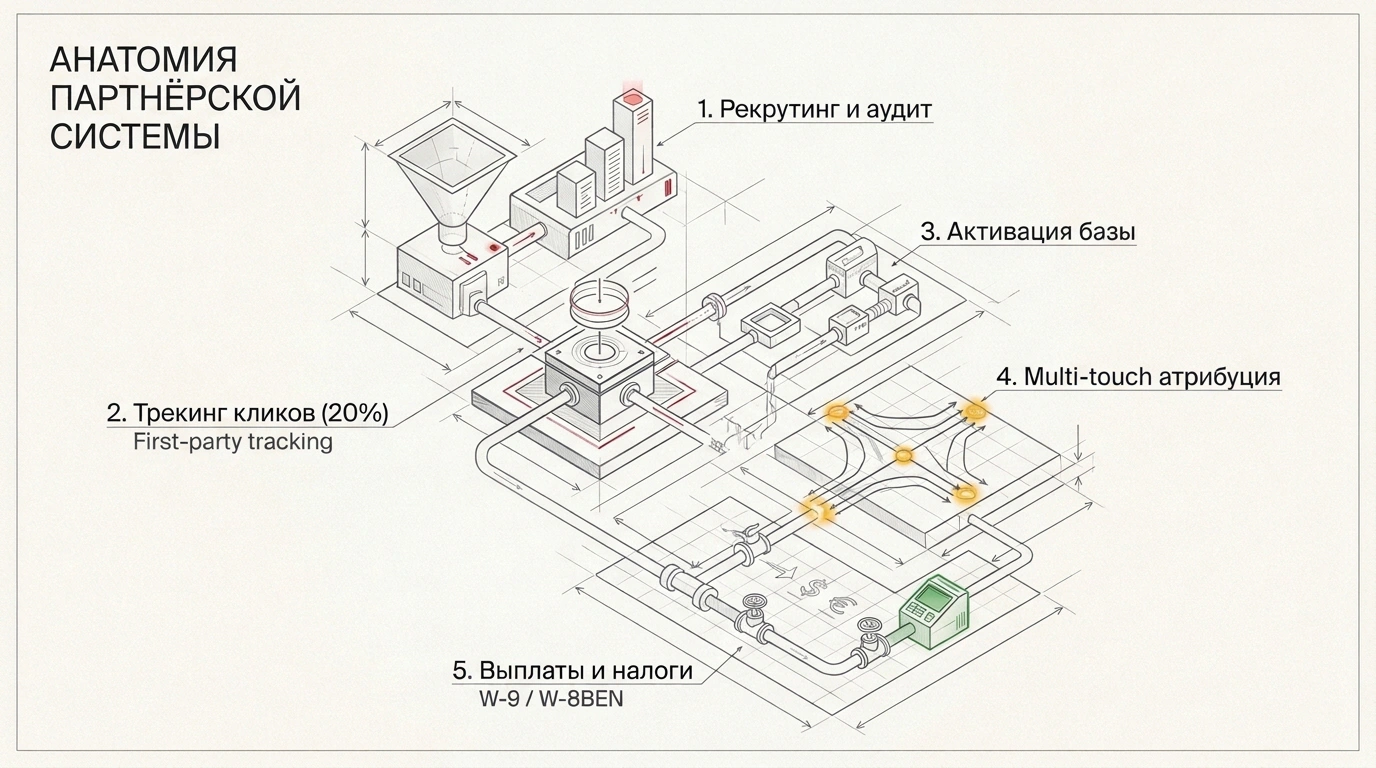
Why a Link Tracker and Dashboard Only Cover 20% of the Job
Almost every entry-level affiliate tool works like a click counter bolted onto a partner portal. A partner signs up, grabs a link or promo code, sends traffic, and the system tallies orders for a month-end payout sheet. At the start, with five friendly creators and ten weekly sales, that is plenty.
The moment a program tries to scale past fifty active partners, an uncomfortable truth hits: technical click tracking is maybe 20% of the real workload. The other 80% is operational work a basic tracker never touches. You have to find partners and vet them for fake followers before shipping free products or granting access. Then you have to activate them, because most sign-ups grab a link and vanish. And once sales roll in, finance teams face dozens of invoices across countries, currencies, and tax forms.
Iceberg metaphor of an affiliate program: 20% click tracking sits above water, while 80% of recruiting, retention, and payout work stays hidden below.
For companies selling internationally via Shopify, Stripe, PayPal, or Wise, this gap hits the bottom line directly. Even if you operate in a single domestic market with local payment rails, the selection logic stays the same. The real question is never "who tracks clicks cheapest?" It is always where your current bottleneck sits: finding new partners, keeping existing ones active, multi-channel attribution, or mass payouts.
Five Questions to Ask Any Platform Before Paying Invoice One
Before comparing pricing tables, run any candidate tool through five practical filters. They cut past marketing claims and show what you're actually paying for.
Filter one is recruiting and vetting. Some platforms have no partner database at all: you bring your own contact list and add people manually. Others offer an opt-in marketplace where affiliates apply, though that limits you to whoever bothered filling out a profile. The widest reach comes from platforms indexing public social profiles with no creator sign-up required, letting you check audience demographics, engagement, fake followers, and past sponsorships before sending a single email.
Filter two is commission flexibility and workflows. In modern e-commerce, the same creator might get a gifted product in March, post a referral code in April, and film a flat-fee sponsorship in May. If your software only handles a flat percentage on a link, you'll juggle three tools and reconcile numbers by hand. For subscriptions and B2B, look for recurring commissions (paid on every monthly renewal), lifetime commissions (paid on all future orders from a referred buyer), volume tiers, and different rates for new versus returning customers.
Setting up flexible commission structures in Tapfiliate (Source: tapfiliate.com)
Filter three is activation and retention. Getting a hundred sign-ups is easy. Getting them to keep posting two months later is hard. Well-built management tools trigger automated follow-ups when a partner goes quiet for two weeks, send product launch briefs, track outreach like a CRM pipeline, or run bonus challenges. If a tool only hands out links, your partner count grows on paper while live posts flatline.
Filter four is attribution beyond the last click. Classic last-click attribution gives 100% of the credit to whichever link was clicked a minute before checkout. In reality, a buyer first saw a creator's review, returned via an email newsletter a week later, and pasted a coupon code at checkout. Mature tools add first-party tracking (tracking on your own domain so Safari and Chrome third-party cookie limits don't break it) and multi-touch attribution across touchpoints, plus leading signals like post volume, reach, and whether a partner brings truly new buyers.
Filter five is payouts and taxes. With ten partners, manual transfers take an hour. With 150 partners across twenty countries, it turns into a part-time job. Solid payout infrastructure collects tax forms automatically (W-9 for US residents, W-8BEN for non-US, European VAT), generates invoices, enforces minimum payout thresholds to avoid micro-transfer fees, and handles currency conversion. Top-tier setups use a vendor of record model: you pay one monthly consolidated invoice to the platform, and it pays creators and handles their support questions.
E-Commerce and Creator Programs: Modash, Refersion, and LeadDyno
The first major category is online stores where affiliate marketing blends closely with influencers, promo codes, and product gifting. Three popular tools compete here with very different economics: Modash, Refersion, and LeadDyno.
One note for full transparency: the original comparison of these eleven tools was compiled by Modash's own team, so they predictably put their own product first. Keep that in mind and weigh Modash's limitations just as strictly as the others.
Modash is built as an all-in-one suite for e-commerce teams working with creators. Inside is a database of 380M+ public profiles across Instagram, TikTok, and YouTube — no creator opt-in required. You filter creators by audience stats and fake followers, check audience overlap with existing partners, email them from an integrated inbox (up to 100 bulk emails per batch), and manage relationships in a pipeline. The platform automatically pulls live content including Stories and Reels roughly every 12 hours and saves posts even if deleted later. Gifting, paid sponsorships, and affiliate codes live in one place tied directly to orders.
Modash handles payouts as vendor of record across 180+ countries and 36 currencies, holding a 4.9/5 rating on G2. Entry pricing starts at $199/month billed annually or $299/month monthly (with a 14-day trial). Now for the trade-offs. All affiliate tracking, promo codes, and gifting rely tightly on Shopify — if you run WooCommerce or a custom store, half the magic disappears. Social coverage is limited to Instagram, TikTok, and YouTube, leaving out Twitch, X, and Snapchat. Finally, the Performance tier with full tracking and payouts runs around $499/month, and exceeding the free payout allowance (such as ~$10,000/year on certain plans) can trigger a ~5% fee on volume above the cap.
Refersion takes another angle: a fast, straightforward tool for Shopify and WooCommerce stores (plus Stripe) that don't need a heavy creator CRM. Its technical strength is reliable first-party tracking on your own domain and granular commission rules down to specific SKUs or customer email addresses. It also includes a free built-in marketplace where partners can find your offer.
Look closely at Refersion's pricing math, though. On its classic hybrid tiers, Launch costs $39/month plus 3% of affiliate sales, and Growth costs $199/month plus 2% (with 20% off annual billing). Newer flat packages around $99–$249/month with conversion caps also circulate, while Scale uses custom quotes. When your program brings in a couple thousand dollars a month, $39 plus 3% looks tiny. Once the channel hits $50,000/month, 3% becomes $1,500/month on top of your subscription, while analytics remain fairly basic.
LeadDyno targets small and mid-sized e-commerce stores wanting an affordable start. It offers 25+ ready-made integrations (Shopify, WooCommerce, BigCommerce, Stripe), a clean branded portal on your domain, and automated welcome emails that reduce partner drop-off before the first sale. Higher tiers unlock multi-level MLM commissions and lifetime customer rewards.
Entry prices look friendly: Lite is $49/month, Essential is $129, Advanced is $349, and Unlimited is $749 (15% annual discount, 30-day trial). The catch hides in active-partner limits. Lite caps you at just 50 active affiliates, and Essential caps you at 150. Once your program gains traction, you get pushed onto a plan costing three times as much — and LeadDyno has no creator discovery database or advanced retention workflows beyond welcome emails.
To see how percentage-of-sales fees overtake flat subscriptions as revenue grows, drag the monthly affiliate revenue slider below. The calculator compares real monthly costs across five pricing models at the same sales volume.
Platform Cost Calculator: Flat Fee vs. Percentage of Sales
The calculator numbers sober you up fast. "Small flat fee plus percentage of sales" feels safe early on while testing a channel. By $20,000–$30,000 in monthly affiliate revenue, a 2–3% tax on sales already costs more than a mature flat subscription — and at $100,000, it turns into thousands of dollars in pure monthly overhead.
B2B SaaS and Stripe Subscriptions: Rewardful, Tapfiliate, and PartnerStack
Subscription software and B2B services run on different economics than physical e-commerce. You rarely ship sample boxes, while renewals, refunds, plan upgrades, and long sales cycles with agencies, integrators, and trade media matter deeply. Here, the gap between tools is stark: 15-minute setup on one end, heavy annual PRM contracts on the other.
Rewardful is a favorite for SaaS and AI startups billing through Stripe (Paddle is supported too), used by over 2,800 tech teams. Stripe setup takes under 15 minutes with two-way sync: it tracks new subscriptions, recurring payments, and upgrades automatically, and adjusts commissions on refunds. Built-in self-referral protection blocks clever buyers from using their own link, and mass payouts run via PayPal and Wise.
Automated partner payouts interface in Rewardful (Source: rewardful.com)
Rewardful's standout feature is zero platform transaction fees on every plan. Starter is $49/month, Growth is $99, and Enterprise starts at $149 (14-day trial). There's a catch, though: each tier caps monthly affiliate revenue ($7,500 on Starter, $15,000 on Growth, $30,000+ on Enterprise). If you delegate payouts via Managed Payouts, a 3% fee applies. And crucially, Rewardful is tied tightly to Stripe and offers no partner directory — you must recruit partners yourself.
Tapfiliate acts as a versatile Swiss Army knife for small and mid-sized SaaS and e-commerce. Setup takes about 30 minutes across 30+ integrations including Shopify, WooCommerce, Stripe, and Zapier. Inside one account you can run standard affiliates, customer referrals, ambassadors, and resellers. It supports flat, percentage, tiered, recurring, and lifetime commissions, plus coupon tracking for podcasts, social posts, and offline events where links rarely get clicked.
Pricing is clear: Launch is $89/month ($74 billed annually), Scale is $179 ($149 annually), and Enterprise is custom, with 7- to 30-day trials depending on the tier. Downsides match typical light trackers: no built-in partner discovery, click/conversion caps on plans, and analytics that hit a ceiling on complex funnels. On Reddit, practitioners often describe Tapfiliate as a solid first-year launchpad that growing companies eventually outgrow.
PartnerStack plays in a completely different weight class. It is a full B2B partner relationship management (PRM) platform built for software companies running affiliates, referrals, resellers, and co-sell motions together. It includes a network of 115,000+ active B2B partners — agencies, consultants, and industry publications — plus PartnerStack AI to match candidates and kick off outreach.
PartnerStack's biggest strength is tackling that "graveyard of inactive partners." You can build step-by-step onboarding flows, inactivity triggers, a built-in learning management system (LMS) on Growth, bonus challenges, and market development funds, all settled in one monthly invoice.
The price for that comfort bites. Launch starts at $1,000/month and Growth at $1,520/month (both billed annually, so $12,000+/year, while real-world deal medians hover around $19,600/year). Reddit users also warn that marketplace access doesn't replace manual recruiting — your team still carries the main outreach load, so this check only makes sense with high B2B contract values and a dedicated manager.
Scaling, Performance Networks, and Enterprise: Impact, Trackdesk, Post Affiliate Pro, Everflow, and Tune
Once a program reaches hundreds or thousands of partners, millions in revenue, and traffic from content, paid search, email, and coupon sites all at once, simple trackers fall short on attribution and fraud protection. Five heavy-duty platforms step in here.
Impact is one of the industry's main heavyweights for mid-market and enterprise teams. Over $100 billion in partnerships has flowed through it, backed by a marketplace of 90,000+ vetted partners. Impact unifies affiliates, influencers, and referrals in one attribution model, supports cross-device tracking (ad seen on phone, purchase made on laptop), multi-touch attribution, and automated contracts, with anomaly-based fraud protection at the Enterprise level.
Its entry price is deceptive, though. While a $30/month Starter plan exists, real enterprise features start with Essentials at $500/month and Pro at $2,500/month, plus a 2.5% fee on all affiliate transactions and a one-time setup fee. On Reddit, Impact is praised as the gold standard for profitable large programs — and strongly discouraged for beginners due to a steep learning curve, cluttered UI, and the need for a dedicated affiliate manager.
Trackdesk bets on reliability and predictable pricing with no growth penalties. Hosted on Google Cloud with a 99.99% SLA, it removes caps on partners, offers, and conversions across every plan. Its second strength is one-click mass payouts via PayPal, Wise, Tipalti, bank wire, and even crypto (BTC, ETH), which the company estimates saves ops managers around 30 minutes a day.
Trackdesk offers a rare free tier up to $1,000/month in affiliate revenue — handy for testing mechanics risk-free. Paid plans run Business ($249/month; recent team/network tiers start around $249–$329), Enterprise ($499), and Enterprise PLUS (~$1,999). The trade-off is simple: Trackdesk focuses strictly on tracking and payouts, offering no creator search or engagement tools.
Post Affiliate Pro is a veteran option for companies and agencies needing deep customization and a self-hosted deployment option. It connects with 220+ CMS platforms and payment gateways and backs up standard cookies with IP and fallback tracking. Its Network plan lets agencies launch white-label multi-merchant networks with prepaid invoicing.
Pricing is predictable on annual billing: Pro is $129/month, Ultimate is $249, and Network is $599 (with a 30-day no-card trial). Common complaints on Reddit center on usability: the interface feels dated, admin onboarding is weak, and high-competition verticals like iGaming often expect more modern affiliate backends.
Everflow and Tune target performance marketers, agencies, and large affiliate networks. Everflow pulls affiliates, influencers, email, offline, and paid media into one dashboard, maps conversion paths visually, and tracks post-purchase events (upsells, renewals, repeat orders) to judge true traffic quality, backed by Everflow Pay and real-time fraud blocking. Tune goes even deeper technically as an API-first enterprise platform where engineers customize tracking, attribution, and fraud rules at the infrastructure level.
Neither publishes open pricing; both sell through sales teams. Market benchmarks put Everflow around $950/month with a six-month minimum and roughly $500 onboarding fee, while Tune's Scale tier starts around $1,500/month billed annually. Entering either without strong engineering support and huge traffic volume will overwhelm a small team.
Minimum Entry Cost of Affiliate Platforms (Annual Billing / Market Benchmark)
The chart reveals the market's main trap. A low entry price on a landing page says almost nothing about total cost. The cheapest paid plans either take a cut of every sale or hit tight caps on revenue and active partners. The upper half reflects the cost of B2B networks, advanced fraud protection, or dedicated API infrastructure.
How to Keep Partners Active and Build Your Shortlist
Whichever platform you pick, software alone won't generate sales. Almost every program stalls at the same spot: a partner grabs a link, posts once (or never), and disappears. Since basic trackers don't wake up dormant rosters automatically, you have to build a retention loop — or buy tools that support it.
Four habits work reliably in practice. First, set inactivity triggers: if someone sends zero clicks for two weeks, send a friendly nudge with a ready-to-use post idea. Second, use tiered commissions where rates rise after ten or twenty sales, giving partners a clear reason not to quit early. Third, send short briefs ahead of promos and launches so creators don't have to invent news angles. Fourth, keep a steady human rhythm: a real check-in every two or three weeks beats daily automated blasts.
Click, conversion, and customer status reporting in Tapfiliate (Source: tapfiliate.com)
Looking at reports with a marketer's eye quickly shows who is actually growing your business. A good dashboard separates new buyers from repeat orders, breaks down conversion by channel, and spots creators whose posts earn clicks that die on your landing page. Often, tweaking an offer or landing page for one creator's audience turns a quiet partner into a top earner.
To avoid getting lost across eleven names, use the four-scenario matrix below. Pick the platform that solves your biggest bottleneck — long feature checklists rarely pay off without a real team need.
| Business scenario | Start looking at | Best fit for the job | Watch out for before paying |
|---|---|---|---|
| E-commerce with creators on Shopify | Modash, Refersion | Creator search, gifting, and promo codes tied to orders | Modash's Shopify and 3-network lock-in plus over-cap payout fees; Refersion's sales cut scaling fast |
| B2B SaaS and Stripe subscriptions | Rewardful, PartnerStack | Fast 0%-fee start (Rewardful) or B2B network & LMS (PartnerStack) | Rewardful's revenue caps and Stripe lock-in; PartnerStack's high annual check and manual recruiting |
| Fast SMB launch without developers | Tapfiliate, LeadDyno | Dozens of integrations, coupon tracking, branded portal | No discovery database; Tapfiliate click caps and LeadDyno's 50/150 active-partner limits |
| Scaling, networks, and Enterprise | Impact, Trackdesk, Post Affiliate Pro, Everflow, Tune | Multi-touch attribution, anti-fraud, unlimited partners, crypto payouts, self-hosted & API-first | Impact's steep learning curve and 2.5% fee; dated UI on Post Affiliate Pro; enterprise contracts on Everflow/Tune |
One last check before signing an annual deal comes down to payouts. Even flawless tracking won't save you if finance gets stuck wiring manual payments to twelve countries after your first good month.
Pre-Launch Payout Infrastructure Checklist
- Multi-currency payout support across standard methods (PayPal, Wise, bank wire, and crypto if needed).
- Automated invoice generation and tax form collection (W-9 / W-8BEN / VAT) without manual email chasing.
- Configurable minimum payout thresholds so bank fees don't eat $10 micro-payments.
- Automatic clawback reconciliation for refunds and canceled subscriptions before funds leave.
- Total cost modeled at 3x–5x revenue growth, checking transaction fees, managed payout charges, and active-partner caps.

