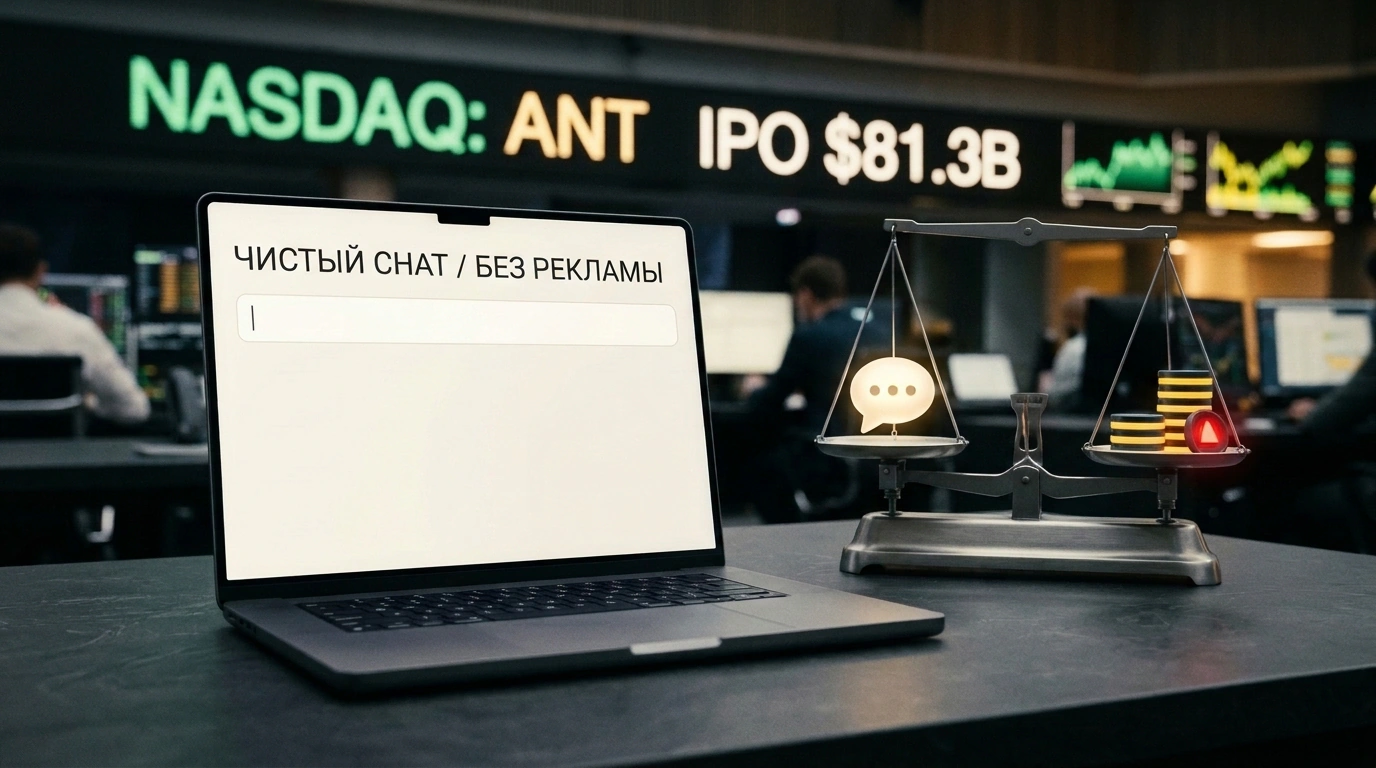
You open Claude in the morning, paste a client brief, test a dozen offer angles, and analyze an ad account export. On screen, everything looks normal: a clean chat, zero banners, the same familiar subscription. Yet behind that window, the engine changed on November 19, 2026. Anthropic listed on Nasdaq under the ticker ANT, meaning a public corporation — not a private research lab — now stands behind every prompt you run.
Clean Chat vs. a Billion Dollars in Ad Revenue
All last year, Anthropic built its reputation on a sharp contrast: while rivals turned chatbots into ad showcases, Claude stayed a clean work tool. In February 2026, the company even aired Super Bowl commercials mocking ads in ChatGPT under the tagline "Ads are coming to AI. But not to Claude."
It reinforced that line in its IPO prospectus — the official investor filing detailing how a company makes money and where risks lie. The filing states plainly that Claude carries no ads and advertisers are not treated as a separate customer group. The logic makes sense: once paid placements enter a conversation, the assistant serves a second master, leaving users wondering whether a recommendation is genuinely best or simply bought.
Wall Street, however, reads principles through a calculator. Ads inside OpenAI's ChatGPT hit a $1 billion annualized revenue run rate in under 200 days after launch. That is a billion dollars in real cash sitting on the shelf next door — and shareholders will inevitably ask why Anthropic is leaving it there.
Public-Market Math and the Price of Convenient Plans
The IPO scale set expectations nobody can ignore. Anthropic priced shares at $83 at launch, raising roughly $81.3 billion at an initial valuation near $1.5 trillion. By the first day's close, market cap stood around $1.3 trillion, or up to $1.75 trillion on a fully diluted basis.
Big capital brings strict rules. Every 90 days, Anthropic must face shareholders with quarterly earnings proving two numbers: revenue growth and margin. Enterprise B2B demand already brought the company close to operating breakeven without ad banners. If Wall Street pressure mounts, Anthropic still has an indirect path: keep the consumer chat clean while selling enterprise and agency marketing tools to the ad industry.
For small businesses and marketing teams, the bigger near-term risk is pricing and usage caps. As a private company, Anthropic could subsidize heavy usage and look away when power users burned thousands of dollars in compute on a $200/month plan. A public corporation counts every dollar of compute cost. Anthropic hasn't announced price hikes, yet the market playbook is familiar: tighter prompt limits, revised API terms, and moving popular features into paid add-ons. Add existing regional access restrictions, and betting your workflow on one account becomes fragile.
One all-in-one subscription stays cheap right up until the first email announcing new limits.
How to Avoid Getting Stuck When a Provider Tightens the Screws
In tech, this is called vendor lock-in. In marketing, it looks ordinary: every copy template sits inside one chat's projects, call analysis hooks into one API, and the team only knows one interface. If limits get slashed tomorrow, prices jump, or regional access breaks, content and analytics grind to a halt.
There is no reason to panic or drop Claude — it remains a strong tool. Just organize your workflow so switching to another model takes a couple of hours.
How to Cut Your Team's Dependence on One AI
- Store working prompts, guidelines, and tone examples in a separate knowledge base (Notion, Google Docs, or local files) outside any single chatbot's projects.
- In automations and scripts, isolate API calls in one step so swapping models takes changing an API key and model parameter.
- Keep at least one tested backup model ready and run routine team tasks — copy, spreadsheet analysis, idea generation — through it monthly.
- Build a buffer into your API and subscription budget in case tiers change or caps tighten.
The easier your setup switches between AI models, the calmer you can watch quarterly earnings and Wall Street pricing shifts.