When launching a project or rebranding, you check the domain, trademark, ad labeling, and contractor agreements. Yet a .woff2 file sitting in a website folder or the typeface inside a logo slips right past the radar. A designer clicked a "Free" download button, the storefront sign is already up, and banner ads are running. Two years later, a million-ruble legal claim lands in your inbox.
To be clear upfront: this isn't a substitute for a courtroom lawyer, but a practical risk map so you ask your designer the right questions before paying for someone else's letters out of company cash.
The 'Free' Button Trap and Where Fonts Hide in a Business
The web is packed with font catalogs where files download in two clicks. The trap is that "free" next to a download button usually means personal use only. Making a school presentation is fine. Putting those same letters into a coffee shop logo, menu, or website header is copyright infringement.
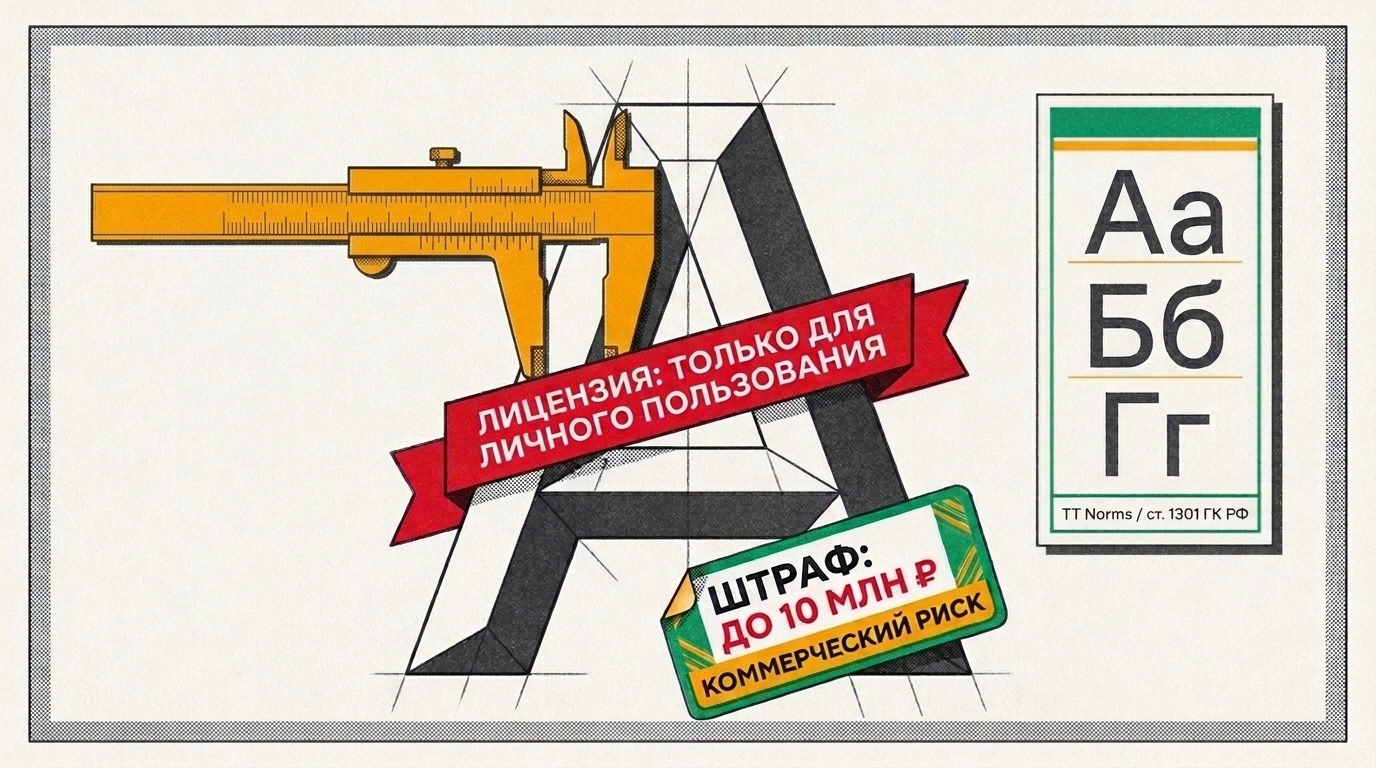
In Russian legal practice, including the Intellectual Property Court (IPC), a typeface design counts as a graphic work. Under the law, it carries the same copyright protection as a photograph or song: you cannot use it commercially without the rights holder's permission.
Unauthorized typefaces usually hide in three places across a business:
- logos, storefront signs, office plaques, and merch;
- websites loading web fonts via CSS
@font-facerules (anyone can spot them in browser dev tools in a second); - ads, product packaging, pitch decks, and menus.
A single "free" file in any of those spots makes your business an easy target for a rights holder.
The TypeType Case and New 2026 Math
A recent example is Case No. A56-49280/2025. Type foundry TypeType (OOO "TypeType") sued AO "Publishing House S.-Peterburgskie Vedomosti." For several years, the website spbvedomosti.ru used the TT Norms font without a commercial license.
The studio demanded 1,500,000 rubles. The court reduced the award on proportionality grounds to 300,000 rubles. The publisher appealed, and in March 2026 the Intellectual Property Court upheld the ruling.
Official presentation of the TT Norms Pro typeface by TypeType studio (Source: typetype.org)
Here came the first trap. After receiving the claim, the publisher removed TT Norms from the site. That feels logical: fix the issue, end the dispute. Not so. Deleting the font stops future infringement, yet it doesn't erase the years the font was live. Damages for past use were still awarded — far more than a regular license once you add legal fees and lost months.
Since January 4, 2026, the stakes jumped even higher. Federal Law No. 214-FZ of July 7, 2025 took effect, amending Article 1301 of the Russian Civil Code. The statutory lump-sum damages cap doubled from 5 million to 10 million rubles (ranging from 10,000 to 10,000,000 rubles, or double the license value). Courts set the final amount based on duration, reach, and platforms — and that money goes straight to the rights holder, not the state budget.
The second trap hurts even more. Founders often think, "The designer picked the font, let them answer for it." The law works differently. Claims hit the company or sole proprietor profiting from the logo and website. Business copyright liability is strict: courts award damages even if you had no idea where your contractor got the file. You can try recovering the money from the designer in a separate lawsuit, yet without clear warranties in your contract, winning is tough.
What Peace of Mind Costs: Licenses, Google Fonts, and 'Tweaked Outlines'
Compared to 300,000 rubles in court, the legal route costs pocket change. A commercial license for a single weight often runs $20–$50, and a full family around $300. Pricing varies by foundry, media type (print, web, app), and company size, yet it stays many times cheaper than a legal bill.
If your launch budget is tight, you don't even have to buy paid fonts. Open catalogs like Google Fonts release most typefaces under the SIL Open Font License (OFL) 1.1. It officially permits free commercial use: logos, outlined vector curves, print, ads, and @font-face web embedding with zero royalties or mandatory credit. Embedding it on a commercial site does not "infect" your site's code with an open-source license.
SIL OFL 1.1 has two main limits: you cannot sell the font files by themselves, and if you modify a font, you cannot keep the author's Reserved Font Name. Even so, read the actual license text every time — free aggregators sometimes mix in fonts with stricter terms.
Google Fonts open-source catalog under the SIL OFL license (Source: fonts.google.com)
For logos, there is one more clean option: custom hand-lettering. A brand designer can study existing fonts for inspiration, then draw the letters from scratch with original proportions to build a unique wordmark.
Watch out for the third trap here. Sometimes a contractor grabs a paid font's outlines, rounds the corners slightly or trims the serifs, and bills it as "custom." Legally, that doesn't save you: minor edits to an existing font count as a derivative work, which still requires a license. Drawing letters from zero and tweaking someone else's vectors are two different things.
To avoid guessing after handoff, lock the rules into your contract before paying a deposit.
Add this clause to your agreement: 'Logo lettering is drawn from scratch, brand fonts use open licenses, and license links are attached in the brand book.' If paid fonts are purchased for the project, specify that licenses are registered to your legal entity or sole proprietorship and delivered alongside source files.
Already on Your Sign or Facing a Claim: What to Do
What if your business is already live and nobody ever checked where your fonts came from? Follow a simple if-then plan.
If you spot an unlicensed font on your site or in ads yourself, buying a license makes sense. That covers future use, though standard licenses start from the purchase date and don't cover the past. Under the Civil Code, parties may agree to apply terms retroactively to prior use; some foundries accept a retroactive clause if drafted properly with a lawyer.
If you simply swap the font out, infringement stops today, yet past usage doesn't vanish: old pages sit in web archives, and storefront photos live on maps and social media. In the S.-Peterburgskie Vedomosti case, removing the font didn't stop damages for earlier years.
If an unlicensed typeface is baked into your logo, the reliable fix is redrawing the wordmark completely from scratch without tracing the old outlines.
If a legal demand already landed in your inbox, don't ignore it and don't delete everything in a panic. First check whether the actual rights holder sent it, since scam demand letters do circulate. If the sender is real, hand the letter to a lawyer — settlements through negotiation often close for far less than a court ruling.
15-Minute Business Font Audit
- Ask your designer which exact fonts are used in your logo, website, brand book, and ad templates.
- Confirm the license type and who holds it for every single font.
- Verify each falls into one of three safe buckets: commercial license bought in your company's name; open license (such as SIL OFL 1.1) whose terms you checked; or logo letters drawn by hand from scratch.
- Store license links, receipts, and license files in one folder next to your logo source files.
- If the answer is 'downloaded it somewhere,' close the gap now: buy a license, switch to an open font, or redraw the logo.