Picture a client looking for custom software development with a budget of 1 to 10 million ₽. They open Yandex Search in Moscow and ask: "recommend a company for software development outsourcing." In November 2026, Yandex's AI ranked 60-person studio Code Pilots first three times out of three. Giant SimbirSoft, with 1,500+ specialists and 25 years on the market, landed third or fourth. A 25x gap in headcount, yet the smaller player sat at the top.
The reason becomes obvious the moment you click the source icon under the top studio's name. It points to a September 3 post on Code Pilots' own blog: "Best Software Outsourcing Companies: Top 10 Contractors in 2026." Inside, the order is Code Pilots, Purrweb, Surf, SimbirSoft. In checks on November 20 and 21, the AI reproduced that exact top four three times in a row.
Where AI Gets the Order of Companies in Its Answer
Companies have published self-made rankings on corporate blogs for years, and Code Pilots even added an honest note: we put ourselves first, and we've built custom software since 2014. Everything is transparent, with no pretense of being an independent media outlet. Yet that disclaimer never made it into the AI answer. The buyer sees a clean ranked list, while authorship sits hidden behind a tiny link icon.
The same pattern showed up in mobile development: studio Amiga beat Surf two times out of two using a ranking on its own blog. To see why, look at how GEO (Generative Engine Optimization — optimizing content for AI-generated answers) works under the hood.
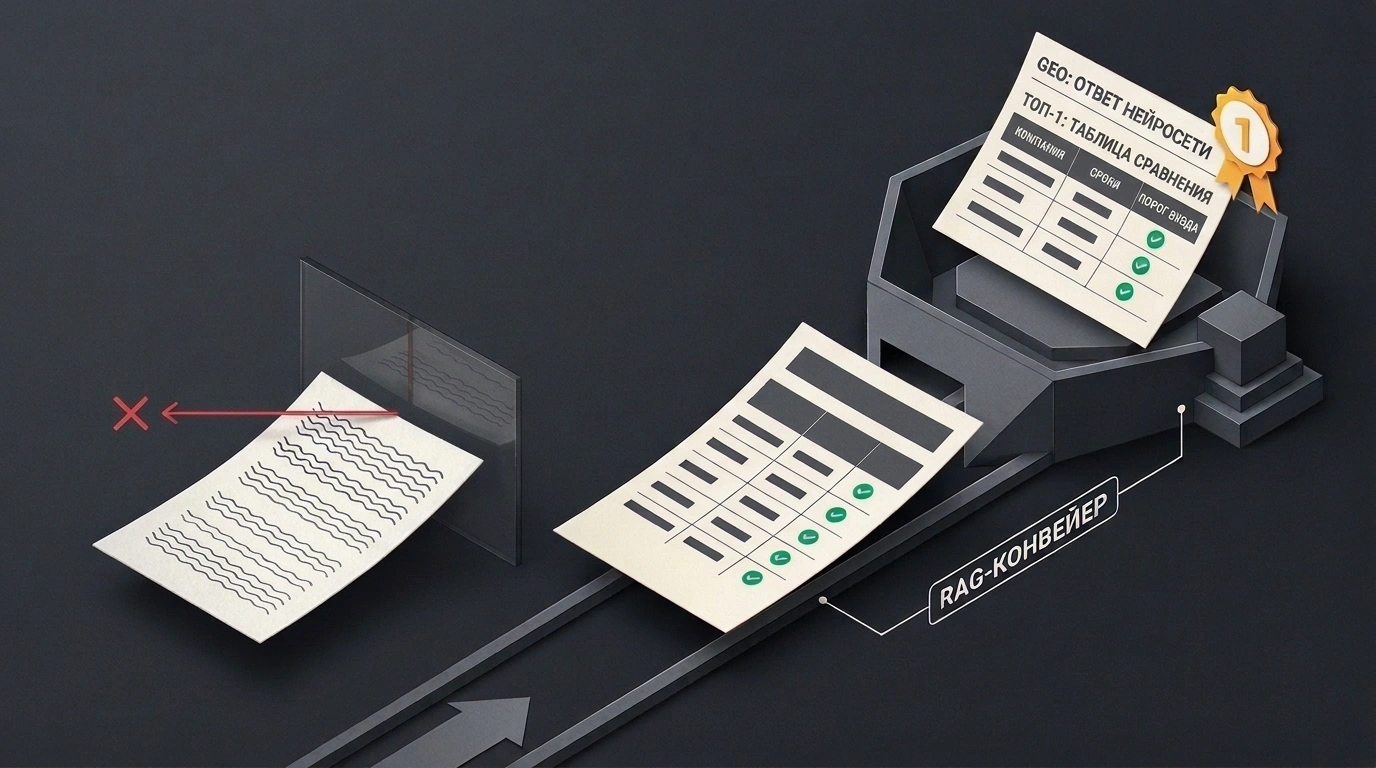
Yandex Search with Neuro runs as a hybrid RAG pipeline (Retrieval-Augmented Generation, where the model pulls search snippets first and writes an answer from them). First, it gathers candidates from the classic organic top 5 or top 10. Next, it filters out pages without quotable text, slices the rest into chunks, and scores their usefulness using BERT and CatBoost models. The top 5–10 fact-dense blocks reach the final stage, where YandexGPT stitches together an answer with source links.
Put yourself in that pipeline's shoes. One site has a glossy landing page full of "tailored approach" and "team of professionals." Another has a structured roundup with identical fields for every vendor: who it fits, timelines, and starting price. SimbirSoft had no comparison table among the retrieved sources, while Code Pilots served one ready-made. AI doesn't count employees or check company age — it summarizes whoever already organized the market cleanly.
A 12.5-Hour Test and Three Limits Where the Trick Breaks
A skeptic would call it luck or an old domain advantage. So the hypothesis was tested on another agency, Nurokod. On November 5, 2026, at 20:29 Moscow time, for the query "recommend a studio for mvp development" (MVP — minimum viable product), Yandex AI listed DELAWEB, RiverSoft, and X Studio. Nurokod wasn't in the AI answer or the top ten organic results.
At 21:33, Nurokod published a roundup on Sostav: "MVP Development for a Startup 2026: Top 10 Studios by Speed and Price." It listed 10 studios with two uniform fields each: time to first working version and starting price. Nurokod ranked first on launch speed. By 10:09 on November 6 — 12.5 hours after publishing — Yandex AI placed Nurokod in first place.
Two weeks later, on November 20 and 21, Nurokod still held the top spot three times out of three, and the AI literally echoed the article's criterion: a first working version can ship in about two weeks. Second place usually went to SCAND (250+ staff and 700+ projects vs. Nurokod's 40+), followed by DELAWEB, Purrweb, Surf, and Code Pilots. Different buyer question, different table — different leader.
Let's keep expectations grounded: field tests in one region across a few launches are a practical signal, not a magic button for every niche. There are three clear limits where a self-made ranking won't work.
First, niches where third-party media and big portals already own the narrative. For Bitrix24 integration, AI reliably puts Pervy Bit first; for Wildberries marketing, XWAY leads. One blog post won't unseat them on broad queries. The workaround is narrowing down to a specific segment or tech stack where media roundups don't exist yet.
Second, volatile search results. In industrial website development, a published ranking put a studio first only once in three checks, dropping it to second and fifth in the other two. When search pulls different sources each time, you won't hold a stable top spot.
Third, real buyer trust. If a prospect clicks the source link under your name and sees a fake "top 10" with no numbers or author disclosure, you lose the lead. State authorship openly and pick a real, verifiable metric where you genuinely lead.
The llms.txt Myth and the Self-Contained Paragraph Rule
While marketers in Runet test comparison tables on Yandex, a cottage industry selling snake oil has grown around Google AI Overviews and AI Mode. Agencies are pitching llms.txt setup in your site root (a text guide for language models modeled on robots.txt) and "special AI schema" as secret markup for Google's AI.
Google Search Central's official stance shuts this down. Gary Illyes confirmed at Search Central Live that Google doesn't support llms.txt and has no plans to adopt it. John Mueller added that no major AI system relies on the file, comparing the hype to the obsolete keywords meta tag. There is no separate "AI markup" either: AI Overviews and AI Mode rely on standard indexing, classic SEO, and regular JSON-LD that matches visible page text.
Official Google Search Central documentation on AI search features (Source: developers.google.com)
Put that saved budget into self-contained paragraphs instead. Search engines pull isolated text chunks into summary answers. If a paragraph leans on words like "it" or "these features," its meaning collapses the moment it's copied out of context.
Take a product page for a commercial espresso machine called Neuroduo. A weak paragraph reads: "It also comes with these features, making it ideal for coffee shops like yours." Drop that into a comparison of three machines and it says nothing. Which model? Which features? What size coffee shop?
Now look at a strong version: "Neuroduo is a dual-boiler commercial espresso machine that holds steady temperature during back-to-back shots. Built for coffee shops serving 150–300 drinks a day, it requires a dedicated 20-amp circuit." Product name, target buyer, and technical constraint all sit in one block. That paragraph survives being lifted into any AI answer.
Trainer: Will Your Paragraph Survive Being Quoted in an AI Answer?
Switch between both examples and test any paragraph from your service pages. Once you strip out blind pronouns, name the product directly, and pair it with a concrete limit, the block works for both human buyers and AI answers.
A One-Evening Plan: Audit Your Niche and Test 20 Paragraphs
An initial audit takes one evening and two steps: scouting AI answers and reviewing your commercial copy.
10-Minute Niche Audit in AI Answers
- Ask the AI in the words of a ready buyer: 'recommend your service for segment' — for example, for a startup or a sales team.
- Run the query three times a couple of minutes apart and note who stays first and where results shift.
- Open the source behind the top result: is it a vendor blog, an industry portal, or an independent outlet?
- Check the format: is it a comparison with uniform fields or a standard sales page?
- If you are missing and media outlets do not own the query, publish your own 10-company comparison with uniform fields, an honest metric, and clear authorship, then retest 24 hours later.
Step two is a site copy audit. List the 20 main questions buyers ask before purchasing: timelines, starting budget, who the service doesn't fit, technical limits, and what is included in the price. Pull the 20 answering paragraphs from your site and paste each into a blank document. If a paragraph stays clear and accurate on its own, keep it. If you can't tell which product it describes or where its limits sit without reading the text above it, rewrite it as "product + target buyer + concrete constraint."