Anyone who has ever tried generating a video clip with modern neural networks knows that agonizing pause. You type a prompt into Midjourney, Runway, or Sora, hit Generate, and walk away to brew tea. You come back a couple of minutes later—the progress bar has reached forty percent. In commercial video production or interactive games, that kind of delay kills experimentation: a director cannot cycle through dozens of camera angles when every five-second take renders longer than a smoke break.
That is why the news from the Pika Labs team made the community sit up. On October 29, 2026, the company open-sourced the Pika H3 Flex model. And this is not another closed web service with a monthly subscription and watermarks, but full open weights published on Hugging Face and GitHub. The newcomer's trump card is phenomenal speed: it can generate a video stream faster than real time. Let's examine the model's architecture, look at what it can do, and find out what price you pay for that kind of speed.
Open Video Breakthrough: From Closed Clouds to Local Weights
For a long time, the generative video market remained the fiefdom of closed cloud giants. Users paid per minute of generation, waited in virtual queues, and constantly ran into strict prompt censorship. Earlier attempts to release open models (like CogVideoX or HunyuanVideo) were an important step forward, but they demanded huge server resources and rendered frames painfully slowly.
Pika H3 Flex is built on the Minimax H3 architecture and counts 33 billion parameters (33B). That is a hefty size that normally requires an entire rack of GPUs. However, the engineers applied aggressive diffusion step distillation, compressing the classic generation trajectory down to just 6 sampling steps. For comparison, standard video models need 30 to 50 steps to form a crisp frame without mush or visual noise.
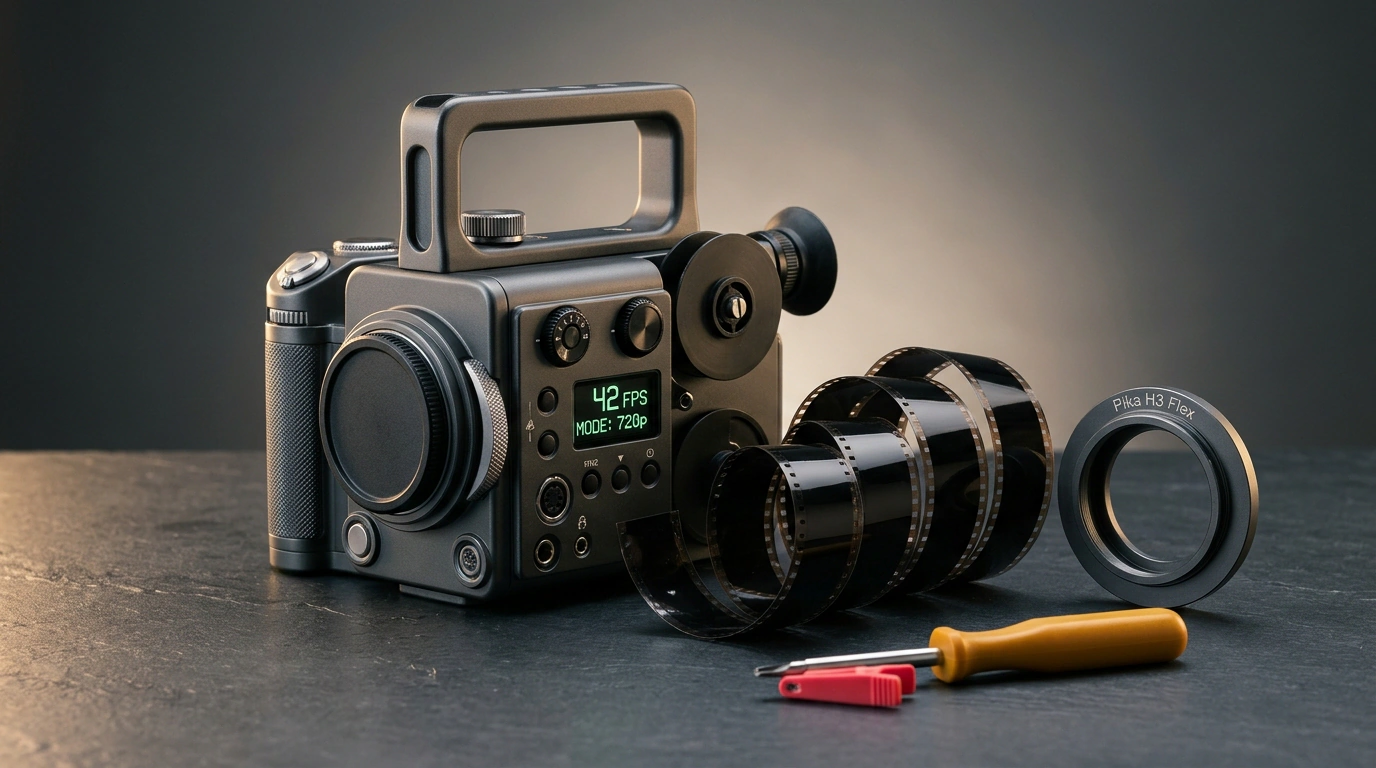
Thanks to distillation, the compute load dropped several-fold. On a server with a single Nvidia H200 accelerator, the model outputs up to 42 frames per second at 720p resolution. Even on a more accessible workstation with a flagship consumer card like an RTX 4090 in 8-bit quantization (FP8), speed holds steady around 28 frames per second. This is a historic milestone: video is generated faster than it plays back on screen (at the standard cinematic framerate of 24 fps).
Multimodal Console: 12 References and Synchronized Audio
Speed is great, but in real production a model is expected to be predictable. If a neural network spits out a random pretty picture that cannot be fitted to a script, it is of little use. Pika's developers solved this through a powerful multimodal context system supporting up to 12 simultaneous input references (multi-reference stack):
- Up to 9 static images: you can upload portraits of the main character from different angles, the scene's color palette, costume textures, and background locations, achieving phenomenal character consistency from frame to frame;
- Up to 3 video clips: used for direct motion transfer and camera dynamics;
- Up to 3 audio tracks: set the tempo, rhythmic accents, and emotional tone of the scene.
The built-in native audio generation module with a 32 kHz sampling rate deserves special attention. Previously, sound had to be cobbled together by hand: running video through third-party lip-sync libraries, layering ambient noise, and mixing it all in an editing suite. H3 Flex generates synchronized audio right as the video sequence is built: footsteps on gravel, wind howling outside a window, the metallic clash of swords, or rustling leaves match what is happening on screen. As we know from video editing automation practices, eliminating extra conversions between disconnected models saves hours of editing time.
In the professional Design Arena ranking of open models, the newcomer immediately claimed the top spot, scoring 1,293 points and outperforming open counterparts from Tencent and Zhipu AI. The model has already been packaged into ready-to-use workflows for ComfyUI, allowing enthusiasts to deploy complex node graphs locally.
Where Real-Time Generation Shines
Generating at over 30 fps opens up completely new scenarios that were impossible to even dream about before:
- Interactive pre-visualization on set: A director or concept artist can adjust lighting parameters, weather conditions, or camera angles right during a brainstorm and see a rough result in a second without blocking the team's workflow.
- Procedural cutscene generation in video games: Instead of pre-rendering gigabytes of heavy video files, a game engine can generate unique clips tailored to the player's current actions and custom gear on the fly.
- Dynamic advertising content: The ability to assemble hundreds of personalized video creatives for specific audience segments in minutes rather than weeks of manual studio work.
Limits and the Price of Haste
Now let's take off the rose-tinted glasses and look at the flaws that inevitably surface under such radical optimization. There are no miracles in compute physics, and cutting diffusion down to 6 steps brought tangible trade-offs.
H3 Flex's main vulnerability is fine-grained dynamic anatomy. If a character in the frame stands still or turns their head smoothly, the image looks spotless. But put rapid hand-waving, piano playing, or a sharp camera angle change into the prompt, and fingers start melting and merging into a single mass. On fast camera pans, a stroboscopic effect and slight blurring of distant background textures sometimes appear.
The second important factor is VRAM appetite. Despite distillation, the base model still contains 33 billion parameters. To run it on a local computer even in the trimmed FP8 format, you need a graphics card with at least 24 GB of VRAM (an RTX 3090, 4090, or dedicated workstation cards). On regular laptops with 8 GB of memory, you won't be able to deploy H3 Flex without heavy cloud quantization.
Pika H3 Flex is a turning point for open generative video. The model proved that local open software can not only catch up to closed clouds, but beat them in speed several times over. For final Hollywood polish it still requires manual post-processing, but as a turbo tool for concepts, drafts, and fast production, it currently has no equal.