If you follow the development of large language models, you have surely noticed a paradox: models are getting smarter, yet their appetite for memory is growing at an alarming pace. To feed a neural network a thick book or a codebase of a couple hundred thousand tokens, a server needs terabytes of RAM. The root of this bottleneck lies at the very heart of the Transformer architecture—the self-attention mechanism. The longer the text, the more computations the algorithm has to perform on every word, and the complexity grows not linearly, but quadratically.
That is why the announcement from the startup Liquid AI, founded by alumni of MIT CSAIL, sparked a wave of excitement among engineers. On October 27, 2026, the team open-sourced the third generation of Liquid Foundation Models—LFM 3. The flagship of the compact lineup, LFM3-1.7B, offers a massive 256,000-token context window, yet weighs only one gigabyte in 4-bit quantization and runs effortlessly even on a single-board microcomputer. Let's take apart this unusual "liquid" architecture nut by bolt and see how its creators managed to beat quadratic complexity.
The Curse of Quadratic Attention: The Dead End of Classic Transformers
Let's picture for a second how a classic transformer reads text. Encountering each new word, it has to mentally cross-check it against every previous word already sitting in its memory. If a prompt has 1,000 words, the connection matrix requires a million operations. But if you load 250,000 words, the number of connections skyrockets to an astronomical 62 billion.
All that flood of intermediate data settles into a special video-memory store—the KV cache (Key-Value cache). In ordinary transformers, the KV cache for long contexts quickly balloons to hundreds of gigabytes, instantly eating up all GPU memory. That is why running models with 128K or 256K token contexts has remained the privilege of giant server clusters.
The Liquid AI team went for a bold architectural experiment. Instead of optimizing the classic transformer for the hundredth time, they built a fundamentally new non-transformer model grounded in continuous dynamical systems (Liquid Neural Networks). In such networks, neuron parameters can smoothly adapt to the stream of incoming data, much like a liquid changing shape under external forces.
Tri-Hybrid Architecture: 24 Layers with Three Types of Processing
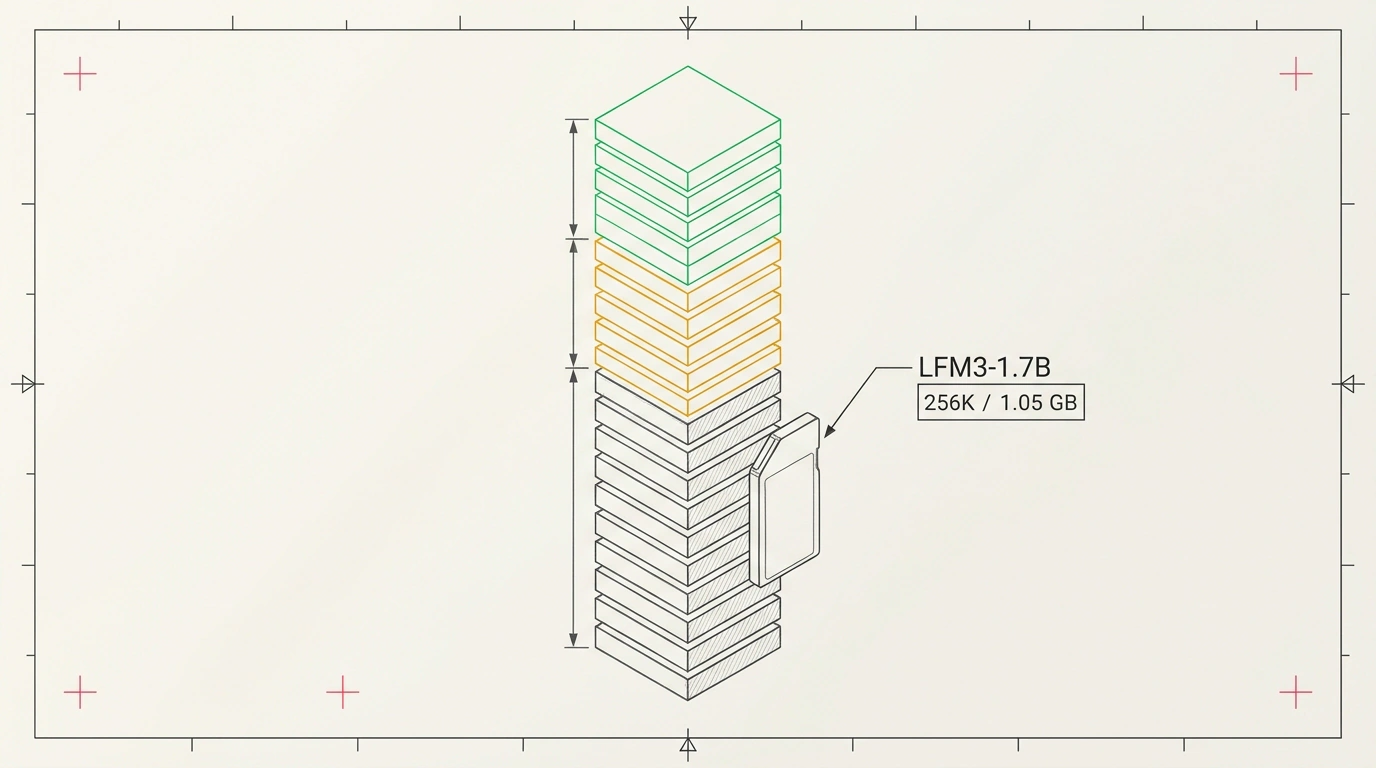
The main engineering highlight of LFM3-1.7B is its "tri-hybrid" internal structure. The model consists of 24 deep layers, but they are built completely differently:
- 13 layers of Gated Convolutions (with window k=7): These form the backbone of the model. Unlike attention, convolutions have strict linear complexity O(N). They handle instant processing of local syntax, word order, and grammatical links. A convolutional layer requires no giant KV cache and processes the incoming data stream almost instantaneously.
- 5 layers of Sliding-window Attention: These layers keep the immediate context (a few hundred neighboring tokens) in focus, letting the model accurately bind pronouns to nouns and hold the local thread of reasoning.
- 6 layers of Global Attention: Their job is to connect distant semantic nodes across huge spans of text. Because there are only six global layers, however, the overall memory load stays tiny.
This hybrid approach cut KV-cache memory consumption by 82% compared to pure transformers of a similar size. The model was trained on a colossal dataset of 22 trillion tokens (22T), guaranteeing deep mastery of natural languages and programming syntax.
256 Thousand Tokens in Your Pocket: Benchmarks and Edge Deployment
The raw spec numbers make a lasting impression:
- Context window: 256,000 tokens (enough for fifty chapters of War and Peace in full);
- Parameter count: 1.73 billion (1.73B);
- File size in 4-bit GGUF quantization (Q4_K_M): just 1.05 gigabytes;
- Throughput on Apple Silicon: over 85 tokens per second via MLX.
I specifically checked the results of synthetic needle-in-a-haystack tests (in the LongEval benchmark). LFM3-1.7B posted 99.1% fact-retrieval accuracy across the entire 256K context. It does not "forget" details from the middle of a document—a flaw that plagues even heavy closed systems.
On general language benchmarks, the compact model holds its own against solid 7B-class models of the previous generation: MMLU came in at 68.4%, and the GSM8K math benchmark reached 74.2%. The model is released under an open license and immediately received native support in popular inference engines vLLM, Ollama, and llama.cpp. As we examined in detail in our overview of the LFM 3 model family, such a leap in efficiency moves long-document work out of the cloud and straight onto users' personal devices.
Where Liquid Neural Networks Change the Game
With a one-gigabyte footprint, LFM3-1.7B opens the door to scenarios that used to sound like science fiction:
- Personal agents on smartphones and watches: the model can be deployed directly on a mobile phone to analyze all personal messages, notes, and receipts without sending confidential data to third-party clouds.
- Onboard systems and IoT: autonomous analysis of telemetry, industrial sensor logs, or drone data on Raspberry Pi 5 microcontrollers.
- Local codebase audits: rapid scanning for architectural inconsistencies and vulnerabilities in corporate repositories without risking trade-secret leaks.
Limits of Applicability: Where the Catch Lies
Still, you shouldn't think a 1.7-billion-parameter model can completely replace heavy flagships like GPT-6 or Claude Opus. There are no miracles: compact size imposes objective limits.
First, the model has a limited store of background encyclopedic knowledge. If you need a detailed historical essay or a deep analysis of a narrow legal precedent without supplying source text, the model will start mixing up dates and names. It is an ideal analyst of provided text, but a modest generator of its own facts.
Second, beyond 150,000 tokens, the model slightly loses accuracy on complex multi-step synthesis, where it needs not just to find a fact, but to compare contradictory hypotheses across ten different chapters of a report.
LFM 3 is a vital signal to the entire industry: the monopoly of classic transformers is coming to an end. Liquid neural networks have proven that the ability to handle massive amounts of information depends not on the number of terabytes in a server rack, but on the elegance of mathematical architecture.